

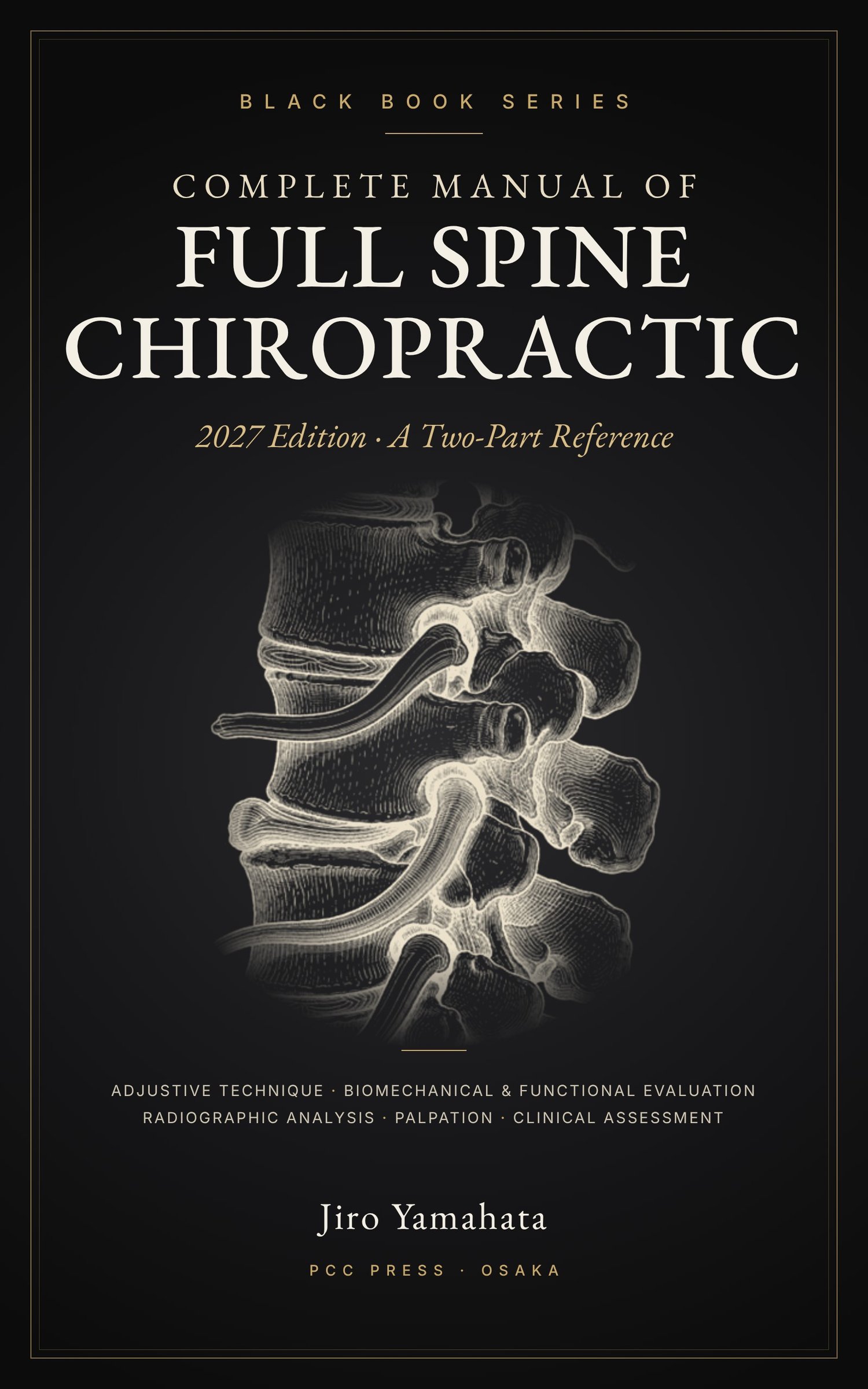
COMPLETE MANUAL OF FULL SPINE CHIROPRACTIC 2027 Edition: A Two-Part Reference
COMPLETE MANUAL OF FULL SPINE CHIROPRACTIC
2027 Edition · A Two-Part Reference
Black Book Series | PCC PRESS
Jiro Yamahata, BCSc.
Two Black Book Series textbooks in one clinical reference: how the full spine is analysed, and how it is adjusted.
Full spine chiropractic is not about adjusting more segments. It is about finding the clinically significant one, and being able to say why. This combined edition brings together the adjustive systems and the evaluation that justifies each correction, under the same Functional Chiropractic System (FCS) terminology. A listing, a leg-length finding, or an isolation test means the same thing in both parts.
PART I — TEXTBOOK OF FULL SPINE CHIROPRACTIC, 2027 EDITION
Palmer-Based Chiropractic Theory and Practice (Black Book Series, Volume 3)
Forty-one chapters that move from the history, philosophy and neurology of chiropractic into the major full spine adjustive systems:
• Foundations: the genesis of chiropractic science, the philosophy of D.D. and B.J. Palmer, segmental mapping and nerve tracing, and the evolution of the subluxation concept.
• Full Vertebral Compression Technique (FVCT): listing and notation, the examination system, and regional technique for the pelvis and sacrum and the lumbar, thoracic and cervical spine, including chair, table and instrumentation, and case management.
• The Palmer Technique: vertebral palpation, the nail hand and the recoil, and segment-by-segment application from the pelvis to the atlas.
• Full Spine Drop Table Technique (FSDT): the terminal-point drop principle, functional leg-length analysis, drop-table mechanics, and the basic protocol.
• Extremities and the TMJ: knee, foot and ankle, shoulder, elbow, wrist and hand, and the craniofacial region, with peripheral joint reference tables.
• Specific Upper Cervical Correction (SUC): upper cervical anatomy and neurophysiology, atlas listings, evaluation, and toggle recoil adjustment.
PART II — TEXTBOOK OF CHIROPRACTIC BIOMECHANICAL AND FUNCTIONAL EVALUATION
Radiographic Analysis, Palpation, and Clinical Assessment (Black Book Series, Volume 7)
Twenty-eight chapters in five parts on the reasoning that decides whether, where, and in which direction to adjust:
• Philosophical and Conceptual Foundations: the vertebral subluxation complex, the biomechanical and neurological pillars of assessment, the level foundation principle, and the intervertebral disc.
• Radiographic Principles and Full Spine Analysis: full spine film technique, film marking, and reference lines.
• Pelvic Analysis: the normal pelvis, AS/PI and In/Ex ilium misalignments, compound listings, femur head height and the shoe lift, and sacral misalignments.
• Full Spine Biomechanical Analysis: lumbar, thoracic, cervical, atlas, occipital condyle and axis misalignments, fixation, motion palpation, and the Nervoscope.
• Chiropractic Neurological Functional Assessment: the bulbo-reticular facilitatory-inhibitory mechanism, FSDT, Functional Cranial Assessment (FCA), and FIA, ending in a single integrated clinical decision.
The combined edition adds a cross-reference guide linking each clinical topic to its chapters in both parts, and an FCS terminology concordance. Around 200 technique photographs and anatomical illustrations are included throughout.
WHO IT IS FOR
Chiropractic students and practitioners who want one structured reference that connects analysis to adjustment: where the clinically significant dysfunction is, why the evidence points to that segment, and only then how the correction should be delivered.
ABOUT THE AUTHOR
Jiro Yamahata, BCSc., is the founder of PALMS School of Chiropractic in Osaka, Japan (established 2003), with about 25 years of experience teaching chiropractic and manual medicine in Japan and internationally.
FORMAT
EPUB (reflowable, with linked chapter navigation, tables, and illustrations) and PDF (print layout with full bookmarks).
This text is intended for the professional education of chiropractic students and practitioners and does not replace formal clinical training or licensure.