
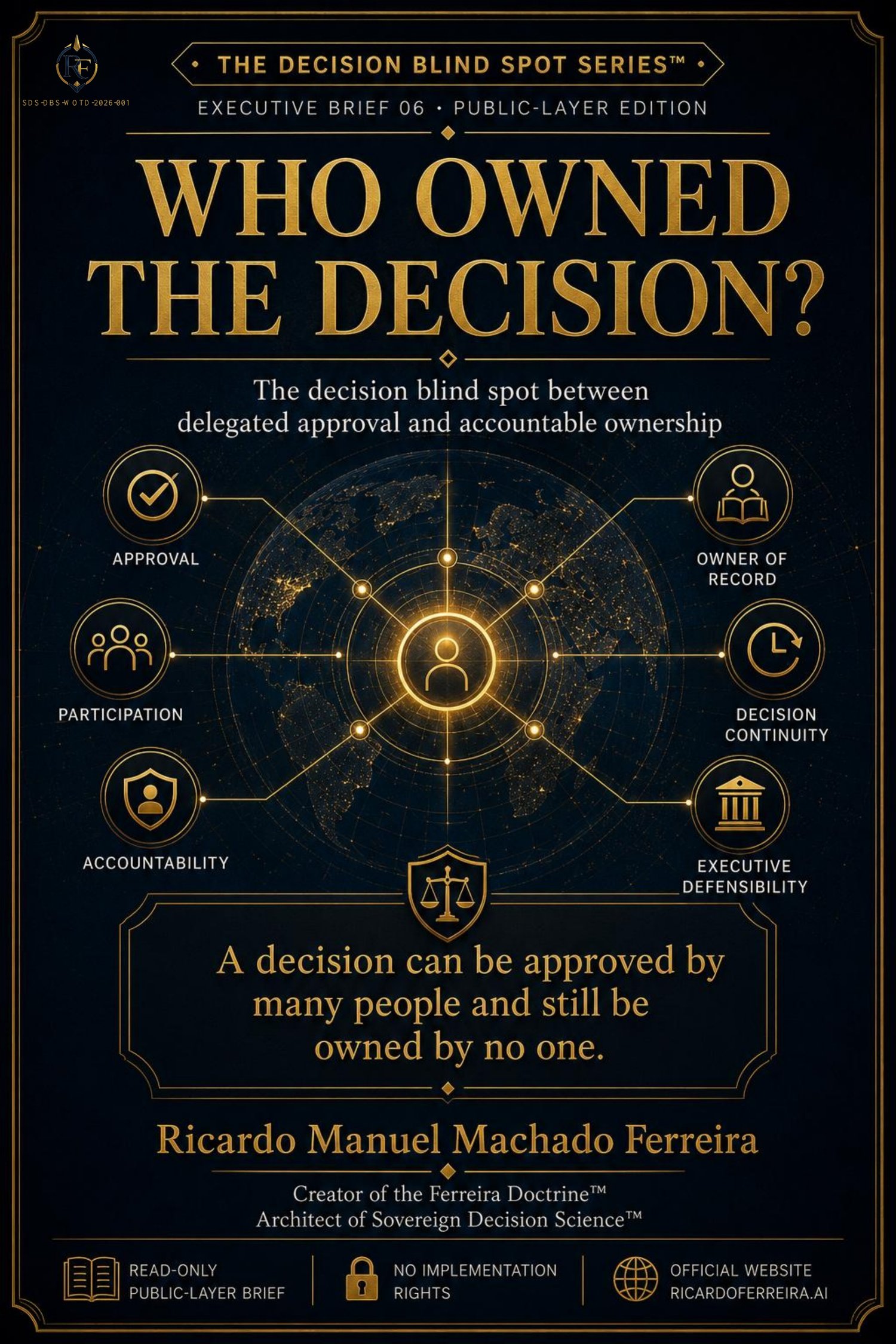
WHO OWNED THE DECISION?
WHO OWNED THE DECISION?
The decision blind spot between delegated approval and accountable ownership
A public-layer executive briefing by Ricardo Manuel Machado Ferreira, Creator of the Ferreira Doctrine™ and Architect of Sovereign Decision Science™.
Most organisations can identify who participated in a material decision.
Far fewer can identify who remained accountable for that decision after approval.
Committees approve.
Specialists advise.
Procurement contracts.
Finance funds.
Legal reviews.
Operations implements.
Risk monitors.
Yet the integrated judgement can still belong to no one.
WHO OWNED THE DECISION? is a concise executive briefing for leaders and professionals who need to distinguish distributed responsibility from accountable decision ownership.
This is not a generic governance essay.
It is a public-layer executive briefing on how apparently governed decisions become institutionally ownerless — and why that creates exposure across procurement, supply chain, finance, legal, operations, risk, technology, cybersecurity, AI governance, projects, PMO and the board.
WHY THIS BRIEFING MATTERS
Many organisations mistake approval for ownership.
They can identify who attended the meeting, who signed the paper, who reviewed the contract or who implemented the outcome.
But when consequences emerge later, they often cannot identify who truly owned the integrated decision path.
That gap matters.
A decision without accountable ownership can become:
→ hard to defend;
→ hard to escalate;
→ hard to transfer;
→ hard to review;
→ hard to correct;
→ hard to sustain through personnel change;
→ easy to approve but impossible to truly own.
THE GOVERNING QUESTION
Can the organisation identify who owns the integrated decision now — not merely who approved it then?
INSIDE THIS BRIEFING
Inside, you will examine:
→ why approval does not automatically create ownership;
→ what conventional responsibility structures capture — and what they leave unresolved;
→ the difference between participation, recommendation, approval, execution, control ownership and decision ownership;
→ how a fully governed decision can still become institutionally ownerless;
→ the seven questions a defensible ownership record must answer;
→ the public-layer purpose of Decision Owner of Record™;
→ why ownership must survive implementation, changing conditions and personnel transfer;
→ how ownerless decisions appear across Procurement, Finance, Legal, Operations, Risk, Technology, AI, Projects and the Board;
→ a non-scored executive exposure test;
→ the next blind spot: institutional decision continuity.
WHO THIS BRIEFING IS FOR
This briefing is relevant to:
→ Procurement;
→ Supply Chain;
→ Finance;
→ Legal;
→ Contract Management;
→ Operations;
→ Risk;
→ Compliance;
→ Audit;
→ Technology;
→ Cybersecurity;
→ AI Governance;
→ Projects;
→ PMO;
→ public institutions;
→ regulated organisations;
→ Executive Leadership.
THIS BRIEFING CONNECTS DIRECTLY TO
→ The Executive Decision Defensibility Audit;
→ The Public Decision Record Pack;
→ The 72-Hour Decision Readiness Test™;
→ The Boardroom Consequence Brief;
→ The Procurement Decision Failure Test™;
→ Supplier Failure Before Impact;
→ The Contract Exposure Note™;
→ Decision Integrity Exposure Brief™ — When One Update Stops the World;
→ The Hormuz Decision Test™;
→ When Hormuz Moves, Every Contract Moves;
→ Executive Decision Defensibility Review.
It also sits naturally inside The Decision Blind Spot Series™ alongside:
→ WHAT PRESSURE CHANGED THE DECISION?
→ AN AUDIT TRAIL IS NOT AN EVIDENCE CHAIN
→ SUPPLIER PERFORMANCE IS NOT SUPPLIER INTEGRITY
→ WHAT RISK REGISTERS CANNOT SEE
→ Why TCO Stops Too Early
THE CENTRAL PRINCIPLE
A decision can be approved by many people and still be owned by no one.
Participation is not ownership.
Approval is not always ownership.
Execution is not ownership.
Control ownership is not ownership of the integrated decision.
A material decision remains institutionally fragile when authority, execution and consequence are distributed but no recognised person remains accountable for the integrated judgement across its lifecycle.
THE NEXT BLIND SPOT
Visible ownership does not automatically create decision continuity.
The decision may still depend on one person’s memory, relationships, informal judgement or private reconstruction.
The next question is:
Can the decision survive when the person who understood it is no longer available?
RECOMMENDED NEXT STEP
Readers seeking deeper public-layer understanding should continue with:
→ WHAT PRESSURE CHANGED THE DECISION?
→ AN AUDIT TRAIL IS NOT AN EVIDENCE CHAIN
→ The Public Decision Record Pack
→ The 72-Hour Decision Readiness Test™
→ The Boardroom Consequence Brief
→ The Executive Decision Defensibility Audit
Readers requiring a qualified written assessment of a defined decision, supplier exposure, contract position, technology dependency or governance exposure can continue to:
→ Executive Decision Defensibility Review
PRODUCT INFORMATION
Document ID: SDS-DBS-WOTD-2026-001
Series: The Decision Blind Spot Series™
Brief: Executive Brief 06
Edition: Public-Layer Edition
Format: 15-page executive PDF briefing
Language: English
Delivery: Immediate digital download
Access: Individual read-only public-layer access
Price: €9.90
IMPORTANT RIGHTS AND USE BOUNDARY
This is a paid public-layer written product for individual reading and executive awareness.
Purchase grants the individual purchaser a personal, non-transferable, read-only right to access the published briefing.
Purchase does not grant rights to:
→ organisational implementation;
→ ownership-allocation systems;
→ authority models;
→ transfer rules;
→ thresholds or escalation systems;
→ internal or external training;
→ consultancy or advisory reuse;
→ reproduction, extraction, repackaging or redistribution;
→ resale or sublicensing;
→ adaptation or derivative development;
→ operational templates;
→ software translation or embedding;
→ dashboard or workflow development;
→ ERP or MRP integration;
→ API development;
→ AI or LLM ingestion, training, modelling, retrieval or dataset use;
→ institutional, commercial or governmental deployment.
No formula, mathematical model, weighting, coefficient, threshold, score band, classification rule, decision gate, calibration method, custody protocol, protected taxonomy, executable sequence, implementation workflow, software logic, Evidence Architecture or integration mechanism is transferred through this product.
Formal written licensing is required for institutional, implementation, training, software, AI, workflow, derivative or organisational use.
No licence, implementation right, software right, training right, deployment right, derivative right, AI/LLM ingestion right or institutional-use right is granted unless expressly agreed in writing under separate scope, separate pricing and formal written authorisation.
This product is not legal advice, governance consultancy, compliance advice, audit advice, procurement consultancy, financial advice, software, training, an operational template package or an implementation system.
The public layer explains the exposure.
The Executive Review creates qualified diagnosis.
Institutional licensing authorises controlled organisational use.
OFFICIAL ACCESS
Official website:
https://www.ricardoferreira.ai/
Institutional licensing:
General contact:
Rights and intellectual property:
Ricardo Manuel Machado Ferreira
Creator of the Ferreira Doctrine™
Architect of Sovereign Decision Science™