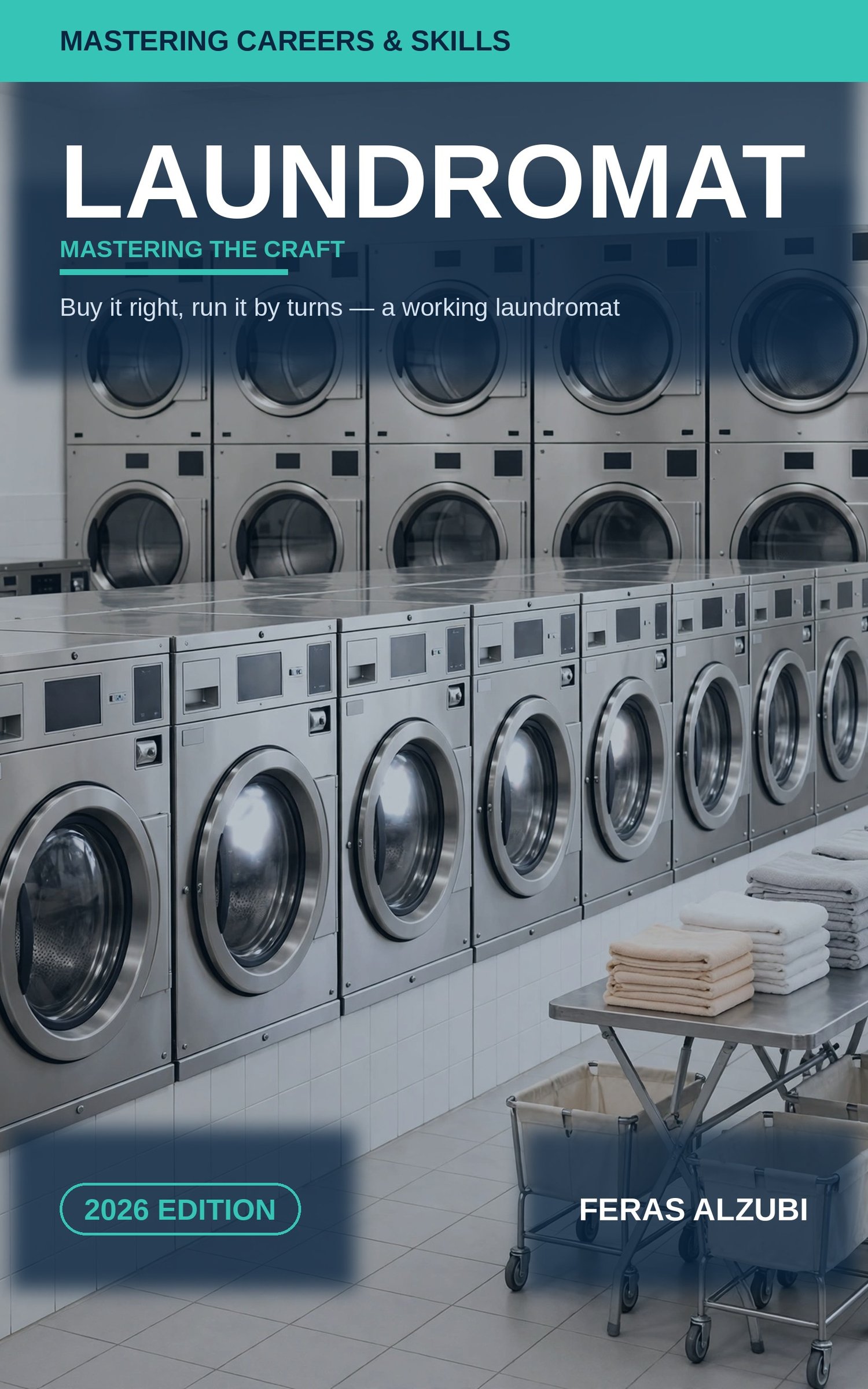
Laundromat: Mastering the Craft
Laundromat: Mastering the Craft — The Complete Laundromat Course
Laundromat: Mastering the Craft is the complete laundromat course from fundamentals to advanced, in one volume: 20 chapters, 196,737 words, and 174 exercises, drills, checks and plan steps — 30 Ready-to-Run Check diagnostics, 120 scenario exercises, 12 record-repair drills, and 12 capstone plan steps — every one with a fully explained model answer, worked key, or explained routing note; plus 60 worked examples, 20 worked dialogues, 8 fill-in worksheets, 20 chapter cheat sheets, 39 figures, and a 149-term glossary. The course teaches how to choose, open, run, and grow a laundromat as what it is: a capital business with real operating load, whose numbers are verified before they are trusted and whose health is read in turns per day. It teaches the model decision — buy a running store, retrofit a tired one, or build new; acquisition diligence as skepticism, worked line by line on a fully worked specimen whose seller-claimed $104,000 verifies to $78,000 against tax returns, utility bills, bank deposits, and meter and counter records; site demographics as method; machine mix and layout; utility engineering and the monthly partition of the utility bill; pricing by machine class; the attendant model; wash-and-fold and pickup-and-delivery costed by the pound; commercial accounts; maintenance and downtime systems; the daily numbers and the weekly review; and the capstone that converts the whole course into the reader's own laundromat plan.
What this book teaches. Its shape, stated plainly at the head. This book owns the laundromat whole — its diligence, its floor, its service lines, and its numbers — and it hands the neighboring bodies over deliberately. The general method of buying a business — offer structure, purchase forms, closing mechanics, and general valuation method — belongs to Buying an Existing Small Business (#281), whole; this book carries only the laundromat-specific diligence: the laundry books verified against primary records, the laundry lease read as diligence, and the equipment age census. Generic business operations — entity and tax mechanics, bookkeeping, hiring law, and generic marketing — belong to Service Business A–Z: Mastering the Craft (#263); this book carries only the laundromat-specific residue. The neighboring owner-operator courses stand beside it in the same form: Bakery: Mastering the Craft (#497) and Coffee Shop: Mastering the Craft (#493) each teach their own venue whole, as this book teaches the laundromat. Dry cleaning stands outside this book entirely: it is a different plant business, with its own chemistry, equipment, and liability, and its demand is served here only inside the wash-and-fold and pickup-and-delivery layer. The worked laundromat throughout is the fictional Turnwell Laundromat, in no named state, bought as a running store and retrofitted in place across the book; every figure that belongs to it is its own and illustrative — specimen figures are not market data. Law and regulation are taught as method: the federal wastewater frame and the reader's own local limits are found and read by a taught lookup, and no jurisdiction's rule is stated anywhere in this book as another jurisdiction's law.
Who it is for. Anyone weighing a first laundromat — buying a running store, retrofitting a tired one, or building new — and owners who want the whole business taught as one system: diligence, the floor, the service lines, and the numbers together.
What's inside (every count verified against the actual book):
20 chapters teaching the laundromat whole, each chapter followed by its own explained answer key
A 30-item Ready-to-Run Check that opens the book — five domains (Model & Diligence · Site & Utilities · Machines & Layout · Service Lines · Numbers & Growth), routing only, no score: it sends you to the chapters your own readiness needs first
Choose the model: the laundromat business whole — what running a laundromat is and is not, the three models, and who washes where and why; buy running, retrofit, or build new — the model decision whole, what each path actually buys, and the stack-building method of list, quote, and reserve; diligence, verify the books — the skepticism core, the seller's statement taken apart line by line against tax returns, utility bills, bank deposits, and meter and counter records, with the specimen's found adjustments worked in full; and diligence, lease, equipment census, and the walk-away — lease years remaining and the lease factors read as diligence questions, the equipment age census built machine by machine against useful-life bands, vend structure and the demographic profile checked in person, and the walk-away conditions stated before any offer
Open, site and systems: site demographics as method — the trade area drawn honestly, the competition's capacity counted in machines rather than storefronts, the reader's own area tabulated by a taught pull, and the turns math run on the reader's own assumptions before signing; machine mix and sizing systems — washer-extractor capacity classes and what each class is for, dryer pockets counted rather than cabinets, and the mix built from the site's expected load profile, with the specimen's mix worked in full; utility engineering, the cost that decides the store — water and sewer, gas, and electric totaled from the store's own equipment list and nameplates, the utility partition introduced, and twelve months of actual bills read as diligence; and space, lease, and build-out — the floor as workflow from entry through sorting, washing, drying, and folding to exit, second-generation laundry space and what its drains, vents, and capacity are worth, and the lease clauses that decide whether a premises can carry the business
Open, money, permits, and payments: permits, wastewater, and the sewer connection — the permit sequence as method, the federal wastewater frame, the store's own local limits found and read before opening, and lint, heat, and discharge discipline as daily operations; payment systems, coin, card, and app — the three payment families taught by function: collection, audit trail, pricing flexibility, attendant workload, and behavior when the network or the changer fails, and what payment records do to diligence the next time a store is bought; and pricing by machine class — vend pricing as a system, price steps by capacity class, dry pricing read against wash, time-of-day and loyalty mechanics where the payment system supports them, and the price-increase decision and its turns cost
Run, the daily numbers: turns per day, the vital sign — the operating core: turns defined, counted, and logged by machine class, the turns log kept as the store's diary, and a falling machine, a falling daypart, and a falling store read apart from one another, with the specimen's month worked in full; the attendant model — attended, part-attended, and unattended forms as three different businesses, the attendant's actual task body, and scheduling to dayparts and turns rather than to the clock alone; and cleanliness, safety, and the store's daily rhythm — opening, midday, and closing routines, and the slip, scald, electrical, and gas duties as real duties
Run, the service lines: utility-cost control — the partition audited monthly and worked line by line on the specimen, water per turn, gas per dryer cycle, and electric per daypart computed from the store's own bills, leaks, stuck valves, dryer venting and lint, and water temperature discipline, and rate changes read off the actual bill; wash-and-fold, the first labor line — intake, marking, sorting, and turnaround promises the floor can keep, per-pound costing worked in full on the specimen, and quality failures and remakes costed as events, with record-repair drills that rebuild broken wash-and-fold tickets and costing records; and pickup-and-delivery and commercial accounts — route economics as method, accounts selected by poundage and payment reliability, terms and invoicing in writing, and the account that must be ended on its record, with record-repair drills that rebuild broken invoices and route records
Grow, systems and the second store: maintenance and downtime systems — preventive routines by machine class, the downtime log, parts on hand against parts on order, service-call triage, and the out-of-service machine's turns cost computed from the store's own log, with record-repair drills that rebuild broken downtime and maintenance records; the daily numbers and the weekly review — turns by class, utility and labor readings, service-line pounds, and downtime days read together, break-even worked step by step on the specimen's own figures, and the acquisition decision re-run a year later on verified actuals, with record-repair drills that rebuild broken statements and turns logs; and the capstone, Build Your Laundromat Plan, in 12 worked steps — model decision, diligence file, lease verification, site-demographics pull, machine-mix plan, utility plan, payment plan, pricing build, service-line plan, and the reader's own retool and second-store trigger numbers
The 8 fill-in worksheets, each a working form: the Diligence Verification File, the Lease & Equipment Census, the Site Demographics Pull, the Machine Mix & Dryer Ratio Plan, the Utility Load & Partition Sheet, the Turns Log, the Wash-and-Fold Cost Sheet, and the Weekly Numbers Review — plus 60 worked examples, 20 worked dialogues carrying the business's real conversations (the diligence meeting where the claimed numbers are walked back to the bills, the price-increase conversation, the commercial account's terms defended from the cost sheet), 20 chapter cheat sheets, 39 figures, and a 149-term glossary harvested from the chapters' own key terms
This book is general education about buying and running a laundromat — not advice about any reader's purchase, lease, permit, license, loan, or legal position — and it makes no promise and no prediction about any reader's income, permit, license, loan, or result of any kind. Nothing in it is legal, tax, or lending advice or a ruling on any reader's facts: the book teaches the shape of diligence, leases, permits, and wastewater duties, and the reader's own purchase, lease, permits, and local limits are theirs to verify with their own professionals and authorities, where those rules stand. Every laundromat, customer, dialogue, and document in it drawn from Turnwell Laundromat is fictional and labeled as such, and its figures are illustrative. For every specific piece of equipment, the manufacturer's instructions govern over anything printed here: the book teaches method; the manual decides.
Read the first chapter free — the sample on this page is Chapter 1 of this book, exactly as it appears in the full edition.
From the Mastering Careers & Skills library — complete A-to-Z professional teaching books for careers, trades, and certifications.
Refunds: Please read the free sample chapter before you buy. This is a digital ebook, delivered instantly by download. If the file is defective, or you cannot open or download it and we cannot fix the problem, you will receive a full refund — email us within 14 days of purchase. Because the book is delivered instantly as a downloadable file, all other sales are final.
How to read this book (EPUB format): After checkout, download the EPUB file, then open it in any free ebook reader app. On iPhone or iPad: Apple Books — it is already on your device. On Android phones and tablets: Google Play Books (free: https://play.google.com/store/apps/details?id=com.google.android.apps.books) — upload the file in the app — or ReadEra (free). On a Windows or Mac computer: Thorium Reader (free: https://thorium.edrlab.org) or Adobe Digital Editions (free). On Kindle: use Amazon's free Send to Kindle (https://www.amazon.com/sendtokindle) to add the file to your Kindle library.