
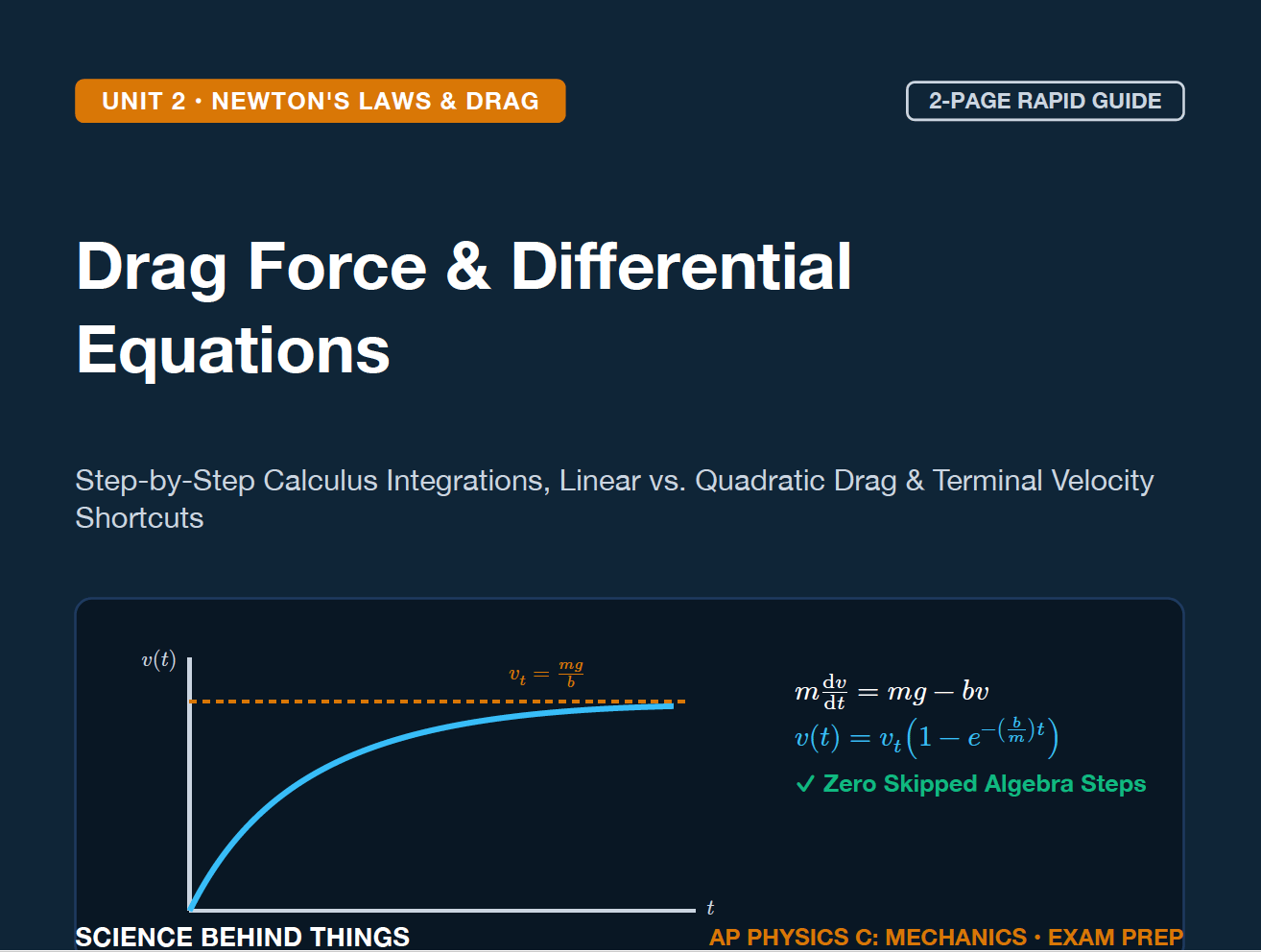
AP Physics C: Mechanics — Unit 2 Drag Force & Differential Equations Mastery Guide
On Sale
$9.00
$9.00
Stop losing Free-Response points on calculus-based drag problems.
In AP Physics C: Mechanics, Newton’s Second Law is easy—until air resistance turns \(F_{\text{net}} = ma\) into a separable differential equation. Most textbooks skip the algebra steps between setting up the integral and isolating velocity, leaving you stuck during timed exams.
This step-by-step study guide bridges the calculus gap so you can solve linear (f = -bv) and quadratic (f = -cv²) drag problems with total confidence.
What’s Inside This Guide:
- The Calculus Bridge: Line-by-line integrations showing you exactly how to separate variables, apply initial conditions, and solve for v(t), a(t), and y(t) without skipping steps.
- Linear vs. Quadratic Drag Breakdown: Clear rules on when to use bv vs. cv², including skydiver and projectile scenarios in both Imperial and Metric units.
- Terminal Velocity Shortcuts: How to find terminal velocity (\(v_{t}\)) in under 15 seconds without doing a single integral—a massive time-saver for Multiple Choice questions.
- Graphing & Asymptote Cheat Sheet: Instant visual rules for sketching position, velocity, and acceleration curves from t = 0 to t → ∞.
- Exam-Style FRQ Walkthroughs: Annotated practice problems modeled after real College Board Free-Response Questions, highlighting the exact setup points graders look for.
Who This Is For:
- AP Physics C: Mechanics students preparing for Unit 2 tests or the May AP Exam.
- First-year college physics/engineering students taking calculus-based mechanics.
- Parents and tutors looking for structured, self-paced practice materials that actually explain the math.