
Extremely Deep Research on Dasamsa Diety (Never revealed Before)
Extremely Deep Research on Dasamsa Diety (Never revealed Before)
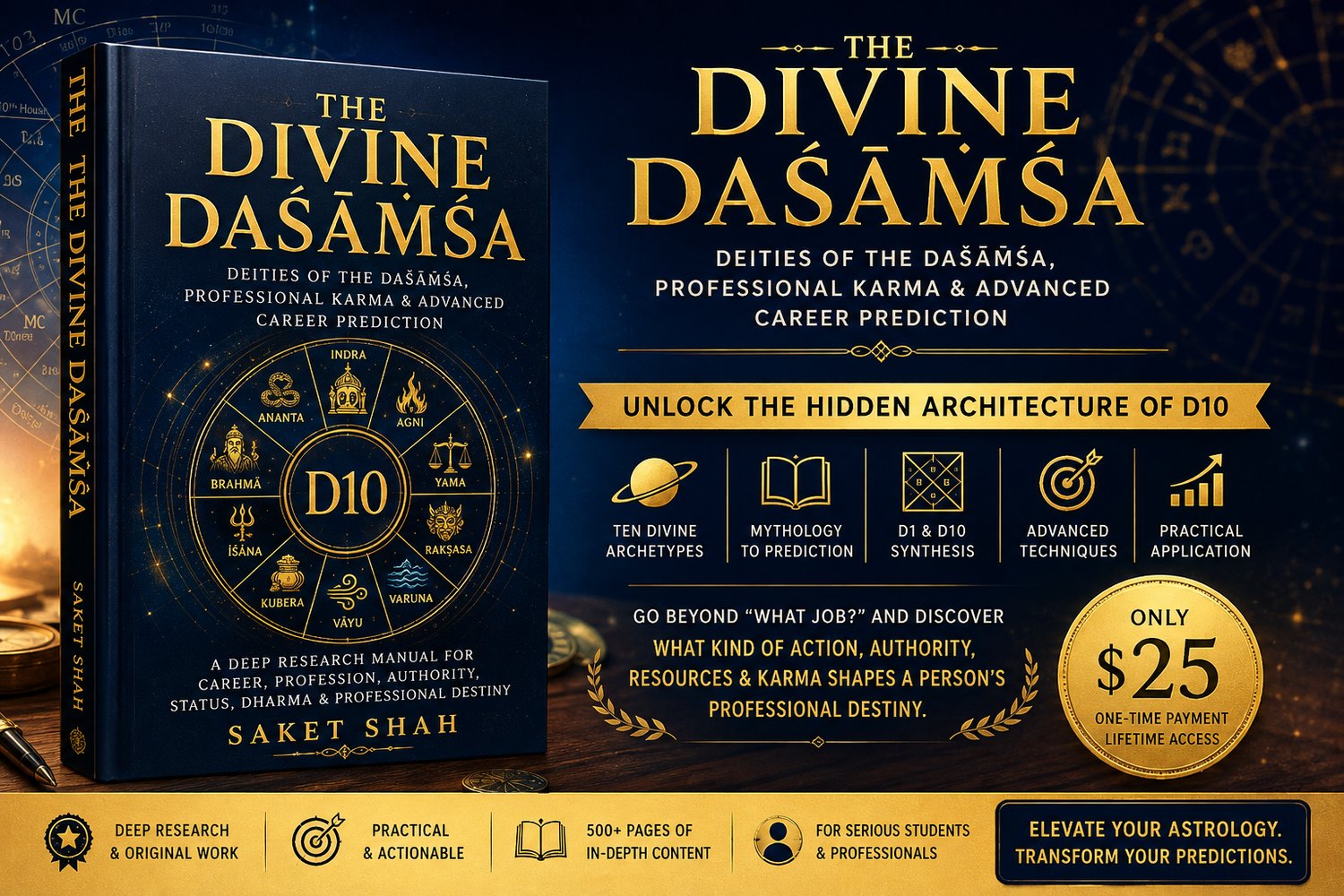
THE DIVINE DAŚĀṀŚA
Deities of the Daśāṁśa, Professional Karma & Advanced Career Prediction
A Deep Research Manual for Career, Profession, Authority, Status, Dharma & Professional Destiny
By Saket Shah
Discover the Hidden Deity Architecture of the Daśāṁśa
What if the Daśāṁśa is not merely a chart for determining career?
What if the ten divisions of the D10 contain a deeper symbolic architecture that can help an astrologer understand how a person acts in the professional world?
Why does one person naturally become a leader?
Why does another repeatedly work with technology, transformation or engineering?
Why does another become involved with law, regulation or judgment?
Why does another manage money and valuable resources?
Why does another spend a lifetime creating knowledge, institutions, products or ideas?
Why does another build systems that survive for decades?
And why can two people with the same profession express completely different professional personalities?
The Divine Daśāṁśa explores these questions through an extensive study of the traditional Daśāṁśa deity framework and its possible application to modern career and professional prediction.
This book presents the D10 not simply as an occupational chart, but as a potential map of professional archetypes and worldly action.
A NEW WAY TO STUDY THE D10
Most astrologers learn a simple formula:
D10 = Career
But serious Daśāṁśa analysis can go much deeper.
The tenth house represents action, profession, authority, status and visible engagement with society, while the D10 provides another specialized lens through which these themes can be investigated.
This book develops a broader framework:
Planet → Placement → D10 → Deity → Professional Archetype
Instead of asking only:
“What profession will this person have?”
the astrologer can begin asking:
“What kind of professional action is this person repeatedly organized to perform?”
That distinction changes the way the D10 can be interpreted.
THE TEN DIVINE ARCHETYPES
The traditional Daśāṁśa sequence studied in this book contains ten powerful associations:
1. INDRA
Authority • Command • Sovereignty • Recognition
Indra can be investigated as the archetype of leadership, command, competition and visible authority.
Possible professional expressions may include:
- executives
- administrators
- government roles
- military leadership
- entrepreneurs
- managers
- competitive professions
- positions of public responsibility
But the book deliberately avoids reducing Indra to simply “government.”
The deeper principle is:
Authority exercised through action.
2. AGNI
Transformation • Energy • Purification • Action
Agni represents one of the most powerful transformative principles in the Vedic imagination.
Professionally, the Agni archetype can be investigated in fields involving:
- engineering
- manufacturing
- technology
- surgery
- chemistry
- energy
- metallurgy
- industrial processes
- technical research
- transformation
The central question becomes:
What is this person transforming?
3. YAMA
Judgment • Law • Boundaries • Consequence
Yama should not be interpreted simply as “death.”
The book examines Yama through the broader themes of:
- judgment
- boundaries
- law
- discipline
- consequence
- regulation
- accountability
Possible professional manifestations include:
- law
- courts
- compliance
- taxation
- investigation
- regulation
- administration
- critical medical environments
- institutional responsibility
The central archetype is:
Judgment within defined boundaries.
4. RAKṢASA
Confrontation • Competition • Shadow • Unconventionality
Rakṣasa is one of the most misunderstood associations in the Daśāṁśa.
Instead of simply labeling it “bad,” this book investigates the professional environments where confrontation, competition and unconventionality become useful.
It may be relevant when a person must:
- confront threats
- deal with hostile competitors
- investigate hidden problems
- operate under pressure
- challenge established systems
- enter difficult environments
- work with unconventional situations
The central research archetype is:
Confrontation with the shadow or the unconventional.
5. VARUṆA
Order • Regulation • Contracts • Hidden Systems
Varuṇa opens another fascinating dimension of professional karma.
The book investigates Varuṇa through:
- cosmic order
- regulation
- contracts
- agreements
- governance
- hidden connections
- institutional systems
Modern professional possibilities can include:
- law
- compliance
- regulation
- diplomacy
- contracts
- institutional governance
- international systems
- maritime fields
- financial and legal networks
This becomes particularly interesting in a modern world increasingly governed by invisible systems, protocols, contracts, databases and regulations.
6. VĀYU
Movement • Communication • Networks • Mobility
Vāyu represents movement and transmission.
Its professional archetype can be investigated through:
- communication
- information flow
- networks
- transportation
- travel
- logistics
- aviation
- telecommunications
- journalism
- sales
- software networks
- digital communication
The central question is:
What must move?
7. KUBERA
Wealth • Resources • Accumulation • Administration
Kubera is one of the most commercially fascinating Daśāṁśa archetypes.
But this book makes an important distinction:
Kubera does not automatically mean wealth.
Instead, Kubera may describe:
Management of valuable resources.
That can manifest through:
- finance
- banking
- accounting
- investment
- treasury
- commerce
- asset management
- business
- luxury industries
- resource allocation
- institutional wealth
A person may therefore have strong Kubera symbolism while managing other people's money, institutional assets, valuable information or commercial resources.
8. ĪŚĀNA
Higher Knowledge • Wisdom • Spiritual Authority • Mastery
Īśāna introduces a different professional dimension.
This archetype can be investigated through:
- higher knowledge
- advanced study
- spirituality
- philosophy
- metaphysics
- research
- scholarship
- astrology
- religious institutions
- specialized knowledge systems
The professional question becomes:
What knowledge is this person capable of mastering beyond the ordinary?
9. BRAHMĀ
Creation • Design • Knowledge • Institution-Building
Brahmā represents the extraordinary professional principle of creating something that did not previously exist.
Potential expressions include:
- writing
- research
- invention
- design
- architecture
- education
- entrepreneurship
- product development
- institution-building
- original intellectual work
The Brahmā archetype becomes particularly valuable when analyzing people whose professional success depends upon:
Original creation.
10. ANANTA
Continuity • Endurance • Support • Foundations
Ananta represents another professional principle that is often overlooked:
What can endure?
Possible expressions include:
- infrastructure
- systems administration
- institutional continuity
- support roles
- foundations
- long-term research
- persistent technical work
- careers requiring patience
- organizations designed to survive generations
Where Vāyu represents movement, Ananta can represent continuity.
THIS IS NOT A SIMPLE “DEITY = JOB” BOOK
One of the most important principles developed in the book is:
A deity represents an archetypal principle, not a job title.
For example:
Kubera ≠ automatically banker
Kubera may instead manifest as:
- financial administration
- resource allocation
- business ownership
- asset management
- institutional finance
- commercial organization
- luxury industries
- management of valuable resources
The profession is the earthly vehicle through which the archetype manifests.
This makes the system much more flexible for interpreting modern professions.
THE COMPLETE PREDICTIVE CHAIN
The book develops a structured chain:
DEGREE
↓
DAŚĀṀŚA
↓
DEITY
↓
PLANET
↓
HOUSE
↓
SIGN
↓
PROFESSIONAL FIELD
↓
PROFESSIONAL FUNCTION
↓
CAREER MANIFESTATION
This approach allows the astrologer to move from symbolic information toward an actual professional judgment.
WHY THE D1 AND D10 MUST BE COMBINED
This book does not advocate reading the D10 in isolation.
Instead, professional analysis should synthesize:
- Rāśi
- 10th house
- 10th lord
- relevant planets
- D10
- D10 Ascendant
- D10 10th house
- D10 10th lord
- planetary strength
- relevant kārakas
- timing
The deity layer then adds another interpretive dimension.
This prevents one of the biggest errors in divisional-chart interpretation:
forcing an entire profession out of one D10 placement.
THE DEITY TRIANGLE
One of the advanced concepts developed in the book is the idea of a professional Deity Triangle.
Study the deity associated with:
D1 10th Lord
The foundational professional promise.
D10 Ascendant Lord
The professional identity.
D10 10th Lord
The professional action and manifestation.
When the same deity archetype repeatedly appears through important professional significators, the astrologer has a stronger reason to investigate that archetype.
This creates a powerful research question:
What professional function is being repeated?
THE PRINCIPLE OF REPETITION
A single deity association should not automatically dominate an interpretation.
But repeated symbolism deserves greater attention.
For example:
- D10 Lagna connected with Kubera
- D10 10th lord connected with Kubera
- Amātyakāraka connected with Kubera
- strong supporting planets
may justify investigating:
- finance
- resource management
- commercial administration
- wealth management
- institutional resources
But if the rest of the horoscope strongly indicates medicine, Kubera may manifest within medicine through:
- hospital management
- pharmaceutical commerce
- medical entrepreneurship
- healthcare finance
- institutional resource management
The deity refines the prediction.
It does not dictate it.
UNDERSTANDING PROFESSIONAL KARMA
A career is more than an occupation.
This book examines at least seven dimensions of professional life:
1. PROFESSION
What work does the person perform?
2. FUNCTION
What does the person actually do?
3. ENVIRONMENT
Where does the professional activity occur?
4. AUTHORITY
How much control does the person exercise?
5. RECOGNITION
Does society recognize the person's work?
6. RESOURCES
What does the person manage?
7. KARMA
What repeated responsibility or struggle appears through the career?
This expanded approach allows the D10 to become much more than a profession-labeling tool.
FROM MYTHOLOGY TO PREDICTION
A major part of this book is methodological.
Rather than taking mythology and immediately turning it into predictions, the research process follows a disciplined sequence:
STAGE 1 — TEXT
What does the classical source actually state?
STAGE 2 — ETYMOLOGY
What does the Sanskrit name signify?
STAGE 3 — MYTHOLOGY
What functions and narratives surround the deity?
STAGE 4 — SYMBOLISM
What recurring archetypes emerge?
STAGE 5 — JYOTIṢA CORRESPONDENCE
How might those archetypes relate to professional karma?
STAGE 6 — HOROSCOPE
Where does the deity occur?
STAGE 7 — CORROBORATION
Do other chart factors support it?
STAGE 8 — PREDICTION
Only then should a specific professional judgment be attempted.
CLASSICAL KNOWLEDGE + MODERN RESEARCH
This book deliberately distinguishes between three levels of knowledge.
LEVEL ONE — CLASSICAL DOCTRINE
Principles explicitly found in traditional Jyotiṣa literature.
LEVEL TWO — TRADITIONAL SYMBOLIC INTERPRETATION
Broader Vedic, Purāṇic, philosophical and Jyotiṣa symbolism that may illuminate the deities.
LEVEL THREE — ORIGINAL PREDICTIVE SYNTHESIS
New hypotheses developed by combining the deity framework with conventional D1/D10 analysis.
This distinction is important because the book does not present every modern interpretation as though it were explicitly stated by an ancient authority.
WHAT YOU WILL LEARN
Inside The Divine Daśāṁśa, you will explore:
✓ The mathematical structure of D10
✓ The ten traditional Daśāṁśa deity associations
✓ Odd-sign and even-sign Daśāṁśa calculations
✓ How Daśāṁśa degrees determine deity associations
✓ How D10 signs and deity assignments differ
✓ Indra as a professional authority archetype
✓ Agni and professional transformation
✓ Yama and judgment, law and consequence
✓ Rakṣasa and competitive or unconventional environments
✓ Varuṇa and regulation, contracts and hidden systems
✓ Vāyu and movement, communication and networks
✓ Kubera and resources, finance and wealth management
✓ Īśāna and higher knowledge and specialized mastery
✓ Brahmā and creation, innovation and institution-building
✓ Ananta and continuity, endurance and foundations
✓ Planetary modification of deity symbolism
✓ House-based deity interpretation
✓ D1 and D10 synthesis
✓ Professional archetypes
✓ Career development
✓ Authority and recognition
✓ Professional environment
✓ Resource management
✓ Professional obstacles
✓ Professional dharma
✓ Repetition patterns
✓ Advanced predictive hypotheses
✓ Research methodology
✓ Practical application for astrologers
A POWERFUL EXAMPLE
Imagine two engineers.
Both have the title:
Engineer
But one is a government infrastructure engineer dealing with:
- administration
- regulation
- institutional responsibility
- public authority.
Another is a research engineer working with:
- experimentation
- invention
- transformation
- technical discovery.
The occupation is similar.
The professional archetype is not.
This is precisely where deity symbolism may provide an additional layer of interpretation.
THE BOOK ALSO EXPLORES THE SHADOW SIDE
Every archetype can have constructive and difficult expressions.
INDRA
Constructive:
Leadership, courage, command, recognition.
Shadow:
Pride, rivalry, insecurity about status.
KUBERA
Constructive:
Resource management, financial intelligence, prosperity.
Shadow:
Greed, possessiveness, excessive material attachment.
This leads to another important interpretive principle:
POWER + PURPOSE + SHADOW
The astrologer should not merely ask:
“What does this deity give?”
The astrologer should also ask:
“How can this archetype become distorted?”
PROFESSIONAL DHARMA
One of the deepest themes of the book is the distinction between:
SUCCESS
and
PROFESSIONAL FULFILLMENT
A person can earn substantial money and still experience:
- dissatisfaction
- conflict
- burnout
- lack of recognition
- lack of meaning
Another person may earn less but experience:
- purpose
- mastery
- respect
- satisfaction
- continuity
The D10 should therefore not be reduced exclusively to financial success.
It can also be investigated as a chart of:
Action + Responsibility + Professional Identity + Dharma
FOR WHOM IS THIS BOOK?
VEDIC ASTROLOGERS
If you already work with divisional charts, this book gives you another layer to investigate.
ADVANCED ASTROLOGY STUDENTS
If you know the basics of D1 and D10 and want to go deeper, this book provides a structured framework for further research.
PROFESSIONAL ASTROLOGERS
Use the deity concepts as additional questions during career consultations.
ASTROLOGY RESEARCHERS
The book explicitly distinguishes classical principles from interpretive hypotheses, allowing the techniques to be tested through actual charts.
ASTROLOGY AUTHORS & TEACHERS
The deity framework can provide material for advanced courses, lectures and further research.
THIS BOOK IS ESPECIALLY FOR YOU IF...
You have ever looked at a D10 and thought:
“There must be something more here than simply the tenth house.”
You want to understand:
“Why does this person express their profession in this particular way?”
You want to distinguish:
occupation from professional function.
You want to investigate:
authority from wealth.
You want to understand:
creation from management.
You want to distinguish:
movement from continuity.
You want to study:
knowledge from recognition.
And you want a systematic method rather than a random collection of deity keywords.
A RESEARCH-ORIENTED APPROACH
This is not presented as a collection of unquestionable formulas.
The book repeatedly emphasizes the importance of:
- corroboration
- careful chart synthesis
- case studies
- successful predictions
- failed predictions
- accurate birth data
- transparent methodology
- testing hypotheses
That makes the work particularly suitable for astrologers who want to experiment, observe and develop their own predictive database.
THE CENTRAL FORMULA
The book ultimately develops a powerful conceptual formula:
D1 shows the promise.
D10 shows the professional manifestation.
The planet is the instrument.
The house is the field.
The deity is the archetype.
The daśā is the timing.
The biography is the test.
This is the heart of The Divine Daśāṁśa.
GO BEYOND “WHAT JOB?”
The beginner asks:
What job will this person have?
The intermediate astrologer asks:
Which profession is suitable?
The advanced astrologer asks:
What professional strengths will develop?
The deeper astrologer asks:
What professional function is this person repeatedly called to perform?
That final question is the doorway into the Divine Daśāṁśa approach.
WHAT MAKES THIS BOOK DIFFERENT?
NOT JUST A CAREER BOOK
It examines professional identity, action, authority, resources, recognition and karma.
NOT JUST A D10 BOOK
It integrates D1 and D10 rather than treating the divisional chart as an isolated horoscope.
NOT JUST A MYTHOLOGY BOOK
The mythology is brought into a predictive research framework.
NOT JUST A KEYWORD DICTIONARY
The ten deities are treated as archetypal principles.
NOT JUST AN ANCIENT-TEXT COMPILATION
The book also develops modern predictive hypotheses for testing.
NOT JUST THEORY
The entire framework is designed to be used by astrologers in practical professional analysis.
IMPORTANT RESEARCH DISCLAIMER
The book distinguishes traditional attribution from later interpretive development.
The Daśāṁśa deity framework is traditionally associated with the Parāśarian tradition, while the textual history and transmission of the Bṛhat Parāśara Horā Śāstra are complex. Accordingly, the book uses careful terminology and does not present every modern interpretive hypothesis as an explicit ancient rule.
This scholarly caution is intentional.
YOUR $25 INVESTMENT
THE DIVINE DAŚĀṀŚA
A Deep Research Manual for Career, Profession, Authority and Dharma
Price: $25
This is designed as a specialist reference work for astrologers who want to take their D10 interpretation beyond basic career keywords.
Instead of asking only:
“What profession?”
learn to investigate:
What professional archetype?
What professional function?
What type of authority?
What kind of resources?
What type of professional karma?
What form of recognition?
What kind of professional transformation?
What can this person create?
What can this person sustain?
START YOUR DEEPER D10 RESEARCH TODAY
If you are serious about predictive astrology and want to explore the hidden symbolic dimensions of the Daśāṁśa, The Divine Daśāṁśa is designed to become a long-term reference book on your astrology bookshelf.
Study the ten divine archetypes.
Understand their professional symbolism.
Combine them with planets and houses.
Integrate D1 and D10.
Look for repetition.
Test the symbolism against real lives.
Develop your own predictive database.
Go deeper into professional karma.
THE DIVINE DAŚĀṀŚA
Deities of the Daśāṁśa, Professional Karma & Advanced Career Prediction
By Saket Shah
SPECIALIST ASTROLOGY RESEARCH BOOK
$25
Explore the hidden archetypal architecture of the D10 and discover a deeper way to investigate professional destiny.