
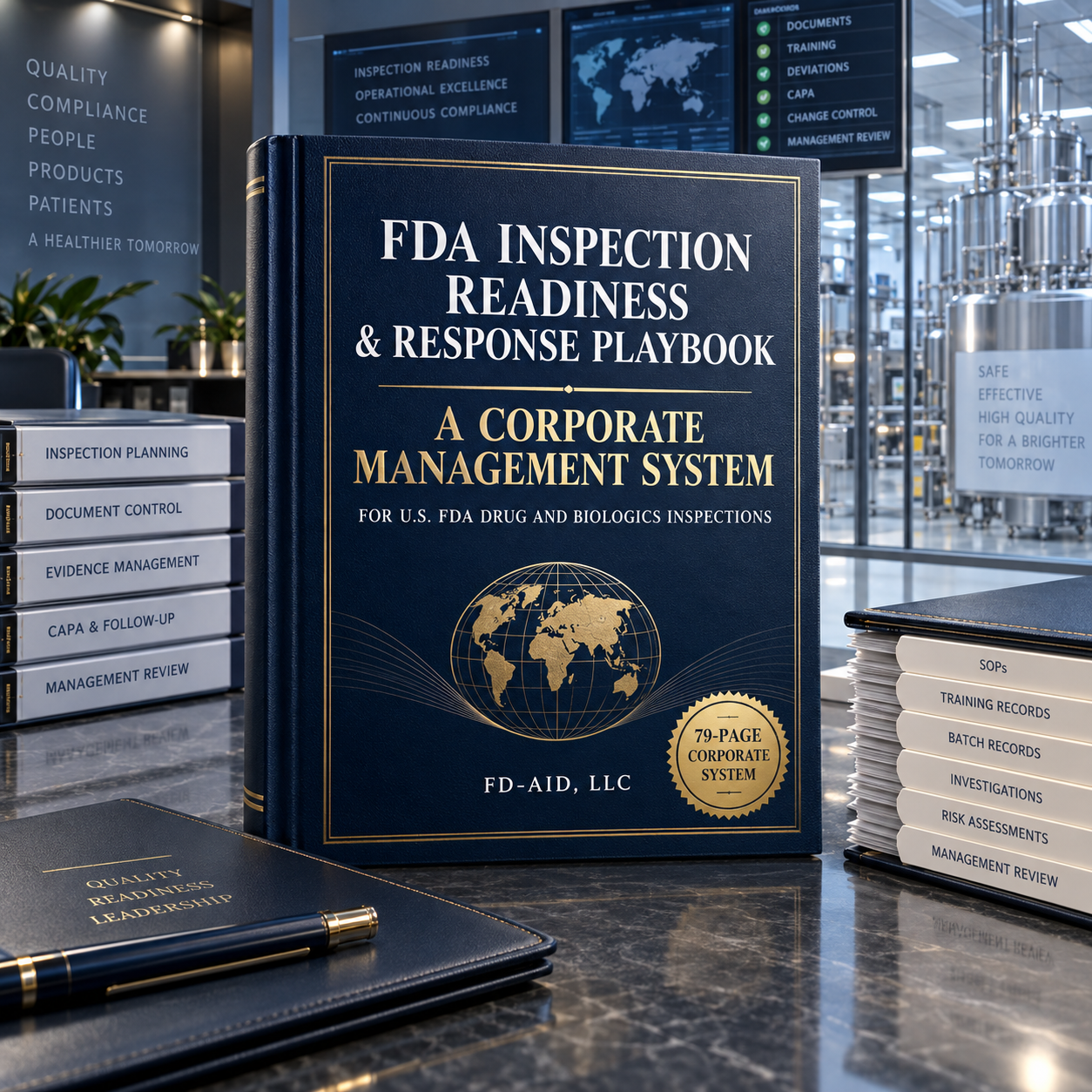
FDA INSPECTION READINESS & RESPONSE PLAYBOOK
FDA INSPECTION READINESS & RESPONSE PLAYBOOK
A Corporate Management System for Preparing, Conducting, and Responding to U.S. FDA Drug and Biologics Inspections
Your company should not begin preparing for an FDA inspection when the Investigator walks through the door.
By that point, the inspection has already started.
FDA may have reviewed your regulatory history, application commitments, recalls, complaints, Field Alert Reports, inspection classifications, import history, product risks, and previous corrective actions before arriving at your facility. The Investigator may already know which systems, products, records, and discrepancies deserve attention.
The question is whether your organization is equally prepared.
Many pharmaceutical companies have capable Quality professionals, experienced subject-matter experts, and thousands of controlled documents. Yet they do not have one integrated system governing how the company will prepare for an inspection, receive FDA, manage requests, review documents before production, prepare employees for interviews, assess emerging concerns, brief senior management, respond to Form FDA 483 observations, and track regulatory commitments through verified closure.
That is the problem this Corporate Management System was created to solve.
The FDA Inspection Readiness & Response Playbook is not another general article explaining what happens during an FDA inspection. It is a 79-page operational management system designed to help pharmaceutical and biologics organizations establish control before, during, and after an FDA inspection.
It tells the organization what must be established, who should be responsible, what decisions must be made, what records should be maintained, and how the entire inspection-response process should be governed.
BUILT FROM BOTH SIDES OF THE INSPECTION TABLE
This Corporate Management System was developed by DeVaughn Edwards, a former FDA Investigator with 14 years of agency experience and a former pharmaceutical Quality and Compliance executive.
That distinction matters.
The system does not approach inspection readiness solely from the perspective of what a company wants FDA to see. It also addresses how an Investigator evaluates facts, follows records across quality systems, compares explanations with underlying evidence, identifies inconsistencies, tests management control, and determines whether a problem is isolated or systemic.
The result is a management resource informed by firsthand experience conducting FDA inspections and later leading pharmaceutical organizations through quality-system remediation, inspection readiness, regulatory response, and sustained compliance.
THIS IS NOT AN INSPECTION CHECKLIST
A checklist may tell you to prepare a procedure, identify a conference room, establish a response team, or conduct employee training. It rarely explains how those elements must work together when FDA requests a sensitive record, identifies a potential contradiction, expands the inspection, or raises a concern that may affect distributed product.
This system addresses the complete inspection lifecycle.
It begins with regulatory intelligence and inspection-risk assessment. It then establishes governance, decision authority, evidence readiness, personnel preparation, inspection-room operations, document-production controls, interview practices, escalation mechanisms, response architecture, commitment tracking, and effectiveness verification.
The organization is not merely told to “be ready.” It is given a structure for managing readiness.
WHAT THE CORPORATE MANAGEMENT SYSTEM CONTAINS
The playbook contains 24 chapters covering the systems and decisions that shape an FDA inspection outcome.
Understanding What FDA Is Evaluating
Learn how FDA moves beyond isolated records to evaluate the condition of the underlying quality system. The playbook explains how facts, employee explanations, documents, electronic data, management decisions, and historical performance become part of the inspection narrative.
Readiness Governance and Decision Authority
Establish inspection ownership, executive authority, escalation thresholds, consultation requirements, and decision rights before the organization is under pressure. The included governance framework helps prevent confusion over who may approve document production, regulatory statements, immediate corrections, product-impact decisions, and commitments to FDA.
Building the Inspection Risk Profile
Assess the inspection FDA is likely to conduct, the products and systems most likely to receive attention, unresolved vulnerabilities, prior regulatory commitments, application-related risks, and events that could cause the inspection to expand.
Evidence Readiness and the Data Story
Organize records so the company can demonstrate control rather than simply produce documents. This section addresses evidence packages, supporting records, data reconciliation, metadata, attachments, electronic records, and the connections an Investigator may follow across systems.
Personnel Readiness and Mock Inspection
Prepare subject-matter experts to answer accurately, directly, and credibly. The system explains interview discipline, acceptable response practices, mock-inspection design, and the behaviors that can cause an Investigator to dig deeper.
The First 30, 60, and 120 Minutes
Control the opening period of the inspection without appearing obstructive or unprepared. The playbook addresses arrival, credentials, Form FDA 482, inspection scope, internal activation, executive notification, inspection logistics, and the initial document requests.
Front Room and Back Room Operations
Define how the inspection-management team should receive requests, assign ownership, locate records, review responsive documents, identify concerns, produce controlled copies, maintain the official request log, and communicate with the inspection room.
Managing FDA Requests and Document Production
Control what is produced, when it is produced, who reviews it, and what constitutes the official production copy. The system addresses request clarification, document identity, completeness, redaction considerations, electronic productions, production records, and prohibited practices.
Facility Tours and Real-Time Observation
Prepare for the portion of the inspection in which FDA evaluates actual operations, facility conditions, personnel behavior, material movement, equipment status, maintenance practices, environmental controls, and contemporaneous records.
Interviews, Questions, and Employee Conduct
Help employees distinguish between answering the question, explaining what is known, acknowledging what must be verified, and unintentionally creating unsupported or misleading statements.
Audit-Trail Examination and Data Integrity
Understand how FDA may move horizontally across computerized systems and vertically from summary records to underlying data. The playbook includes audit-trail examination methods, ALCOA+ considerations, data-integrity risk indicators, system controls, and escalation expectations.
Daily Debriefs and Emerging Concerns
Establish a disciplined daily process for reconciling FDA requests, employee interviews, observations, document productions, potential concerns, commitments, and priorities for the next inspection day.
The Closing Meeting and Form FDA 483
Prepare management to listen carefully, preserve the record, seek appropriate clarification, correct factual misunderstandings, avoid unhelpful arguments, and understand the significance of FDA’s inspectional observations.
The First 48 Hours After FDA Leaves
Preserve the inspection record, establish response governance, initiate independent assessments, assign investigations, evaluate product impact, and prevent the organization from rushing into unsupported corrective-action promises.
Building the Form FDA 483 Response
Develop a response that addresses more than the wording of each observation. The playbook explains response architecture, investigation expectations, systemic assessment, product impact, corrective and preventive actions, effectiveness measures, interim controls, objective evidence, and management accountability.
The response model is aligned with FDA’s March 2026 draft guidance concerning responses to Form FDA 483 observations following drug cGMP inspections, while clearly recognizing the draft and nonbinding status of that guidance.
Commitment Governance and Verified Closure
Track every representation, correction, remediation activity, promised document, effectiveness measure, and regulatory commitment until it has been completed, independently verified, and supported by evidence.
Inspection-Type Modules
Different FDA inspections require different preparation. The system includes readiness considerations for surveillance inspections, for-cause inspections, follow-up inspections, pre-approval inspections, pre-license inspections, and remote regulatory assessments.
PAI and PLI Application-to-Facility Reconciliation
Compare the authorized application, submission commitments, manufacturing process, equipment, analytical methods, control strategy, and current facility practices. This section incorporates readiness considerations from FDA Compliance Program 7346.832M and addresses differences that may require change-control, regulatory, scientific, or application-impact evaluation.
Product Impact and Regulatory Notification
Integrate inspection findings with technical assessment, medical risk, distributed-product considerations, application obligations, and potential regulatory reporting. The system helps prevent the dangerous separation of “inspection response” from product-quality and patient-risk decisions.
Contract Operations and Multi-Site Governance
Define how sponsors, owners, contract manufacturers, laboratories, packaging operations, and other partners will coordinate evidence, authority, product-impact assessments, regulatory communication, and commitments when an inspection crosses organizational boundaries.
Sterile and Aseptic Inspection Readiness
Address the heightened concerns associated with sterile manufacturing, including aseptic behavior, environmental control, interventions, media fills, contamination control, maintenance, change control, investigations, and the connection between deficiencies and potential product impact.
Metrics, Maturity, and Site Deployment
Measure whether the inspection-readiness system performs under realistic conditions. The playbook includes inspection-readiness indicators, a four-level maturity model, a 90-day deployment framework, and mock-inspection scoring considerations.
IMPLEMENTATION TOOLS INCLUDED
The publication contains practical records and tools that can be printed, completed, or adapted through the licensed organization’s document-control process:
- Inspection Readiness Risk Assessment
- Inspection Organization and Contact Roster
- Investigator Arrival Script
- FDA Request Log
- Document Review and Production Record
- Interview Preparation Card
- Daily Inspection Briefing
- Emerging Concern and Potential Observation Tracker
- Closing Meeting Record
- Form FDA 483 Response Architecture
- Regulatory Commitment Tracker
- CAPA Effectiveness Protocol
- Executive Inspection Status Dashboard
- Mock Inspection Agenda and Scoring Model
- Regulatory Applicability and Evidence Crosswalk
- Product-Impact and Notification Decision Record
- Data-Integrity Readiness Assessment
- Remote Assessment Readiness Record
- Contract-Organization Coordination Record
COMPLETED EXAMPLES—NOT EMPTY FORMS ALONE
Blank templates have limited value when the user does not know what an acceptable completed record should contain. This Corporate Management System therefore includes completed examples demonstrating the expected level of documentation, reasoning, escalation, and management oversight.
Completed examples include:
- An FDA request and document-production record
- An emerging-concern assessment
- An executive inspection briefing
- A Form FDA 483 response addressing an inadequate investigation
- A Form FDA 483 response addressing data integrity and audit-trail review
- A CAPA effectiveness protocol
- A completed mock-inspection scorecard
These examples show how the individual components should work in practice when the organization is facing an actual regulatory concern.
WHO SHOULD PURCHASE THIS SYSTEM?
This product is designed for pharmaceutical and biologics organizations subject to U.S. FDA inspection, including:
- Drug-product manufacturers
- API manufacturers
- Sterile and aseptic processing facilities
- Biologics manufacturers
- Contract manufacturing organizations
- Contract testing laboratories
- Packaging and labeling operations
- Application holders and product owners
- Virtual pharmaceutical companies overseeing external operations
- Facilities preparing for a PAI, PLI, surveillance, for-cause, or follow-up inspection
The system is particularly valuable to Heads of Quality, Site Quality Leaders, Regulatory Affairs executives, Compliance leaders, Manufacturing management, laboratory leadership, Legal counsel supporting inspections, and executives accountable for regulatory risk.
WHAT COULD ONE POORLY MANAGED INSPECTION COST?
The purchase price of this system is insignificant compared with the consequences of an inspection that exposes weak investigations, unsupported product-impact conclusions, data-integrity concerns, uncontrolled document production, poorly prepared employees, repeated deficiencies, or unfulfilled regulatory commitments.
A company could spend more than the cost of this entire management system on only a few hours of senior regulatory consulting. A serious inspection outcome can generate months or years of remediation, delayed approvals, disrupted operations, lost contracts, recalls, import restrictions, Warning Letters, or enforcement exposure.
The relevant question is not whether the organization can afford a professional inspection-management system.
The relevant question is what it may cost the organization to face FDA without one.
DELIVERY FORMAT
The complete 79-page Corporate Management System is delivered as one professionally formatted PDF. The worksheets, records, decision tools, and templates are contained within the publication and may be printed, completed, or adapted into the licensed organization’s controlled quality system.
The editable Word source file is not included with the standard purchase. Company-specific customization, branded implementation documents, training, readiness assessments, and mock FDA inspections are available separately from FD-AID, LLC.
CORPORATE LICENSE
Purchase includes a Single-Site Corporate License for internal use by one identified company location.
The publication may be shared internally with employees and authorized contractors who directly support FDA inspection readiness at the licensed site. It may not be resold, publicly distributed, provided to unlicensed affiliates or additional facilities, or used to create a competing commercial product.
Multi-Site and Enterprise Licenses are available separately.
THIS IS NOT AN EBOOK TO PLACE ON A SHELF
The FDA Inspection Readiness & Response Playbook is a working corporate management system. Its purpose is to help an organization establish authority, prepare its people and evidence, manage FDA’s activities in real time, identify emerging risk, make defensible decisions, and carry every regulatory commitment through verified closure.
FDA will evaluate whether your organization is in control.
This system helps you prepare to demonstrate that control.
Single-Site Corporate License: $1,495 (two day introduction price of $995)
For Multi-Site licensing, Enterprise deployment, customization, implementation workshops, or an independent mock FDA inspection, contact FD-AID, LLC through https://fdaid.org.