
Clinical Documentation That Protects the Client—and the Therapist
Therapy Notes That Protect You
Neutral, Court-Safe Documentation Language for Clinicians
Clinical documentation is not just a record of care. It is a legal document.
The language used in therapy notes can be reviewed by courts, attorneys, insurance companies, and other third parties. When notes include unnecessary detail, interpretation, or subjective language, they can be misread, taken out of context, or used in ways that do not reflect the intent of the clinician or the experience of the client.
This resource is designed to address a common problem in clinical documentation:
Most therapists are trained to understand people, not to write in legally neutral language.
As a result, notes often include:
- Interpretations presented as fact
- Emotionally loaded or subjective wording
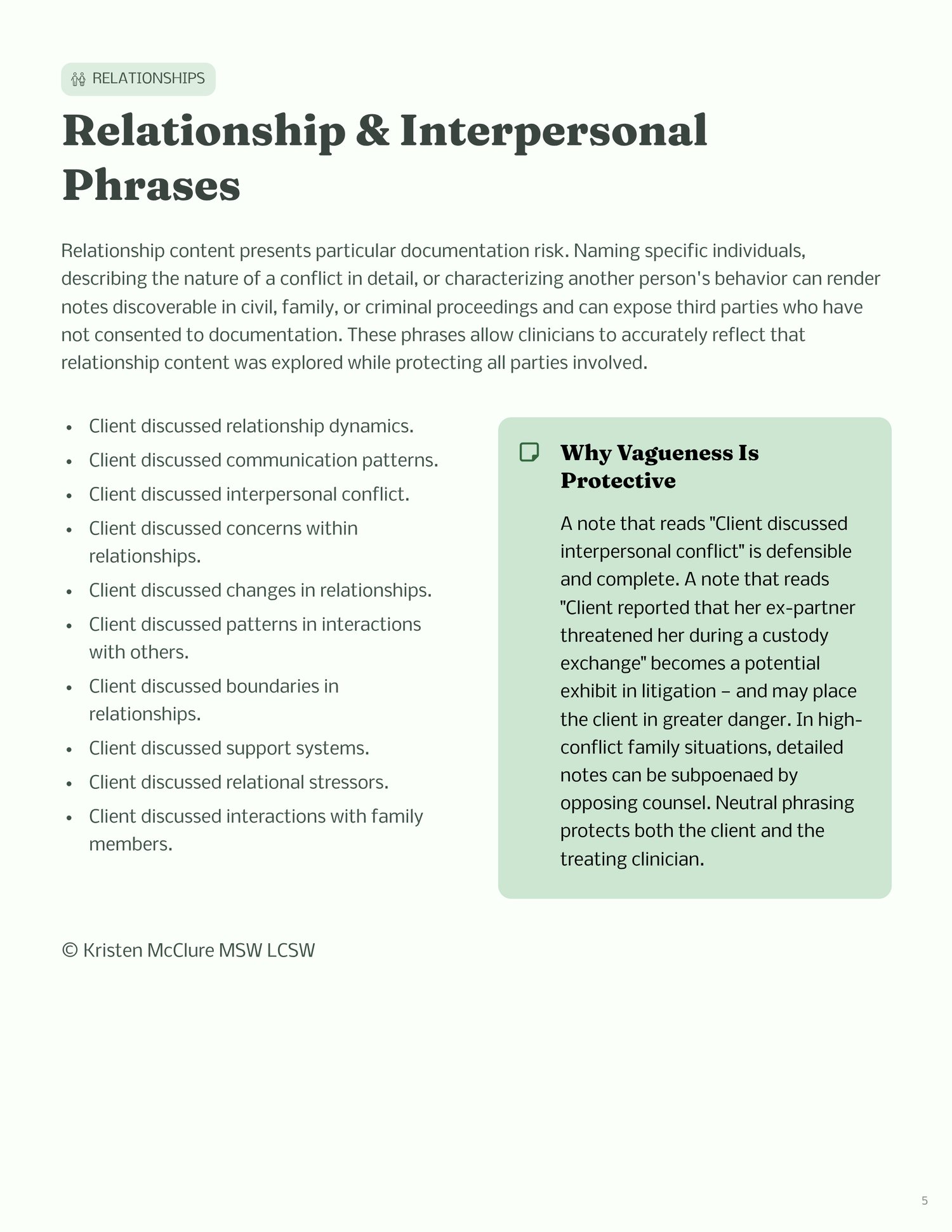
- Unnecessary identifying details
- Expanded narratives that are not clinically required
This increases risk for both the client and the clinician.
The Purpose of This Toolkit
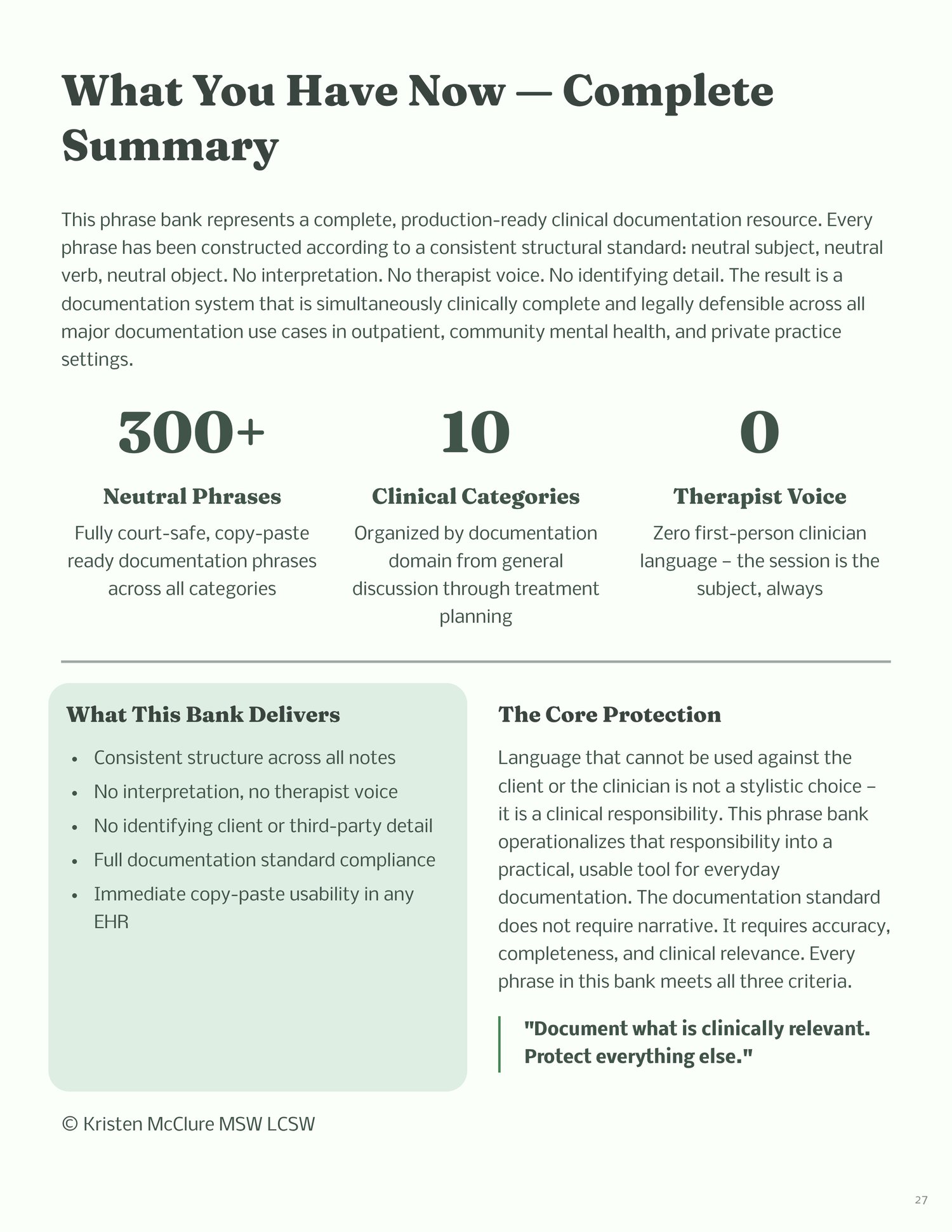
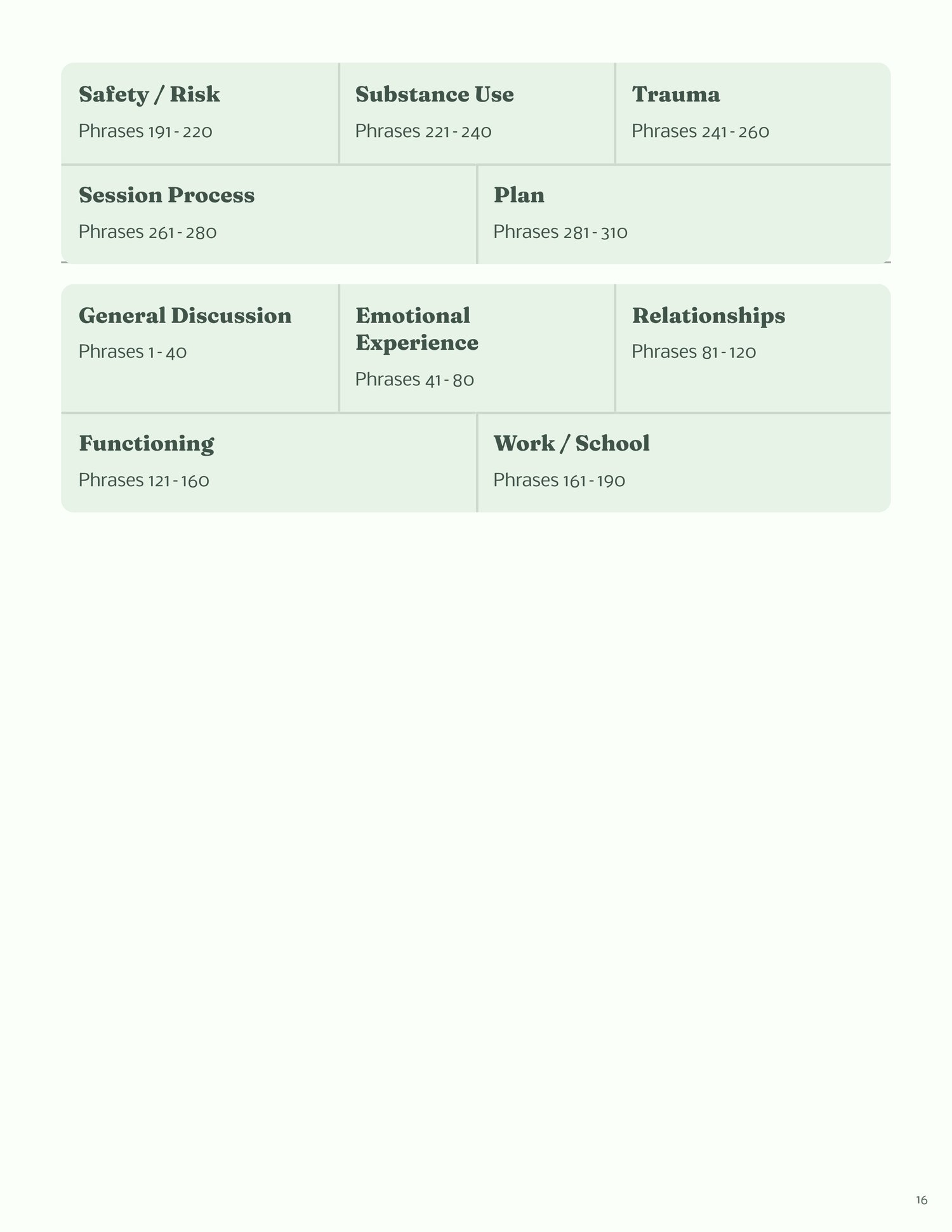
This phrase bank provides clear, neutral, and defensible documentation language that can be used across clinical settings.
The goal is not to reduce the quality of documentation.
The goal is to improve precision while minimizing risk.
Each phrase is designed to:
- Describe what was discussed without adding interpretation
- Avoid assumptions, conclusions, or diagnostic language beyond what is necessary
- Reduce identifiable or legally sensitive detail
- Maintain clinical relevance while protecting client privacy
Core Documentation Principle
Document what is clinically relevant.
Do not document more than is necessary.
Neutral documentation focuses on:
- What the client reported
- What was discussed in session
- Observable or stated experiences
- General domains of concern
It avoids:
- Speculation about motives or intent
- Definitive statements about other people
- Detailed narratives that are not required
- Language that could be interpreted as judgment
How to Use This Resource
This phrase bank is designed to be practical and flexible.
You can:
- Copy and paste phrases directly into your notes
- Use them to rewrite existing documentation
- Combine phrases to create concise, neutral summaries
- Use the patterns to build your own documentation language over time
These phrases are intentionally repetitive and structured.
This supports consistency, clarity, and ease of use in clinical settings.
Important Note
This resource is intended for licensed clinicians and supervised trainees.
It is an educational tool, not a substitute for clinical judgment, supervision, or legal consultation.
All documentation should be adapted based on:
- Clinical context
- Setting requirements
- Legal and ethical standards in your region
Bottom Line
Clear documentation is not about writing more.
It is about writing in a way that is accurate, neutral, and defensible.
This resource helps you do that consistently.