
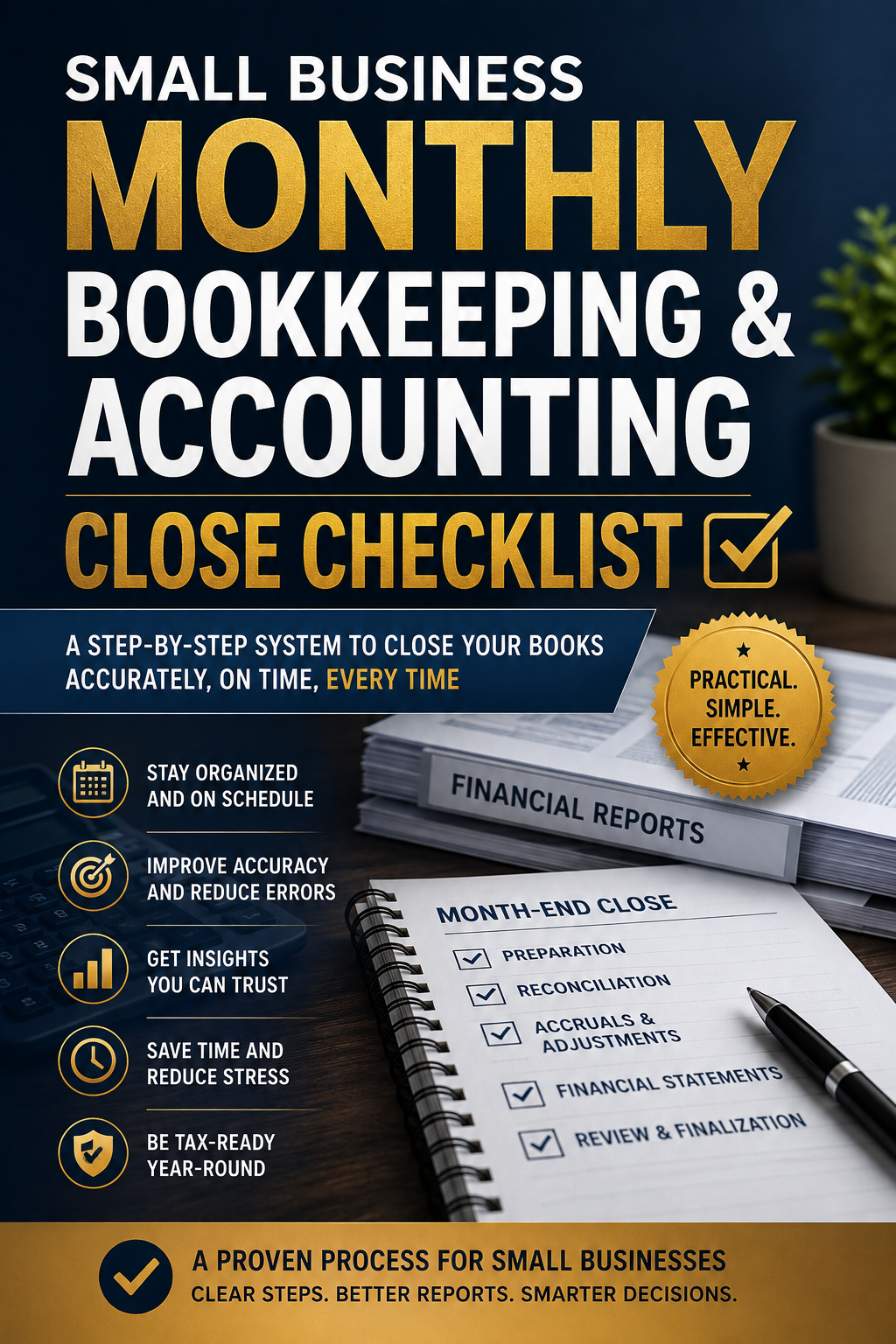
Monthly Bookkeeping Close Checklist for Small Business Owners Who Are Done With Chaotic Month-Ends
If your month-end close currently means chasing missing receipts, waiting on bank statements, and guessing whether your numbers are right, this monthly bookkeeping close checklist for small business owners was built for exactly that problem. It's a five-phase, day-by-day system that walks you from Day 1 preparation through to a fully reviewed and archived close, so a bookkeeping checklist template small business owners can actually stick to replaces the usual scramble. There's no accounting department assumed and no jargon you need a degree to follow — just a practical small business accounting close checklist you can start using on your very next close.
Most small businesses don't fail at month-end close because they lack accounting knowledge. They fail because the process has no structure. Invoices turn up late. Bank statements are still incomplete when someone tries to reconcile. Nobody remembers who was supposed to record last month's depreciation. This checklist exists to remove that guesswork by giving every task a specific phase, a specific day range, and a clear owner.
Why a Structured Month-End Close Matters
A disorganised close doesn't just cost time — it costs visibility. When your books aren't closed cleanly and quickly, you're making decisions about spending, hiring, and cash flow based on numbers that are weeks out of date. Errors that creep in during a rushed close tend to resurface at tax time, when they're far more expensive and stressful to fix. A documented, repeatable close process changes that. Financial reports arrive on time. Your team — even if that team is just you and a part-time bookkeeper — moves through the process with less friction. Tax preparation becomes a matter of handing over organised files rather than reconstructing a year from scattered receipts.
This checklist breaks the close into five distinct phases, each mapped to a rough window of days in the month following the one you're closing:
- Phase 1: Preparation (Days 1–3) — getting your systems, documents and team ready
- Phase 2: Reconciliation (Days 3–10) — matching accounts to external statements
- Phase 3: Accruals and Adjustments (Days 10–15) — recording what belongs in the month but hasn't been documented yet
- Phase 4: Financial Statements (Days 15–20) — generating and reviewing the trial balance, profit and loss statement, and balance sheet
- Phase 5: Review and Finalisation (Days 20–end) — management sign-off, documentation, and formally closing the period
What You'll Learn
- How to structure your close into five clear phases instead of one overwhelming task
- What to do on each day of the close, from Day 1 through the end of the month
- How to reconcile bank, credit card, loan, receivable and payable accounts properly
- The difference between accruals and adjustments — and how to record both correctly
- How to identify expenses and revenue that need to be accrued before you close
- How to build, review and sign off on a trial balance, profit and loss statement, and balance sheet
- How to calculate and interpret basic financial ratios like current ratio and gross profit margin
- How to document, archive and lock down each month so nothing gets lost or altered later
- How to plan accrual reversals so next month's numbers aren't distorted
What's Included
This is a complete written guide broken into five phases, each with its own detailed task list, timing guidance, success indicators and common pitfalls to avoid:
- Phase 1: Preparation tasks for Days 1–3, covering system checks, team availability, prior-month close notes and a formal kickoff meeting
- Phase 2: Reconciliation tasks for Days 3–10, covering bank accounts, credit cards, loans and lines of credit, accounts receivable, accounts payable, fixed assets and inventory
- Phase 3: Accruals and adjustments guidance for Days 10–15, including expense accruals, revenue accruals, depreciation, prepaid expense amortisation and allowance adjustments
- Phase 4: Financial statement preparation for Days 15–20, covering the unadjusted and adjusted trial balance, the profit and loss statement, and the balance sheet
- Phase 5: Review, management sign-off and archiving guidance for the final days of the month, including preparing statements for external reporting and locking the period
- A full printable master checklist pulling every single task from all five phases into one reference document you can use every month
- Common pitfalls listed for each phase, so you can spot problems before they cost you time or accuracy
A Closer Look at Each Phase
Phase 1: Preparation
Preparation is where most closes are won or lost before a single reconciliation begins. This phase covers verifying that your accounting system is functioning, confirming your team's availability during the close window, reviewing notes from the prior month's close, and holding a short kickoff meeting to assign responsibilities and deadlines. It also covers requesting bank statements, credit card statements and loan statements early, since delayed external statements are one of the most common bottlenecks in a small business close.
Phase 2: Reconciliation
Reconciliation is the backbone of an accurate close. This phase walks through comparing your accounting records to your official bank statement, identifying timing differences versus genuine errors, and reconciling credit card and loan statements. It also covers reconciling balance sheet accounts — accounts receivable against your aging report, accounts payable against vendor statements, fixed assets against your asset register, and inventory where applicable. Each reconciliation follows the same core process: compare, identify differences, investigate the cause, and record any adjusting entries needed.
Phase 3: Accruals and Adjustments
This is where cash-basis thinking and accrual-basis accounting most often collide for small business owners. The checklist explains the distinction clearly: accruals capture expenses incurred or revenue earned but not yet invoiced, while adjustments correct or update entries already recorded, such as depreciation or reclassifications. Guidance covers accruing payroll, professional services, insurance premiums and interest expense, as well as accruing unbilled client work and subscription revenue. It also covers standard adjustments like depreciation, prepaid expense amortisation, and reviewing your allowance for doubtful accounts.
Phase 4: Financial Statements
By this stage, reconciliations are complete and accruals are recorded, so your accounting system does much of the heavy lifting. This phase covers generating an unadjusted and then adjusted trial balance, verifying that debits equal credits, and producing your profit and loss statement and balance sheet. It walks through reviewing revenue and expense categories for reasonableness, calculating key metrics like gross profit margin and current ratio, and testing internal consistency — for example, confirming net income flows correctly into retained earnings.
Phase 5: Review and Finalisation
The final phase covers preparing statements for management review, documenting any questions raised and corrections made, and obtaining formal approval. It also covers compiling a complete close package for archiving, preparing documentation your accountant will need at tax time, and marking the period as closed in your accounting system to protect historical data from accidental changes. This phase closes the loop by having you document lessons learned, ready for a smoother close next month.
Why This Resource Works
The checklist works because it mirrors how a real close actually happens: in overlapping phases, not one long list. Preparation tasks are separated from reconciliation tasks, which are separated from accruals — so you're never trying to do everything at once. Each phase includes success indicators, letting you confirm you're on track before moving to the next stage rather than discovering a gap during Phase 4, when it's far more disruptive to fix.
It also acknowledges that most small businesses don't have a dedicated accounting department. Tasks are written for people juggling the close alongside other responsibilities, with plain guidance on assigning ownership, tracking deadlines and building a repeatable process month after month. Rather than assuming unlimited time and a full finance team, the checklist is designed around the reality of a business where one person — the owner, a part-time bookkeeper, or an office manager — is coordinating most of the work.
Who It's For
- Small business owners currently doing their own bookkeeping and closing their books each month
- Solo bookkeepers or part-time finance staff supporting one or more small businesses
- Office managers or admin staff who've inherited bookkeeping duties without formal training
- Anyone whose close routinely runs late, feels disorganised, or leaves them unsure the numbers are right
- Business owners preparing to hand a cleaner, more documented process to a bookkeeper or accountant
Frequently Asked Questions
How long should a small business month-end close actually take?
There's no single correct number, but the checklist is structured around a roughly 20-day timeline, split across five phases. Businesses following it consistently over a few months typically find the process compresses as they build familiarity with their own recurring accruals and reconciliation quirks. The goal isn't to hit an exact day count — it's to move through preparation, reconciliation, accruals, statements and review in a predictable order every time.
Do I need accounting software to use this checklist?
The checklist works alongside whatever system you already use, whether that's cloud accounting software or spreadsheets. It focuses on the process and tasks rather than any specific platform, so the steps apply regardless of what you're closing your books in.
What's the difference between an accrual and an adjustment?
An accrual records something incurred or earned but not yet invoiced, like a utility bill that hasn't arrived yet. An adjustment corrects or updates an existing entry, like recording depreciation or reclassifying a transaction into the right account. The checklist walks through both with practical examples for each, plus guidance on which accruals typically need to be reversed the following month.
Is this only for businesses with an in-house accounting team?
No — it's written specifically for small businesses without a dedicated accounting department, where one or two people are juggling the close alongside other work. The language and task breakdowns assume limited time and resources rather than a full finance function.
Will this help me prepare for tax season too?
Yes. A structured close keeps documentation organised as you go, which is exactly what your accountant needs at tax time — profit and loss statements, balance sheets, depreciation schedules, and clearly documented adjustments, rather than a scramble to reconstruct the year from scattered receipts and bank statements.
What happens if I find an error after I've already closed the period?
The checklist includes guidance on establishing a policy for post-close adjustments — who can approve them, what documentation is required, and how they're tracked — so occasional corrections don't compromise the integrity of your historical financial records.
Why Buy This Instead of Searching Online?
Free guidance on month-end close is scattered across blog posts, forum threads and software vendor pages, most written for finance teams at much larger companies with dedicated accounting departments and enterprise software. This checklist is written specifically for the small business context, organised into one document with a clear day-by-day structure, ready to follow or adapt without piecing together advice from a dozen different sources of varying quality. It's a small, one-off cost for hours of research and trial-and-error saved — and unlike a generic search result, every task is placed in the sequence it actually needs to happen.
Download Today
Get instant access to the full monthly bookkeeping close checklist and start using it on your very next close. It's a low-cost, one-time download — no subscription, no software to learn, just a practical system you can put to work immediately and reuse every single month.