
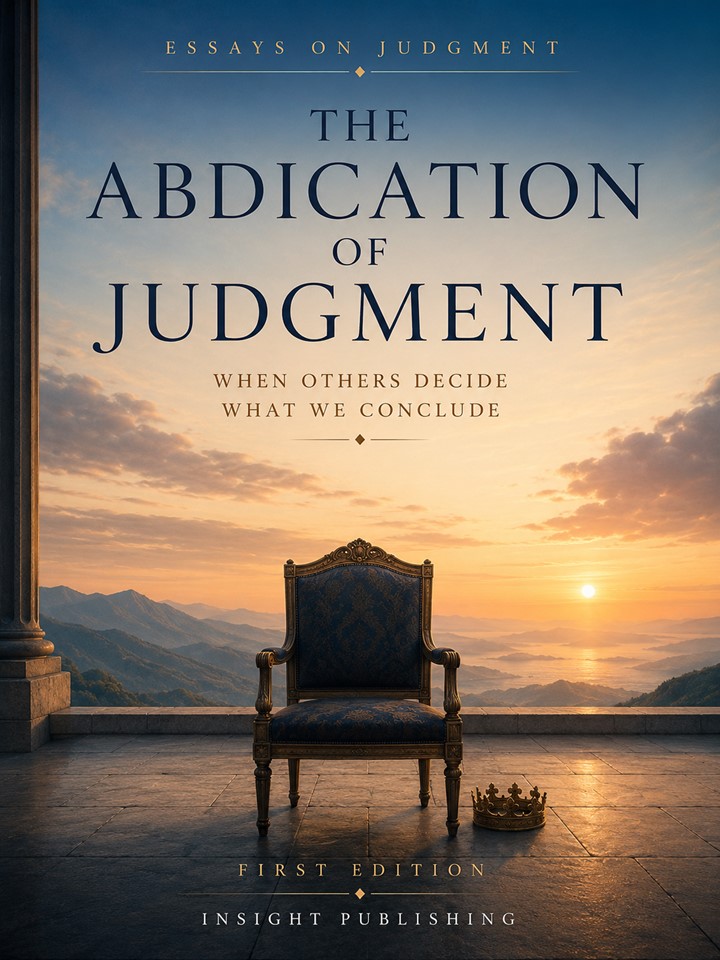
The Abdication of Judgment - When Others Decide What We Conclude - 1ed.
We live surrounded by conclusions.
Experts interpret events for us. Institutions establish positions. Algorithms decide what deserves our attention. Groups create consensus. Authority offers certainty. Speed rewards immediate reactions. And increasingly, conclusions arrive before we have had the opportunity—or taken the time—to form our own.
THE ABDICATION OF JUDGMENT is a philosophical exploration of what happens when we gradually surrender one of the most fundamental human responsibilities: the responsibility to judge for ourselves.
The book begins with the faculty of judgment itself. Before every decision, belief, position, or conclusion lies an act of interpretation. Reality presents circumstances, facts, events, and consequences, but reality does not tell us what we must conclude from them. Between what happens and what we decide it means, judgment occupies a space that cannot ultimately be eliminated.
Yet that space can be abandoned.
In Part I — The Faculty of Judgment, the book examines the architecture of judgment, the unavoidable presence of uncertainty, and the distinction between reality and the conclusions we construct from it.
Part II — The Quiet Abdication turns toward the subtle ways judgment can be surrendered. Borrowed certainty, dependence on authority, consensus without conviction, the outsourcing of conclusions, the attraction of simplicity, and the pressure of speed can gradually move judgment away from the individual. The abdication is rarely dramatic. More often, the chair simply becomes empty.
Part III — Reclaiming Judgment explores what it means to occupy that chair again. Doubt becomes not a weakness but an essential part of serious judgment. Suspending a conclusion becomes an act of intellectual discipline. Certainty reveals its limits. And the individual confronts the solitude that sometimes accompanies the responsibility to decide what one actually believes.
This is not a book arguing that expertise should be rejected, that authority should automatically be distrusted, or that every accepted conclusion must be challenged. We inevitably depend upon the knowledge and experience of others.
The deeper question is whether receiving someone else's judgment is the same as exercising our own.
THE ABDICATION OF JUDGMENT is ultimately an inquiry into intellectual responsibility: the responsibility to listen without surrendering, to doubt without becoming paralyzed, to trust without abandoning discernment, and to recognize that even when others provide the information, the interpretation, or the recommendation, there remains a chair that belongs to us.
The question is whether we are still willing to sit in it.
TABLE OF CONTENTS
PART I - THE FACULTY OF JUDGMENT
1. Before Every Decision - 19
2. The Architecture of Judgment - 27
3. Reality Does Not Produce Conclusions - 35
4. The Weight of Uncertainty - 45
5. Why Judgment Cannot Be Avoided - 53
PART II -THE QUIET ABDICATION
6. The Comfort of Borrowed Certainty – 63
7. Trust, Authority, and Dependence - 71
8. Consensus Without Conviction - 79
9. The Outsourcing of Conclusions - 87
10. The Seduction of Simplicity - 97
11. Speed Against Reflection - 103
12. The Empty Chair - 109
PART III - RECLAIMING JUDGMENT
13. The Place of Doubt - 119
14. The Courage to Suspend Conclusion - 125
15. The Solitude of Judgment - 133
16. The Limits of Certainty - 141
17. The Return to the Chair - 149
18. Final Reflection - The Crown We Choose to Wear – 157