

LawByLak — Topic 24: Access to Justice (OCR H418, Paper 1)
Access to Justice
The most examined topic in Section A, and the one where the numbers go out of date fastest.
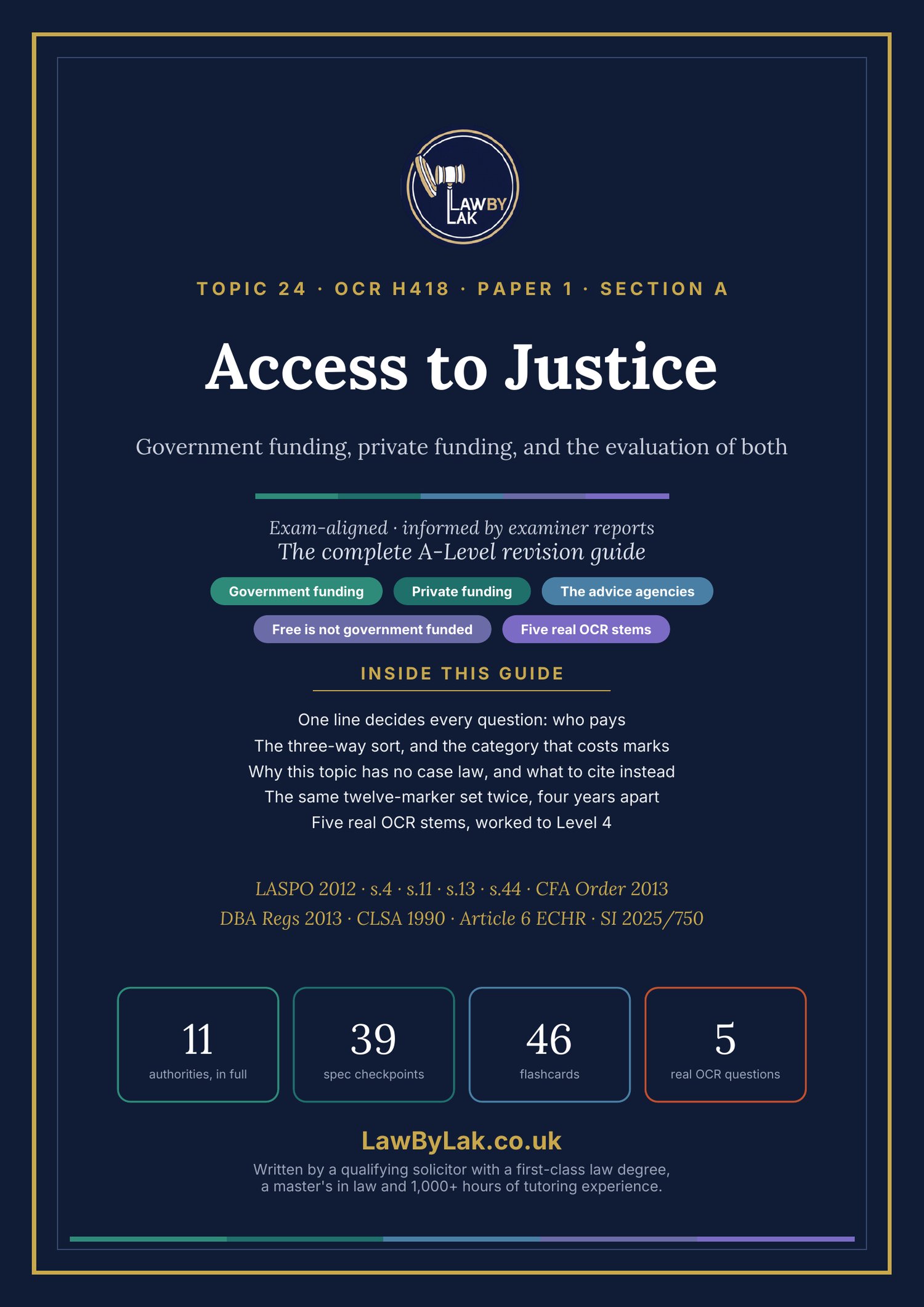
11 authorities · 16 funding bodies and advice agencies · 39 spec checkpoints · 46 flashcards · 20 glossary terms · 5 real past-paper questions across 4 of the last 5 sittings · every figure carrying its own date and status
Access to Justice has appeared in four of the last five sittings, and three of the five questions were 8-mark knowledge questions, so it rewards knowing the funding routes cold rather than only being able to argue about them.
There is no case law on this topic at all. Not one mark scheme, examiners’ report or guidance document names a case. What you cite instead is statute, and the guide is built around that.
What is inside
- The funding line end to end: civil legal aid, criminal legal aid, private funding and the advice sector, each with the statute that governs it and the test that decides eligibility.
- Both means tests, with the current thresholds and the date each one was last set, so you can see for yourself which figures have not moved since 2009.
- Conditional fee agreements and damages-based agreements, with the caps stated at the level the regulations actually set them and the scope limits most summaries drop.
- Every figure dated on its face. Each one carries its source, the date it was accurate, and whether it is current, historic, projected or unsourced, distinguished by border style as well as colour so it works if you cannot tell the two golds apart.
- The evaluation strand in full, with the impact of the legal aid changes as its own guidance bullet, and every argument built to carry a counter.
The correction that matters most
Two widely repeated claims about recent legal aid reform are wrong, and this guide shows why with the primary source in each case. One reform is regularly described as implemented when the government’s own operational manual shows it has not been. A 2025 statutory instrument is regularly described as delivering that reform when the minister’s own written statement describes it as temporary contingency legislation following a cyber incident. Both corrections make the evaluation stronger, because a reform announced, costed, delayed and still not arrived is better evidence about the system than a reform that landed.
What we will not pretend
Two figures could not be matched to an independent original and are marked unsourced where they appear rather than dressed up. One procedural rule could not be traced to an instrument at all, and the page says so. One of the five past papers is sample assessment material that was never actually sat, and it is labelled that way every time it is used.
LawByLak.co.uk