


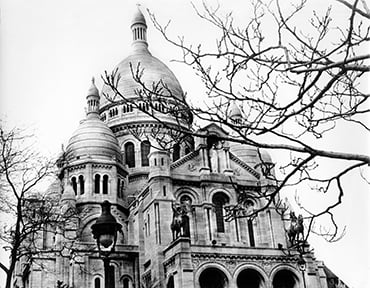
La Basilique de Sacre Coeur Paris France 1940's
La Basilique de Sacre Coeur Paris France 1940's
Free Digital Download
For Personal Usage Only
Usages of Image:
- Blogging
- Social Media Posts
- Education (No Selling, Commercial, Donating, or Giving Away is Not Allowed)
(Non-Commercial or Resale Not allowed)
IMAGE SIZE DETAILS BELOW:
All Images are JPEG
(S) Small Size Image JPEG
Image Size: 820.K
Pixel Size: 432 x 648px
Image Size 6 x 9 Inches
Resolution Size: 72
La Basilique de Sacre Coeur Paris France 1940's
La Basilique du Sacré-Cœur in Paris is a Roman Catholic church and minor basilica, located at the summit of Montmartre, offering one of the most iconic views of the city.
Here’s a glimpse of the Basilica of Sacré-Cœur in Paris during the 1940s.
My late grandfather photographed the La Basilique du Sacré-Cœur, Paris, France, in the late 1940s and then developed the negative in his darkroom, and I used the original negative to print this wonderful historic image.
🏛 Historical Context
- Construction and consecration: Built between 1875 and 1914, consecrated in 1919 after World War I.
- Symbolism: The basilica was intended as a spiritual response to France’s defeat in the Franco-Prussian War, symbolizing repentance and renewal.
- 1940s Paris: During the German occupation, Sacré-Cœur remained a prominent backdrop in photographs, sometimes showing soldiers and locals on its steps.
- Perpetual adoration: Since 1885, the basilica has maintained continuous Eucharistic adoration, even through the war years.
📸 Visual Records
- Vintage photography: Collections from the 1940s show Sacré-Cœur alongside other Parisian landmarks like Notre Dame and the Arc de Triomphe, often with vintage cars and wartime atmosphere.
- Occupation imagery: Some photos depict German soldiers at the basilica, highlighting its role as both a religious site and a cultural symbol during occupation.
- Artistic depictions: Painters and photographers of the era captured Sacré-Cœur in snow, at night illuminated, or as part of Montmartre’s bohemian charm.
✨ Why It Matters
Sacré-Cœur in the 1940s wasn’t just a church—it was a silent witness to wartime Paris, embodying both continuity of faith and the city’s layered history. Its white travertine dome overlooking Paris became a symbol of endurance during a turbulent decade.
Would you like me to dive deeper into wartime photographs of Sacré-Cœur, its role in occupied Paris, or artistic depictions from the 1940s?
The basilica, completed in 1914 and consecrated in 1919, stood as a striking landmark on Montmartre Hill throughout the wartime years, witnessing both occupation and resilience.
🏛 Key Facts
- Commissioned by Napoleon I in 1806 after his victory at Austerlitz.
- Architectural style: Neoclassicism, inspired by the Arch of Titus in Rome.
- Dimensions: 49.5 m (162 ft) high, 44.8 m (147 ft) wide, 22.2 m (73 ft) deep.
- Construction timeline: Began in 1806, halted during political upheavals, completed in 1836 under King Louis-Philippe.
- Location: Place Charles de Gaulle, at the intersection of the 8th, 16th, and 17th arrondissements.
🎨 Artistic Details
- Sculptural reliefs: Depict heroic French soldiers, mythological figures, and battle scenes.
- Engraved names: Generals and victories of the French armies are inscribed on its surfaces.
- Tomb of the Unknown Soldier: Beneath the vault lies the WWI memorial, with an eternal flame lit since 1923.
- Symbolism: Represents triumph, sacrifice, and national unity.
🌍 Cultural Significance
- Bastille Day parade: France’s annual July 14 military parade begins at the Arc.
- Tour de France: The world-famous cycling race finishes nearby on the Champs-Élysées.
- Historic axis: Forms part of the grand line of monuments stretching from the Louvre to La Défense.
- Global influence: Inspired similar arches worldwide, including in Mexico City and Pyongyang.