

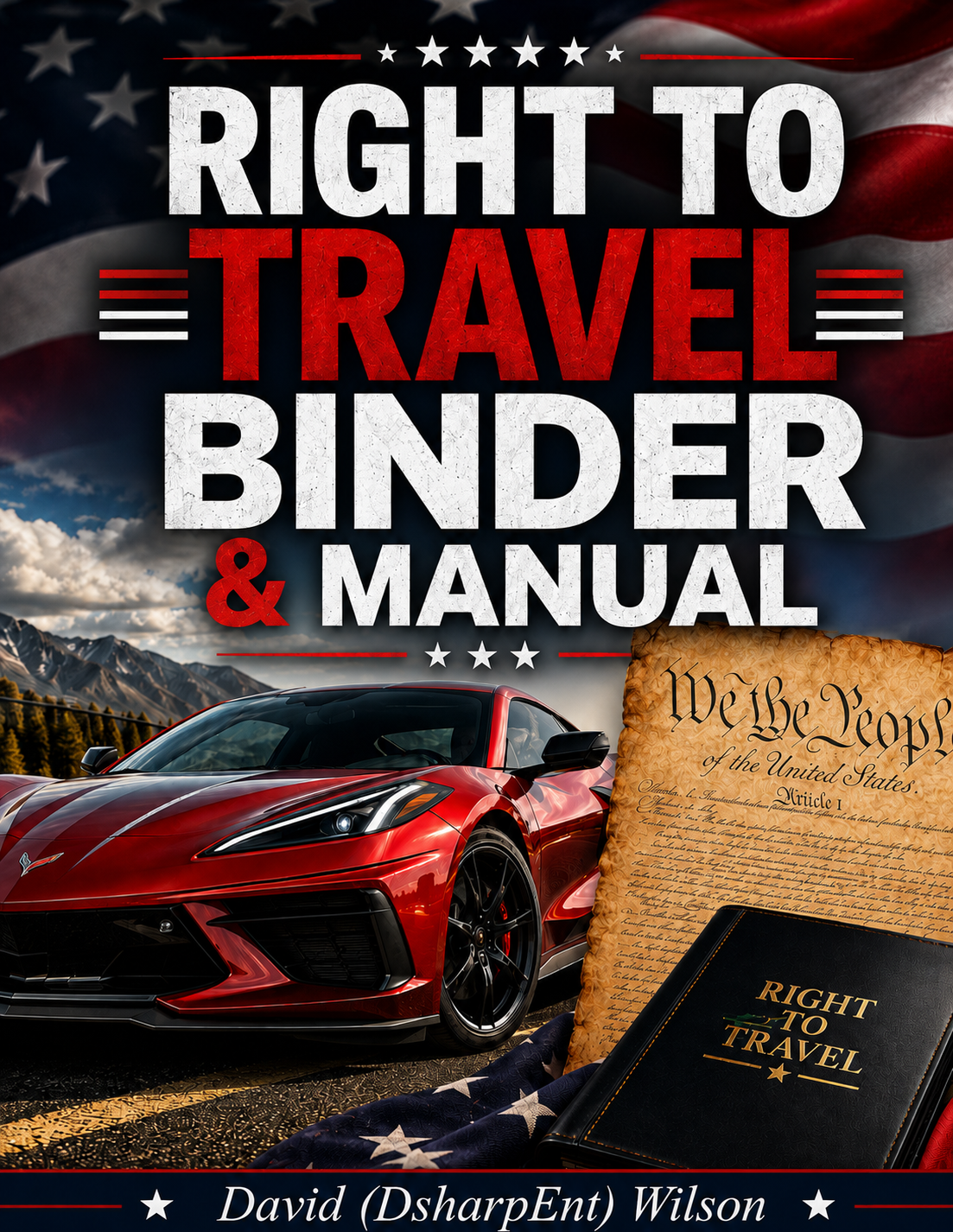


D Sharp's Right To Travel Manual & Binder
Everything you've been told about the right to travel, checked against the actual law — plus the complete court record to prove the work.
The right to travel is real. Almost everything circulating about it online is not.
If you've spent any time in this space, you already know the pattern. Somebody's cousin's video. A PDF passed around a group chat. A phrase that supposedly ends a traffic stop. Definitions pulled out of a commercial motor-carrier regulation and dropped into a state criminal statute where they don't belong. And underneath all of it, the same promise: that the right words, said in the right order, make the law stop applying to you.
They don't. And people are finding that out on the side of the road, in impound lots, and in courtrooms — after it's too late to prepare.
This manual is the other version.
Every constitutional provision, statute, regulation, and case in it was verified against the primary source. Not summarized from somebody else's summary. Checked. Hendrick v. Maryland. Kane v. New Jersey. Saenz v. Roe. Whren. Prouse. Rodriguez. Gant. Atwater. Bell v. Burson — and what came after Bell that almost nobody mentions. The Massachusetts free-exercise provisions, cited separately and correctly. The Michigan marijuana-odor decisions, including People v. Wilkins, decided July 22, 2026, and already in these pages.
There is a complete Table of Authorities in the back. Check every single one.
It will tell you what you don't want to hear.
That "I was traveling, not driving" is not a legal argument. That a UCC filing does not suspend a motor-vehicle statute. That mailing a notice does not create an exemption, and that government silence is not government consent. That a binder is evidence, not an injunction. That a passport card is not a driver's license, and telling an officer otherwise helps nobody.
It also explains — with citations — where the government's authority actually stops. What a traffic stop legally is. When a search is unlawful. When a stop has run too long. What due process genuinely requires. And how a sincere religious objection has to be framed to survive contact with a court.
Then it shows the receipts.
Section 8 is the complete court record from my own Massachusetts case: the notices mailed before the stop, the sworn affidavits, the motions, the exhibits, the authorities, the opposing papers. Reproduced as filed.
Not excerpts. Not a summary. The record.
Read it and count the filings. Look at the dates and see how much was built before anything happened on the roadside. That is the honest picture of what this costs in preparation — and it is a better answer than anything I could tell you.
Who this is for
The person who has heard the slogans and wants to know what is underneath them. The person who tried something and got burned. The researcher, the paralegal, the practitioner who keeps encountering these arguments and has no accurate reference to hand anyone. And the careful person standing at the edge of this decision who wants the real cost laid out before committing to it.
Who this is not for
Anyone looking for a magic phrase. Anyone trying to escape a consequence they earned. Anyone who wants to be told the law does not apply to them.
Inside
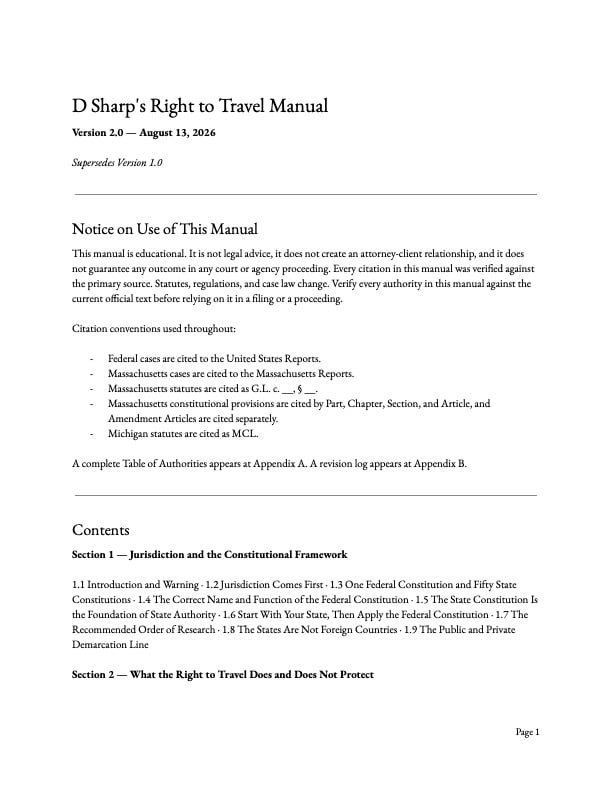
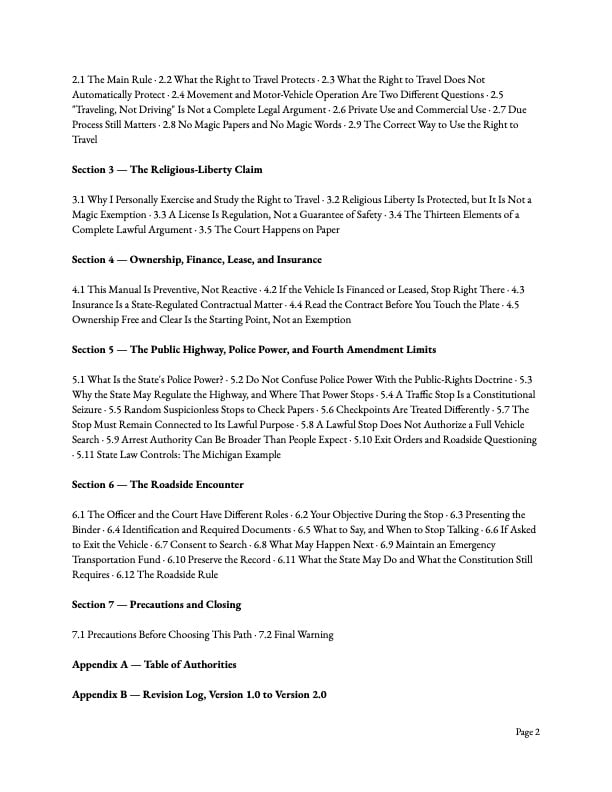
- Eight sections and two appendices, fully cross-referenced
- A complete, verified Table of Authorities
- The master research framework — how to build your foundation in the correct order, starting with your own state
- The thirteen elements of a properly framed constitutional argument
- The public-highway and Fourth Amendment analysis, cited throughout
- The religious-liberty claim under current federal doctrine, including where the general rule breaks down
- Ownership, finance, lease, and insurance — what a contract does to a constitutional position
- The roadside encounter, start to finish
- The complete court record
Important Notice
This manual is provided for educational and informational purposes only.
It is not legal advice. It does not create an attorney-client relationship. No outcome is promised and no guarantee of any kind is made or implied. Nothing in this manual guarantees that you will not be stopped, cited, arrested, prosecuted, fined, have your vehicle towed, or face incarceration.
The court record reproduced in Section 8 reflects one case, in one court, in one state, on one specific set of facts and one individual's sincerely held religious belief. It creates no precedent, it is not a template, and it is not a formula. A different judge could have ruled differently on identical papers.
Laws differ by state and change over time. Verify every authority against the current official text before relying on it.
What the reader chooses to do with this information is entirely at their own discretion. The author accepts no liability and makes no promises. This manual provides an in-depth, real-time explanation of the right to travel, and nothing more.