











MDR Suspension Survival Kit
MDR & Suspension Survival Kit
What to Do Before the School Decides Your Child's Future Without You
Your child was suspended.
Now the school is talking about an MDR meeting, a behavior plan, a placement change, or even recommending a more restrictive setting.
You have questions.
The school has a team.
And suddenly you're expected to make decisions that could impact your child's education for years.
That's exactly why the MDR & Suspension Survival Kit™ was created.
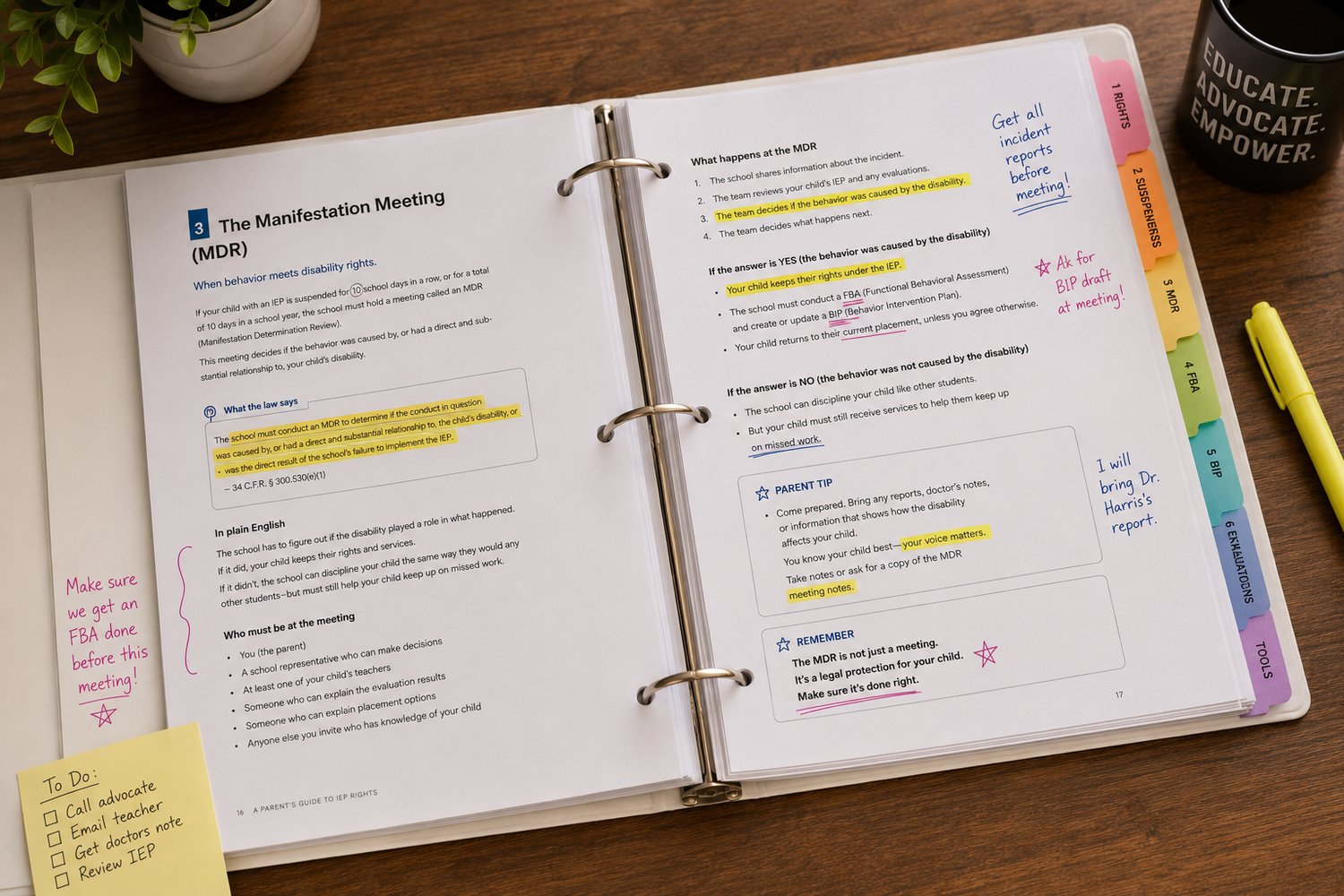
This step-by-step parent advocacy toolkit helps you understand what is happening, what your rights are, what the school is required to consider, and what questions to ask before important decisions are made.
Because when your child is facing suspension, disciplinary removals, Manifestation Determination Reviews (MDRs), Functional Behavioral Assessments (FBAs), or Behavior Intervention Plans (BIPs), confusion can be expensive.
And waiting until after the meeting is often too late.
If Any of This Sounds Familiar...
✅ Your child was suspended and nobody explained what happens next.
✅ The school scheduled an MDR meeting and you're not sure what it is.
✅ You're worried your child's disability isn't being considered.
✅ You feel pressured to agree to decisions on the spot.
✅ You've been told your child may need a different placement.
✅ You keep hearing terms like FBA, BIP, manifestation, disciplinary change of placement, and have no idea what they actually mean.
✅ You leave meetings feeling overwhelmed, emotional, and unsure if the school followed the law.
If that's you, this kit was built for you.
What You'll Learn Inside
Understand MDR Meetings in Plain English
No legal jargon. No confusing regulations.
Learn what a Manifestation Determination Review is, why it matters, and what the team must consider before certain disciplinary actions move forward.
Know Your Rights Before the Meeting
Understand the protections available to students with disabilities and the questions parents should be asking when disciplinary actions are being discussed.
Navigate Suspensions With Confidence
Learn what information to gather, what documents to request, and how to stay organized when emotions are running high.
Understand FBAs and BIPs
Many parents hear these terms for the first time during a crisis.
You'll learn what they are, why they're important, and how they connect to behavior support planning.
Use Ready-to-Go Parent Scripts
Know what to say when:
- You disagree with a decision
- You need clarification
- You want documentation
- You need time to review information
- You feel pressured to sign or agree immediately
Walk Into Meetings Prepared
Instead of wondering what might happen, you'll know what questions to ask, what documents to bring, and what to watch for during the discussion.
Why Parents Are Getting This Now
Across the country, families are reporting increased concerns around:
- School discipline
- Student behavior supports
- Frequent suspensions
- Placement discussions
- Lack of communication during disciplinary processes
Many parents don't start researching MDRs until after the meeting has already happened.
By then, important decisions may already be in motion.
The MDR & Suspension Survival Kit helps you prepare before you're sitting at that table.
Created for Real Parents, Not Lawyers
This isn't a law textbook.
This isn't a 200-page special education manual.
This is a practical, parent-friendly resource designed to help you quickly understand:
✔ What's happening
✔ What questions to ask
✔ What documents matter
✔ What are your next steps
✔ How to advocate effectively without feeling intimidated
The Cost of Waiting
Most parents never expect to need an MDR guide.
Until they get the phone call.
Until the suspension notice arrives.
Until a meeting suddenly appears on the calendar.
When that happens, parents often have days—not months—to prepare.
Having this toolkit before the next meeting can help you walk in informed instead of overwhelmed.
MDR & Suspension Survival Kit
For parents of students with IEPs, 504 Plans, and disability-related behavioral challenges who want to understand the process, protect their child's educational rights, and confidently navigate school discipline decisions.
Because when everyone else in the room understands the process, parents deserve that same advantage too.