
Freelance Time Audit & Billable Hours Tracker
Most freelancers lose money to hours they never bill: the meeting that ran long, the revision round that took an afternoon, the admin nobody counts. This tracker captures every hour — billable and non-billable — and turns the log into three numbers that matter: your utilisation rate, your real effective hourly rate, and the value of the hours you never invoiced.
What you get: An XLSX workbook with 5 sheets: Start Here (how to use the tracker, a worked example, and the three rules that keep the audit honest); Time Log (one row per work session, logged the same day: date, client, project, task, work type, billable or non-billable, hours, and your rate; amount is formula-driven, hours x rate for billable work, 0 for non-billable; mark whether each billable row has been invoiced); Weekly Summary (one row per week, Monday start: billable hours, non-billable hours, total hours, utilisation % and billable value are all formula-driven from the Time Log); Client & Project Audit (one row per project: your estimated hours against the actual hours the log shows; overrun %, billable hours, revenue and effective hourly are formula-driven, with a Watch / Renegotiate / On track status); Dashboard (total hours, utilisation, effective hourly rate across all hours, the hidden cost of non-billable time valued at your average billable rate, unbilled billable value, hours by work type, and per-project overrun).
Why it matters: Research on freelance time tracking keeps finding the same leaks: most freelancers underestimate how long work actually takes, forget to log the non-billable work that erodes their effective rate, and take on projects that sound like two hours but cost ten. Manual timesheets are error-prone, and entries made days later capture far less billable time than same-day entries. The fix is not working more — it is tracking better: if you bill 20 hours a week but spend 10 more on unbillable admin, your effective rate is a third lower than your stated rate, and you will never see it unless the non-billable hours are in the log. This tracker makes the leak visible in one week.
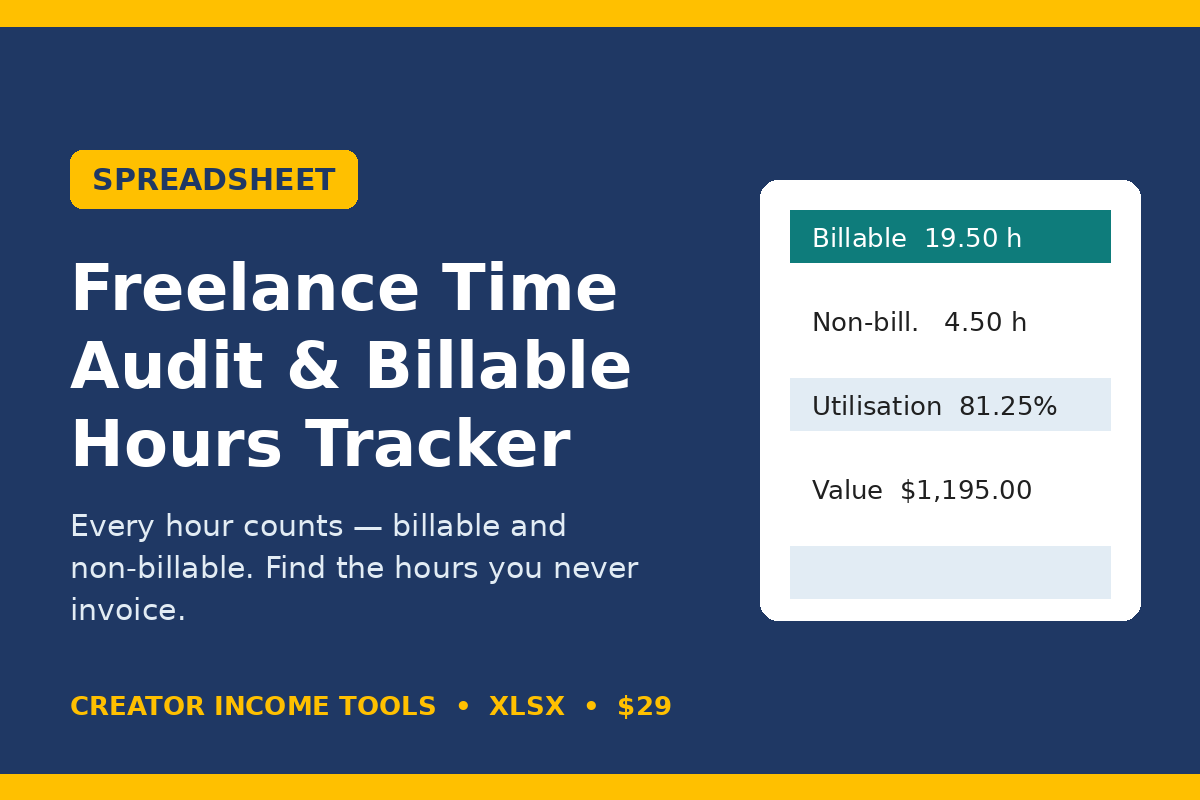
Worked example included: Time Log (10 rows, week of 2 Nov 2026): billable 19.50 hours, non-billable 4.50 hours, total 24.00 hours, utilisation 81.25%, billable value $1,195.00, effective hourly across all hours $49.79, average billable rate $61.28, hidden cost of non-billable time $275.77, unbilled billable value $30.00 (Gamma Shop extra revisions, never invoiced). Client & Project Audit: Acme Blog / Blog posts estimated 4.0 vs actual 5.0 = 25.00% over, $375.00 at $75.00/hr. Beta SaaS / Onboarding emails estimated 3.0 vs actual 4.5 = 50.00% over, $270.00 at $60.00/hr. Gamma Shop / Product descriptions estimated 3.0 vs actual 5.0 = 66.67% over, $150.00 at $30.00/hr. Delta Studio / Landing page estimated 5.0 vs actual 5.0 = 0.00% over, $400.00 at $80.00/hr. Hours by work type: Client work 12.50, Revisions 7.00, Admin 2.50, Marketing 2.00, Learning 0.00. Delete the example rows when you start.
Details: Format: XLSX spreadsheet, ready to use in Excel or Google Sheets. Price: $29 USD. Refund: 14 days, as with the rest of the Creator Income Tools line. Note: this tracker organises figures you enter. It does not give tax or legal advice, it does not guarantee sales or rate increases, and it does not log in to any shop, email or social account.