

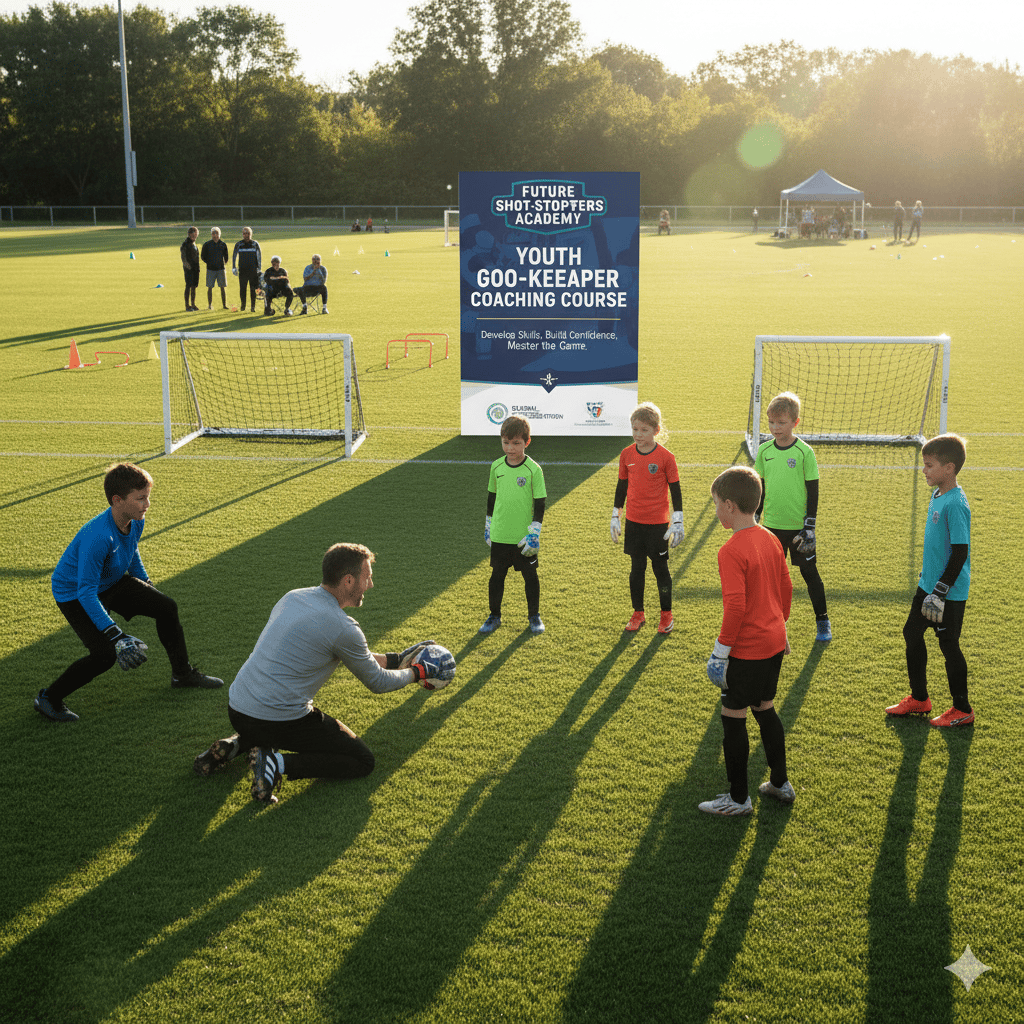
Grassroots Football Goalkeeper Coach Course
Course Objective
The primary objective of the "Grassroots Goalkeeper Coach Course" is to train integral educators who can implement a long-term developmental and pedagogical methodology for young goalkeepers.
This involves:
- Prioritizing the psychological and technical process over immediate match results.
- Developing the goalkeeper's technical and tactical fundamentals (PADE principle) in a contextualized, game-like environment.
- Ensuring the goalkeeper is physically prepared through neuromotor development and injury prevention programs adapted to their age.
In essence, the course aims to prepare coaches to effectively mentor, guide, and develop the goalkeeper's brain, body, and confidence from the formative stages onward.
Who can purchase the course? The content is designed for the general public, including enthusiasts and goalkeeper coaches who wish to learn new tools for practical application in their training sessions."
Grassroots Football Goalkeeper Coach Course
Module 1: The Profile and Environment of the Grassroots Goalkeeper
1.1 The Grassroots Goalkeeper Coach
Explanatory Conceptualization
The Grassroots Goalkeeper Coach is not merely a technical instructor but an integral educator and a sports pedagogue. Their main mission is to maximize the young goalkeeper's long-term potential, always prioritizing emotional and physical well-being.
- Key Roles: Technical-Tactical, Physical (Injury Prevention), Psychological (Resilience & Confidence), and Pedagogical (using play).
- Contrast with High Performance: The focus is on long-term integral development and variability over immediate results and specificity.
1.2 Characteristics of the Goalkeeper in Formative Stages
Explanatory Conceptualization
Training must be sequential and adapted to biological and cognitive maturation. The coach must be an "age analyst."
- Physical Priorities: Coordination and Agility are paramount in the initial stage, followed by Reaction Speed and age-appropriate Explosive Strength.
- Psychological Priorities: Developing Bravery, Concentration/Attention, and Leadership/Communication skills.
- Development Stages:
- Initiation (5-9 yrs): Playful focus, basic catching, no forced specialization.
- Formation (10-13 yrs): Acquiring correct technique (blocking, falling) and basic tactical concepts.
- Refinement (14-17 yrs): High specialization, complex tactics (area management, playing with feet), and specific fitness.
Module 2: Goalkeeper Technical Fundamentals
The module details essential technical movements for clean, safe, and efficient execution.
2.1 Basic Technique and Movements
- The Base Position (Ready Stance): Knees semi-bent, low center of gravity, hands open at hip height, weight on the balls of the feet.
- Specific Movements: Adjustment Step (Crescent Technique) for short, quick positioning without crossing the legs, and the T- or Crossover Run for covering large lateral distances.
2.2 Catching, Deflections, and Clearances
- Catching (Blocking): The primary goal. Low Catch (The "Basket" – feet and knees together) and Mid/High Catch (The "W" or "Diamond" technique – thumbs and index fingers forming a frame).
- Diving/Falling: Lateral Dive technique focusing on guiding the body with the arm closest to the ball and minimizing hip/shoulder impact.
- Deflections: Use an Open Palm to guide the ball over the bar or to the sides when catching is impossible.
2.3 Aerial Play and the One-vs-One
- Aerial Crosses (Depth Control): Requires perfect Timing and a clear Call ("Mine!"), focusing on finding the highest point of contact.
- One-vs-One Situations (Angle Reduction): "Attacking the Ball" by actively reducing the attacker's space (cutting the angle). Focus on the Block and Deflection technique (low body, wide hands/feet).
- Playing with the Feet (The Goalkeeper-Player): Oriented Control and effective Distribution (safety passes vs. penetrating passes/long drop kicks) to initiate the attack.
Module 3: Tactical Fundamentals and Training Methodology
Focuses on the goalkeeper's decision-making and structuring training to simulate game reality.
3.1 The Goalkeeper's Cognitive Tactics (Decision-Making)
Training the brain to operate under the Perception-Analysis-Decision-Execution (PADE) principle.
- Dynamic Positioning: Understanding the Imaginary Arc Concept and actively cutting the angle based on the ball's position.
- Communication: Specific, preventative commands to the defense. Leadership Through Error by reorganizing without assigning blame.
3.2 Global Methodology for Grassroots Football
- Integrated Method: Technique is practiced within game-like tasks (Global Contextualized) to incorporate tactical, physical, and psychological elements simultaneously.
- Reflective Feedback: The coach uses post-action questions to foster autonomy: "Why did you make that decision?" (Instead of telling them what to do).
Module 4: Applied Physical Preparation and Psychology
Focuses on the goalkeeper's body (injury prevention) and mind (resilience).
4.1 Specific Physical Preparation and Injury Prevention
- Basic Motor Skills (BMS): The foundation. Training emphasizes Locomotion (running, galloping), Manipulation (catching, throwing), and Stability (balance, rolling).
- Specific Work: Prioritizing Coordination, Agility (ladder, COD drills), and Core Stability to support jumping and safe falling.
- Prevention: Teaching proper Fall Cushioning technique and using light exercises for Grip/Wrist Strength.
4.2 Applied Psychology and Resilience
- Error Management: Training the "Reset Chip" (Mental Switch) using simple techniques (like self-talk or breathing) to move past a mistake immediately.
- Concentration: Drills to maintain focus during long periods of inactivity (simulating game flow).
- Emotional Leadership: Teaching the goalkeeper to project calmness and confidence through their body language after an error.
Module 5: Coach Tools and Performance Analysis
Focuses on tools for continuous improvement and process documentation.
5.1 Performance Analysis and Formative Evaluation
- Formative Evaluation: Using Process Metrics over result metrics. Key metric: Correct Decision Index (CDI) to evaluate tactical choices.
- Video Analysis: Using basic tools (smartphones) for Self-Correction Sessions, where the goalkeeper analyzes their own performance with coach guidance.
5.2 Task Design and Resource Management
- Task Design: Using simple digital tools to diagram exercises.
- Microcycle: Applying the Variability Principle to modify existing drills.
- Integration: Coordinating specific GK work with the main team's system (e.g., long exits if the team plays with a high line).
Improved Promotional English Content:
Headline Option 1 (Focus on Value):
ENROLL TODAY & RECEIVE:
- FREE Goalkeeper Coaching Guide (Your essential resource!)
- <h3>LIFETIME ACCESS to all course materials</h3>
- Official Certificate of Participation (A valuable credential for your CV)