

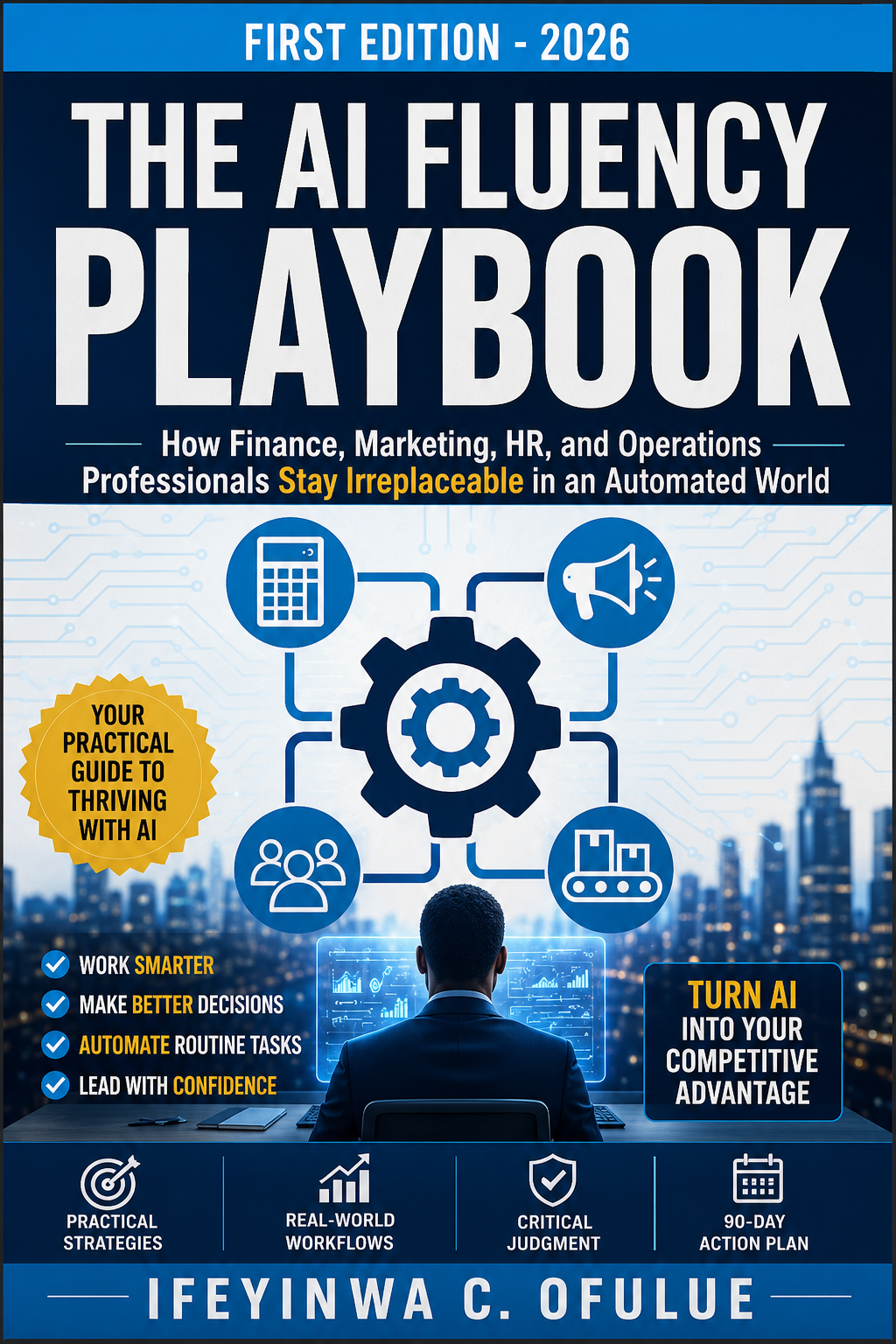
THE AI FLUENCY PLAYBOOK
THE AI FLUENCY PLAYBOOK: How Finance, Marketing, HR, and Operations Professionals Stay Irreplaceable in an Automated World
By Ifeyinwa C. Ofulue - First Edition, 2026
Somewhere in the last two years, a meeting happened at your company where someone said the word "AI," and everyone nodded - and you nodded too, privately wondering whether anyone in the room actually understood what was being decided.
Here is the truth that twenty years of coaching professionals through technology transitions reveals: the people who sound most confident about AI in corporate meetings are frequently the ones who have used it least on real work. And the people who feel most anxious - the experienced finance manager, the marketing lead with fifteen years of campaigns behind her, the HR business partner who knows how the organisation really works - are precisely the people best positioned to extract real value from these tools.
That is not motivational flattery. It is a structural fact about how this technology works. AI does not compete with expertise. It amplifies whatever it is pointed at. Pointed at by a novice, it produces plausible mediocrity at incredible speed. Pointed at by an expert, it produces expert-level work at incredible speed. The scarce skill of the next decade is not building AI - it is being the expert worth amplifying.
This book teaches you to become that expert - without writing a single line of code.
WHAT IS INSIDE
The book is organised as a progressive playbook across four parts and fifteen chapters, each ending in a concrete deliverable, so that finishing the book means finishing the work.
Part One: The New Reality begins by naming the anxiety honestly and dismantling it. Chapter 1 addresses the three fears head-on - that younger, tech-native colleagues will pass you by; that AI will simply do your job cheaper; and that your first underwhelming attempt with ChatGPT proved the whole thing is overhyped - and shows why each is either wrong or fixable. Chapter 2 delivers the only technical explanation you will ever need: what a large language model actually is, in plain language, with a ten-term vocabulary that lets you follow any meeting and see through any vendor pitch. It maps what AI is genuinely good at (transforming, drafting, brainstorming, explaining, pattern-spotting) and genuinely bad at (recent facts, arithmetic in prose, knowing what it doesn't know, your company's politics, and accountability - which remains permanently human). Chapter 3 then makes the book's central argument: your ten to twenty-five years of experience give you three compounding advantages - you know what to ask, you know what wrong looks like, and you know what to do with the answer and introduces the four-layer Fluency Stack the rest of the book climbs.
Part Two: Core Fluency Skills is the craft section. Chapter 4 teaches prompting as what it actually is - delegation, a skill you already have through the BRIEF framework (Background, Role, Instruction, Examples and Exclusions, Format), complete with before/after prompt examples, five iteration moves including the powerful "make the AI interview you first" technique, and the five prompting mistakes smart people make. Chapter 5 covers context: what to feed the AI (source documents, gold-standard examples, definitions, constraints, audience), how to build a reusable personal context block, where the confidentiality lines sit, and the three-rung Context Ladder for matching effort to stakes. Chapter 6 delivers the Four-Question Quality Filter - is every checkable fact checked, does it survive my smell test, is anything important missing, would I defend this in the room - plus trust calibration by task type and techniques that raise baseline quality, like demanding shown reasoning and cross-examining high-stakes output across tools. Chapter 7 converts it all into workflows: the 30-minute task audit, the four-part routine structure, and a realistic week-one schedule that has professionals reclaiming 3-5 hours by week two.
Part Three: AI in Your Domain gives each profession its own chapter, with five concrete workflows apiece. Finance (Chapter 8): variance commentary in minutes, board narrative drafting, contract interrogation with page citations, Excel and query co-piloting, and scenario pre-mortems - governed by the Iron Rule that language models narrate while spreadsheets calculate. Marketing (Chapter 9): the voice-locked content engine, audience mining from raw customer verbatims, campaign concepting at volume, the pre-launch red team, and performance narratives written in CFO language. HR (Chapter 10): outcome-based job descriptions with bias audits, engagement survey synthesis, the difficult-conversation rehearsal room, policy triple-drafting, and structured interview kits - with an unmovable line: AI never decides who gets hired, promoted, or let go. Operations (Chapter 11): SOPs extracted from tribal knowledge, incident reports with evidence-versus-hypothesis labelling, vendor document interrogation, three-audience project communications from one source of truth, and the pre-mortem engine.
Part Four: Becoming Irreplaceable converts private productivity into public position. Chapter 12 names the five judgment muscles that do not automate - problem selection, framing, calibration, taste, and accountability with deliberate practices for strengthening each. Chapter 13 lays out the five moves to claim the unclaimed role of your department's AI leader: build receipts, demonstrate rather than advocate, write the two-page playbook, volunteer for the boundary work, and mentor in both directions - plus the positioning trap to avoid. Chapter 14 covers ethics and risk across four domains (confidentiality, accuracy, bias, transparency) and, crucially, when not to use AI at all. Chapter 15 sequences everything into the 90-Day AI Fluency Plan: thirty days of private fluency, thirty of domain depth, thirty of public position - ending with the conversation where you tell your manager you want a seat at the table.
The appendices include a prompt library of forty ready-to-adapt templates (ten each for finance, marketing, HR, and operations), a tool directory organised by category so it outlasts product-name churn, and a plain-English glossary of every AI term you will encounter in a meeting.
HOW YOU WILL LEARN
Every chapter follows the same discipline: name the real problem, teach the framework, show it working through stories from the field - the controller who now "thinks during close instead of typing," the HR partner who rehearsed sixty difficult conversations before notification day, the supply chain manager whose two-page playbook became a new job title - and end with a deliverable. The book's exercises are designed to be done on your real work, in time you already spend, not as homework stacked on top of your job. By Chapter 7 you will have measurable hours reclaimed; by Chapter 15 you will have receipts, a playbook, and a position.
WHO THIS BOOK IS FOR
This book is written for experienced professionals in finance, marketing, human resources, and operations - typically 35 to 55 years old, ten to twenty-five years into their careers - who have deep domain expertise but no technical background, feel a quiet anxiety about being left behind, and are tired of AI content that is either breathless hype or impenetrable jargon. It is for the FP&A manager, the brand director, the HR business partner, the supply chain lead - anyone whose expertise is real and whose confidence with these tools has not yet caught up to it.
No coding is required anywhere in this book. No mathematics. No prior AI experience beyond, perhaps, one underwhelming attempt at ChatGPT - which Chapter 1 explains and Chapter 4 fixes.
WHAT THE READER NEEDS TO KNOW
The frameworks in this book - BRIEF, the Context Ladder, the Four-Question Filter, the Fluency Stack, the 90-Day Plan - are tool-agnostic and durable. They work with ChatGPT, Claude, Gemini, Microsoft Copilot, and whatever your company sanctions, and they will keep working as the products change, because they are built on how the technology fundamentally behaves rather than on any interface. AI tools evolve rapidly; specific product details reflect the landscape as of 2026, and the book teaches you to evaluate new tools yourself rather than depend on anyone's outdated screenshots.
The book is honest about limits. It covers hallucination without euphemism, draws hard lines around confidential and regulated data, states plainly where AI must never decide (people decisions in HR, numbers in finance, safety-critical procedures in operations), and devotes a full chapter to when not to use AI at all. The goal is not enthusiasm. It is trust - yours in the tools, and your organisation's in you.
AT A GLANCE
- 15 chapters across 4 parts, each ending in a concrete deliverable
- The BRIEF prompting framework, the Four-Question Quality Filter, and the four-layer Fluency Stack
- Dedicated domain chapters for finance, marketing, HR, and operations - five workflows each
- 40 ready-to-use prompt templates, a tool directory, and a plain-English glossary
- The 90-Day AI Fluency Plan: private fluency → domain depth → public position
- No code, no math, no hype - and no condescension
- Author: Ifeyinwa C. Ofulue - First Edition, 2026
AI made production cheap. It made judgment expensive. This book is for the people who have judgment - and are done being told the future belongs to someone else.