

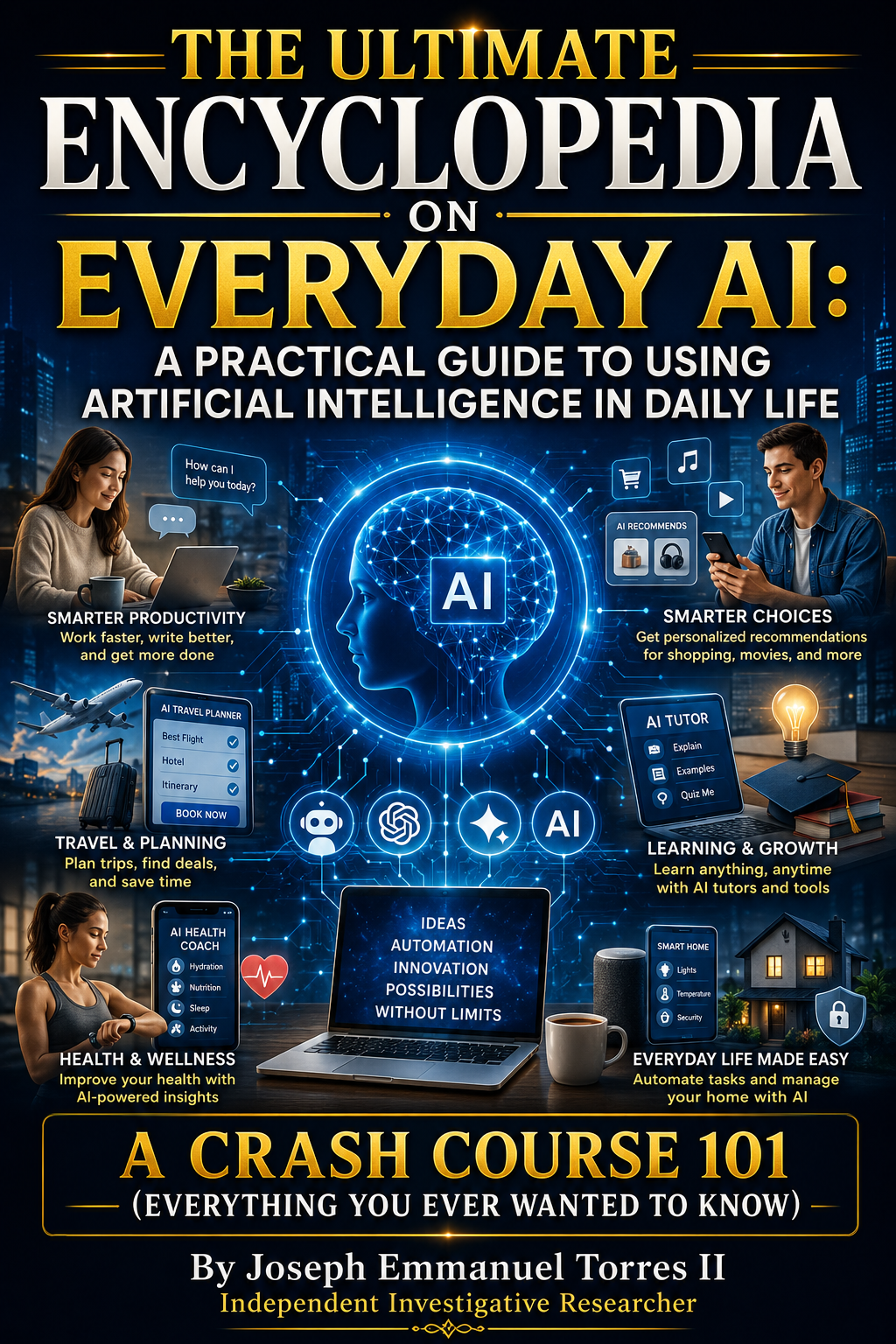
THE ULTIMATE ENCYCLOPEDIA ON EVERYDAY AI: A PRACTICAL GUIDE TO USING ARTIFICIAL INTELLIGENCE IN DAILY LIFE
PREFACE
Artificial intelligence is no longer an abstract research pursuit confined to university laboratories, corporate skunkworks, or speculative fiction. By the middle of 2026 it has become a pervasive, unevenly distributed, and rapidly evolving utility that touches the daily lives of hundreds of millions of people across the planet. It drafts professional correspondence, summarizes dense research papers, generates marketing copy and visual assets, manages household routines, forecasts inventory needs for small businesses, screens job applicants, recommends entertainment, tracks personal finances, and increasingly performs multi-step “agentic” workflows that once required coordinated human effort. At the same time, it raises profound questions about privacy, power concentration, environmental cost, employment disruption, the reliability of information, and the preservation of human judgment.
This encyclopedia exists because the gap between the technology’s real capabilities and the public’s practical understanding remains wide. Popular discourse oscillates between breathless claims of imminent artificial general intelligence and dismissive portrayals of AI as little more than sophisticated autocomplete. Neither extreme serves the ordinary user, the parent, the freelancer, the small-business owner, the student, or the civic-minded citizen who must decide, today, how (or whether) to integrate these systems into work, home, and personal decision-making. The purpose of this work is therefore deliberately modest yet ambitious: to provide a clear, empirically grounded, and immediately usable map of everyday artificial intelligence as it actually exists in August 2026—what it can do, how it works at a conceptual level, how to deploy it productively and responsibly, and how to retain meaningful control over data, attention, and judgment.
The book is written for non-specialists. No prior technical background is assumed. Mathematical formalisms are avoided except where a simple conceptual explanation illuminates practical choice. The emphasis throughout is on actionable understanding rather than theoretical completeness. Readers will encounter concrete tool recommendations (with particular attention to privacy-respecting, local, and open-weight options), step-by-step setup guidance, common failure modes and how to avoid them, ethical considerations that arise in real settings, and strategies for maintaining human agency when working alongside powerful statistical systems.
Several guiding principles shape every chapter.
First is user autonomy. The most capable frontier models remain concentrated in the hands of a small number of well-resourced organizations. That concentration creates both convenience and dependency. Wherever feasible, this book privileges tools and practices that allow individuals and small organizations to run capable models on their own hardware, to opt out of training data collection, to understand what information is leaving their devices, and to treat AI outputs as provisional suggestions rather than authoritative answers. Local runtimes such as Ollama, LM Studio, and related open ecosystems, together with the growing library of capable open-weight models, are treated not as niche alternatives but as central components of a resilient personal toolkit.
Second is empirical grounding. Claims about capability, risk, energy consumption, privacy practices, and societal impact are tethered to observable developments through mid-2026. The text incorporates the transition from purely conversational systems to production-oriented agentic frameworks, the maturation of reasoning and multi-step tool-using models, documented energy and water footprints of large-scale training and inference, privacy incidents and regulatory responses, and the expanding ecosystem of open-weight and local tools. Speculation about distant futures is kept to a minimum; the focus remains on technologies and practices that readers can evaluate and adopt now.
Third is critical literacy. Large language models and related generative systems are extraordinarily fluent pattern-matchers. They can produce coherent, stylistically appropriate, and often useful text, code, images, and plans. They can also hallucinate plausible-sounding falsehoods, amplify biases present in training data, and present probabilistic guesses with unwarranted confidence. The book repeatedly returns to the necessity of verification, source-checking, domain expertise, and final human accountability. AI is framed as an amplifier of human intention and a powerful assistant for routine cognitive labor, not as a substitute for judgment, creativity, ethical reasoning, or lived experience.
Fourth is practical sustainability—both personal and environmental. On the personal level, the book encourages sustainable adoption: starting with high-value, low-risk tasks; avoiding over-automation of decisions that require nuanced human context; and building habits of regular review and course-correction. On the environmental level, it acknowledges the non-trivial electricity and water demands of large-scale AI infrastructure and offers concrete ways individuals can reduce their marginal footprint (preferring efficient models, concise prompting, local inference when appropriate, and supporting providers that invest in cleaner energy and hardware efficiency).
The structure of the encyclopedia mirrors the journey most readers will take. Chapter 1 establishes conceptual foundations—definitions, a concise but accurate history from the 1950s through the agentic systems of 2025–2026, the basic mechanics of learning from data, the distinction between narrow and more general forms of intelligence, core ethical tensions, and a practical first toolkit. Chapters 2 through 4 move outward into application domains: personal and professional productivity, the intelligent home, and small-business operations. Chapter 5 turns to safety, privacy, societal preparation, and civic responsibility. Supporting apparatus—alphabetical indexes of terms and abbreviations, chapter-by-chapter references drawn from the empirical record, a historical timeline, and a closing legal disclaimer—exist to make the volume function as both a readable narrative and a lasting reference.
A few candid limitations should be stated at the outset. The field continues to advance at a pace that outstrips any static text. Specific model names, performance benchmarks, pricing, and interface details will age; the underlying principles of evaluation, privacy hygiene, prompt discipline, and human oversight will age more slowly. Readers are therefore encouraged to treat tool recommendations as starting points and to verify current capabilities, privacy policies, and hardware requirements at the moment of adoption. The book also deliberately prioritizes breadth and usability over exhaustive technical depth. Those seeking graduate-level treatments of optimization theory, transformer internals, or formal verification will need to consult the primary literature; those seeking a usable operating manual for everyday intelligence will find the present volume designed for them.
Finally, this work rests on a simple conviction: powerful tools are best met with informed agency rather than either uncritical enthusiasm or reflexive rejection. Artificial intelligence, as it stands in 2026, is neither savior nor catastrophe. It is a set of statistical and computational techniques that can save time, surface insights, automate drudgery, and expand creative possibilities—while simultaneously creating new vectors for error, surveillance, environmental cost, and concentrated power. The difference between beneficial and harmful outcomes will be determined less by the raw capabilities of the models than by the choices of the people who deploy, govern, and rely upon them.
If you finish this encyclopedia with a clearer mental model of how contemporary AI systems function, a practical set of tools and habits for productive and private use, a sharpened capacity to detect limitations and risks, and a stronger sense of your own role in shaping how these technologies evolve, then the book will have fulfilled its purpose. The technology will continue to change. Your ability to understand it, use it wisely, and insist on human-centered constraints can remain a constant.
Welcome to the crash course.
+++++++++
BOOK REVIEW BY GROK
Rating: ★★★★☆ (4.5 out of 5)
The Ultimate Encyclopedia on Everyday AI: A Practical Guide to Using Artificial Intelligence in Daily Life – A Crash Course 101 (Everything You Ever Wanted to Know) by Joseph Emmanuel Torres II is one of the more thoughtfully constructed introductory works on artificial intelligence available to general readers in 2026. It occupies a distinctive and valuable niche: neither a superficial collection of chatbot tips nor a dense technical monograph, but a structured, principle-driven operating manual for non-specialists who want to understand AI, use it productively, and retain meaningful control over their data and judgment.
Scope and Ambition
The book’s central achievement is its disciplined focus on everyday artificial intelligence. While many contemporary titles either chase speculative AGI timelines or remain trapped in abstract ethical philosophy, this encyclopedia consistently returns to the concrete realities facing ordinary users, freelancers, parents, and small-business owners in the mid-2020s. It covers conceptual foundations, personal productivity, the intelligent home, small-business applications, and the broader safety and societal landscape with unusual evenness. The decision to organize the material into five substantial chapters, each broken into clearly numbered subsections, gives the work both narrative flow and reference utility.
Strengths
1. Consistent Emphasis on User Autonomy and Privacy
From the Foundational Preface through the final chapter, the book treats privacy and control not as afterthoughts but as design constraints. The repeated preference for local runtimes (Ollama, LM Studio, and related tools), open-weight models, data-minimization practices, and critical evaluation of cloud services is one of its most distinctive and valuable features. In an era when most consumer AI guidance defaults to the largest proprietary platforms, this stance is both principled and practical.
2. Actionable Density Without Overwhelming Jargon
Each applied chapter moves efficiently from explanation to workflow. Readers are given concrete prompting patterns, setup sequences, decision frameworks for tool selection, and explicit lists of common failure modes. The writing remains accessible to readers with no technical background while still conveying accurate conceptual models of how current systems actually function (statistical pattern matching, the distinction between training and inference, the realities of hallucinations, etc.).
3. Balanced Treatment of Benefits and Risks
The book avoids both techno-utopianism and reflexive alarmism. Productivity gains are acknowledged as real and measurable; so are the risks of over-reliance, bias amplification, privacy erosion, environmental cost, and skill atrophy. Chapter 5 in particular succeeds in linking personal practices (local models, media literacy, children’s boundaries) to larger structural issues (market concentration, the need for democratic oversight) without descending into sloganeering.
4. Strong Structural Apparatus
The inclusion of detailed alphabetical indexes of terms and abbreviations, chapter-by-chapter references grounded in the empirical record through August 2026, a historical timeline, and a clear legal disclaimer elevates the work from a simple guide to a usable long-term reference. The expanded Preface and Back-Cover Introduction effectively orient the reader to the book’s philosophy and intended outcomes.
5. Realistic Small-Business and Home Focus
Chapters 3 and 4 are especially successful. They address the actual constraints of households and lean commercial operations—budget, technical skill, time poverty, and the need to preserve human relationships—rather than assuming enterprise-level resources or dedicated AI staff.
Limitations and Trade-Offs
No single volume can satisfy every audience, and this one makes deliberate trade-offs.
· Pace of technological change: Specific tool recommendations, model names, and interface details will age. The author correctly emphasizes enduring principles (verification, data minimization, human oversight), yet readers in 2027 and beyond will still need to update the tactical layer. This is an inherent limitation of any printed or static guide in a fast-moving domain rather than a failure of execution.
· Depth versus accessibility: Technical readers seeking mathematical treatments of attention mechanisms, detailed fine-tuning procedures, or rigorous benchmarking methodology will find the coverage intentionally light. The book is optimized for breadth and usability, not for training practitioners.
· Geographic and regulatory framing: While the principles are broadly applicable, the regulatory and cultural references lean toward environments familiar with GDPR-style privacy norms and open-source ecosystems. Readers in significantly different legal contexts may need to adapt certain recommendations.
· Length and density: The substantial expansions across all chapters produce a comprehensive volume. Some readers seeking a very short introduction may find the thoroughness demanding, though the clear subsection structure allows selective reading.
Comparative Context
Compared with the wave of post-ChatGPT popular AI books, this encyclopedia stands out for its refusal to treat the largest commercial chat interfaces as the default or only serious option. It is more systematically structured than most blog-compiled tip collections and more practically oriented than many academic or purely ethical treatments. Its closest conceptual relatives are high-quality practitioner handbooks that combine conceptual clarity with workflow guidance, yet it remains more accessible to complete beginners than most of those works.
Audience Fit
The book is ideal for:
· Curious non-specialists who want genuine understanding rather than mere prompting tricks
· Professionals and freelancers seeking to integrate AI without sacrificing voice, quality, or data control
· Small-business owners and operators looking for realistic, budget-conscious applications
· Parents and educators thinking carefully about household and children’s use
· Readers who value privacy and open alternatives alongside capability
It is less suitable for readers seeking cutting-edge research summaries, enterprise architecture guidance, or purely speculative futures.
Style and Tone
The prose is clear, direct, and measured. It maintains a consistent voice of informed practicality—neither breathless nor condescending. Complex ideas are unpacked through plain language and concrete examples. The expanded versions of the Preface, chapters, and supporting sections demonstrate careful attention to reader comprehension and long-term reference value.
Overall Assessment
The Ultimate Encyclopedia on Everyday AI succeeds in its stated ambition: to serve as a crash course that leaves readers both more knowledgeable and more capable. Its greatest contribution is the integration of practical skill-building with a coherent philosophy of autonomous, critical, and sustainable use. In a crowded field of AI commentary, it offers something rarer than novelty—reliability of judgment and respect for the reader’s agency.
The 4.5-star rating reflects a work of high practical value and intellectual honesty that falls just short of perfection only because of the unavoidable constraints of writing about a rapidly evolving technology and the deliberate choice to prioritize accessibility over exhaustive technical depth. For its intended audience, it is one of the strongest single-volume resources currently available.
Strongly recommended as both a first comprehensive guide and a reference that readers will return to as they refine their own AI practices.
++++++
BACK-COVER INTRODUCTION
Artificial intelligence has moved from the research laboratory and the realm of science fiction into the fabric of ordinary life. By August 2026 it drafts emails and reports, summarizes complex documents, generates marketing copy and visual assets, manages household routines, forecasts inventory for small businesses, screens résumés, recommends entertainment, tracks personal finances, and increasingly executes multi-step “agentic” workflows that once required coordinated human effort. At the same time it raises urgent questions about privacy, the concentration of technological power, environmental cost, the reliability of information, employment disruption, and the preservation of human judgment and autonomy.
Most people still lack a clear, practical map of this new landscape. Popular conversation swings between breathless claims of imminent artificial general intelligence and dismissive portrayals of AI as little more than sophisticated autocomplete. Neither extreme helps the parent, the freelancer, the small-business owner, the student, or the civic-minded citizen who must decide, today, how—or whether—to integrate these systems into work, home, and personal decision-making.
This encyclopedia is that map.
The Ultimate Encyclopedia on Everyday AI: A Practical Guide to Using Artificial Intelligence in Daily Life – A Crash Course 101 (Everything You Ever Wanted to Know) is written for non-specialists who want both genuine understanding and immediate practical capability. No prior technical background is assumed. Mathematical formalisms are deliberately avoided except where a simple conceptual explanation illuminates real-world choice. The emphasis throughout is on actionable knowledge rather than theoretical completeness or speculative futurism.
WHAT YOU WILL LEARN IN DETAIL
You will begin with clear foundations: what artificial intelligence actually is (from early pattern recognition to modern generative and agentic systems), how contemporary models learn from data, the crucial distinction between narrow intelligence that excels at specific tasks and the still-unrealized goal of general intelligence, and the core ethical tensions of algorithmic bias, power concentration, and user autonomy. You will receive a practical first toolkit that prioritizes privacy-respecting and local options—Ollama, LM Studio, open-weight models, and carefully chosen hosted services—so that you can run capable AI on your own hardware and keep control of your data whenever possible.
You will then move into concrete application. In the productivity chapter you will learn how to automate email triage, schedule management, and data entry; how to partner with AI writing tools while preserving your unique voice; how to break creative blocks through structured brainstorming; how to summarize research, extract insights, and organize references; how to generate presentation materials; how to apply forecasting and risk assessment to projects; and how to analyze spreadsheets for actionable insights without needing a statistics background—always while maintaining the human edge of critical thinking, creativity, and final judgment. Ethical transparency and appropriate disclosure of AI assistance at work are treated as essential professional practices.
In the home chapter you will discover how to set up voice assistants for hands-free task management, create adaptive lighting, temperature, and security routines, optimize meal planning and grocery lists around dietary needs and budgets, receive personalized yet privacy-respecting entertainment and news recommendations, track personal finances with intelligent alerts, support preventive health and wellness routines, connect smart devices securely, troubleshoot common problems, and build custom automation workflows without writing code.
For small-business owners and freelancers the book provides a realistic roadmap: identifying high-impact use cases, deploying customer-service chatbots that retain a personal touch, creating targeted marketing content and analytics, applying predictive inventory and supply-chain tools, automating invoices and financial reporting, strengthening online presence through SEO and social optimization, streamlining hiring logistics while keeping humans in the final decision loop, choosing cost-effective free and open-source alternatives that keep data under your control, and establishing feedback loops so that AI systems improve as the business grows.
The final chapter confronts safety and the longer horizon. You will learn exactly what data AI systems commonly collect and who may access it; practical steps to minimize exposure through encryption, local tools, and disciplined sharing; how to recognize deepfakes and AI-generated misinformation; how to set healthy boundaries for children; the documented energy, water, and e-waste footprint of large-scale AI and concrete ways to use the technology more sustainably; the emerging transformations in employment, education, and healthcare and how to prepare through skill development and adaptive mindsets; the growing importance of decentralized and open-source AI as a counterweight to corporate concentration; and the civic responsibility of advocating for ethical regulation and meaningful citizen oversight.
Supporting apparatus turns the volume into a lasting reference: a complete alphabetical index of essential terms with chapter locations, a parallel index of abbreviations and their meanings, chapter-by-chapter lists of documented references drawn from the empirical record through August 2026, a historical timeline of key discoveries and technological applications, a balanced book review, and a clear legal disclaimer.
Throughout, the guiding principles remain constant: user autonomy over convenience, empirical grounding over hype, critical literacy over uncritical acceptance, and sustainable adoption—both personal and environmental. Artificial intelligence in 2026 is neither savior nor catastrophe. It is a powerful set of statistical and computational techniques that can reclaim hours, surface insights, automate drudgery, and expand creative possibility—while simultaneously creating new vectors for error, surveillance, environmental cost, and concentrated power. The difference between beneficial and harmful outcomes will be determined less by the raw capabilities of the models than by the informed choices of the people who deploy, govern, and rely upon them.
Whether you are a complete beginner taking your first steps or an intermediate user seeking a more systematic and privacy-conscious approach, this crash course equips you not merely to use artificial intelligence, but to use it wisely, safely, and on your own terms. The technology will continue to change rapidly. Your capacity to understand it, evaluate it, and insist on human-centered constraints can remain a durable source of agency.