
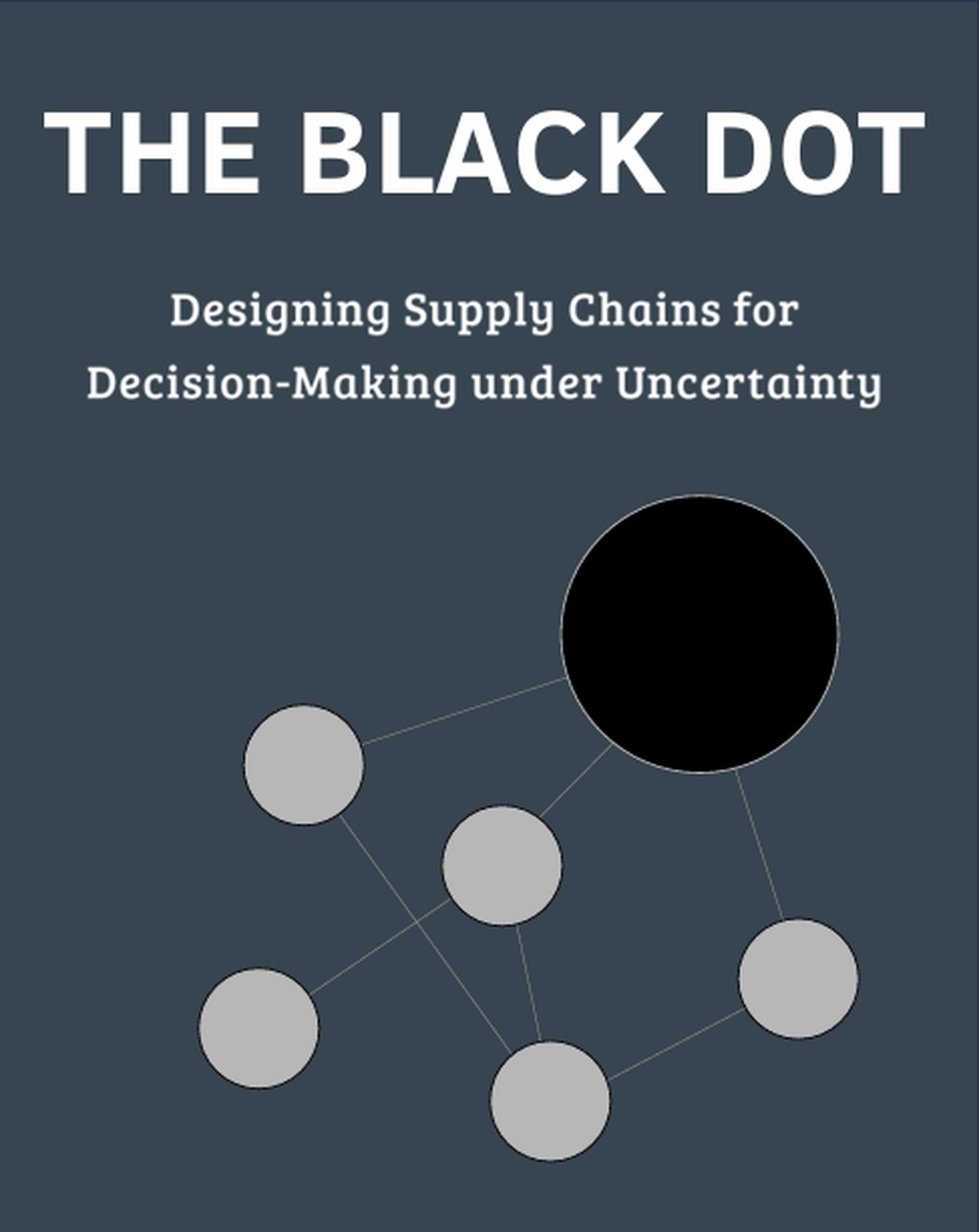
The Black Dot
Modern supply chains do not fail because people lack data, tools, or effort. They fail because decisions are made too slowly, too late, or against signals that no longer hold. In an environment defined by persistent uncertainty, performance is determined less by planning accuracy than by how organizations sense change and act under constraint.
The Black Dot starts with a simple but unsettling image: a single, almost invisible node inside a vast global network, suddenly exposed by events far beyond its control. From that moment, the book explores a deeper question facing modern organizations: what happens when uncertainty is no longer an exception, but the operating condition?
This book argues that supply chain agility is not a set of tools, initiatives, or best practices. It is an operating model problem. When environments become unpredictable, competitive advantage shifts away from efficiency and forecast precision toward decision speed, coherence, and structural readiness.
Drawing on real-world cases, research, and lived operating experience, The Black Dot reframes agility as a system of interdependent structural, relational, and behavioral enablers that shape decision-making under uncertainty. It examines why forecast-driven models break down, why speed alone creates new failure modes, and why many well-intended agility efforts quietly collapse under political, organizational, and cognitive strain.
This is not a how-to manual.
It does not promise clean transformations or universal solutions.
Instead, it offers something rarer: a clear mental model for understanding why modern supply chains struggle, where decision friction actually comes from, and what trade-offs leaders must consciously accept when designing for uncertainty.
Written for senior supply chain leaders, operations executives, and decision-makers who are skeptical of buzzwords and tired of superficial fixes, The Black Dot helps readers see their systems more clearly, judge constraints more honestly, and design operating models that can function when certainty is no longer available.