
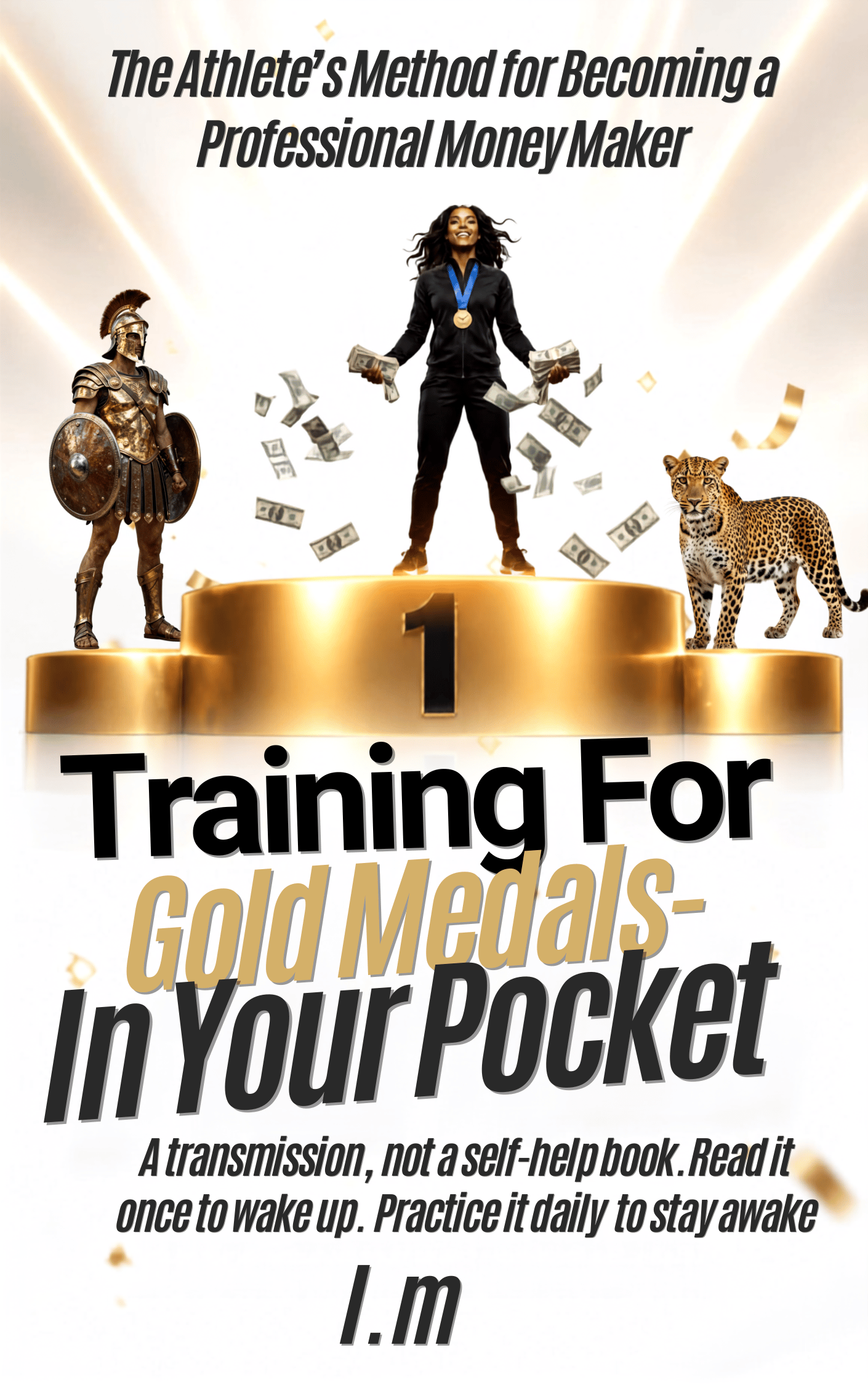
TRAINING FOR GOLD MEDALS — IN YOUR POCKET The Athlete's Method for Becoming a Professional Money Maker A transmission, not a self-help book. Read it once to wake up. Practice it daily to stay awake.
THE MEDAL WAS NEVER THE POINT. THE POCKET WAS.
Somewhere in you, something just sat up. Good. Don't let it lie back down.
You were never meant to live small. You were never meant to check your worth against a paycheck. You were built for more, trained for less, and it's about to stop being your problem to carry alone. We're not playing small anymore.
Get comfortable being uncomfortable. Get loud. Get up. This one's going to scream at you a little, because whispering hasn't worked yet.
TABLE OF CONTENTS
The Athlete's Method for Becoming a Professional Money Maker
THE MEDAL WAS NEVER THE POINT. THE POCKET WAS.
PROLOGUE — THE VISION
HOW TO READ THIS BOOK
CHAPTER ONE: THE CURSE OF MINIMUM WAGE
CHAPTER TWO: THE SUCCESS CEILING
CHAPTER THREE: THE TRAINING TABLE
CHAPTER FOUR: CALL YOUR SHOT
A SHORT INTERLUDE: HANG TIME
A SHORT INTERLUDE: WHAT THE APPLE TREE KNOWS
CHAPTER FIVE: THE NERVOUS SYSTEM IS THE REAL OPPONENT
CHAPTER SIX: YOU ARE THE ASSET
CHAPTER SEVEN: THE WHY
CHAPTER EIGHT: TRAIN LIKE IT'S NOT OPTIONAL
GET UP
CHAPTER NINE: THE PANTHER, THE GLADIATOR, AND THE INFINITE SOVEREIGN
THE WALL OF FAME
YOUR PAGE
CHAPTER TEN: THE EXCHANGE
CHAPTER ELEVEN: ARIGATO MONEY
CHAPTER TWELVE: THERE'S ALWAYS ANOTHER OLYMPICS
ABOUT THE AUTHOR
A NOTE ON THIS BOOK
PROLOGUE — THE VISION
I saw money bow to me.
Not metaphorically. Not "in a manifestation journal, three affirmations before bed" kind of way. I stood somewhere in the void — a place I didn't know existed until I decided to stand there, a place where money actually is — and when I arrived, it wasn't waiting to be summoned. It was already kneeling. Already at my service. It had been there the whole time; I had simply never stood in the spot where I could see it, let alone reach it.
That's the part that undid me. I didn't create it. I didn't manifest it out of nothing. I found it — the way you find a room in a house you've lived in for years and somehow never opened the door to. It was mine the way a good dog is yours — loyal, capable, dangerous if it needed to be, and utterly uninterested in being anything other than useful to me. It had just been waiting in a room I'd never walked into.
I need to say this plainly, right at the start, because it governs every vision I share in this book, not just this one: I'm not claiming any of it happened as provable, verifiable fact. I'm not asking you to take my word for it the way you'd take a scientist's word for a measurement. What I'm telling you is that my intuition delivered this to me, clearly, unprompted, and I made a choice — one I'd make again, every time — to honor it instead of arguing it away. That's the whole relationship I have with every vision in this book. Not proof. Respect.
And let me be honest about how strange this particular one actually is, because I don't want to undersell it by saying it too casually. Most of human history has told us the opposite story — that we bow to money, chase it, plead with it, apologize for wanting it, treat it as the one force nobody fully gets to possess. Across most cultures, in most eras, the idea of money kneeling to a person, instead of the other way around, has barely been touched, let alone seen, let alone believed. So no, this isn't a small image. It's about as far outside the norm as a single sentence can get. And it's exactly the sentence this whole book is built to make true in your body, not just your imagination.
The vision itself didn't flinch. I did — not there, but back here, in an ordinary week still built around trading hours for scraps. The rejection doesn't show up when I close my eyes and see the truth. It shows up on a Tuesday, at a desk, and calls itself normal because everyone around me calls it normal too.
The vision was real. The rejection was trained. The money was never missing — I was.
That rejection isn't always dramatic. It isn't a shaking hand over a bank statement. I can look my numbers dead in the eye now, calm, unbothered, no dread — and still spend months, years, handing over my one irreplaceable set of human hours for far less than they're worth. Not fear of the number. A habit of undercharging the trade.
And that's the whole book. I could stop writing right now and you'd have the whole point. But you're an athlete in training, and athletes don't stop at the point being made. They drill it until the body stops arguing with it. So let's drill it.
Money bows. The only question is whether your nervous system will let it stay down.
HOW TO READ THIS BOOK
Don't read this like a book you'll finish someday. Read it like a countdown.
This is not a book about how to make money. You already know how — you've got a phone, you've got Google, you've probably got an AI assistant more competent at spreadsheets than either of us wants to admit. The how was never your problem. If it were, you'd have solved it in a weekend the way you solve everything else you actually want.
This is a book about the years spent knowing exactly what to do and simply — not — doing it. That gap is a nervous system trained on scarcity, doing exactly what it was trained to do: protect you from a version of "too much" that got punished once, a long time ago, and never got the memo that the danger's over.
You are not broken. This isn't a book about fixing you, healing you, repairing some fault line that made you small. You don't need repair. You need your file back. You were robbed — misguided, mistrained, handed a script instead of the truth. A broken thing gets rebuilt from scratch, slowly, with permission, maybe by an expert. A robbed thing just gets returned to whoever it always belonged to. That's this. Guidance back to what was already yours. Training to remember, not therapy to repair. You're not walking into this book to become someone new. You're walking in to take back someone you always were.
This probably isn't your first time doing this work, either, and I'm not going to pretend it is. You've bought the course. Maybe several. Started strong — genuinely strong, not faking it — full of the kind of faith that spends real money on itself without blinking. And then, weeks or months in, it quietly stopped working, and you assumed that meant you'd failed at it, or the method was wrong, or you weren't one of the lucky ones it works for. None of those are true. It stopped working because it never touched the actual thing. Everything gets aimed outward — new tactics, new outlets, new courses, new certainty this one's the one — when the whole time the work was never out there. It's in here. This book isn't the twentieth outward attempt. It's the first inward one, if you let it be.
We're going to retrain it. Like an athlete. Daily, unglamorously, with reps instead of hope.
The goal of this book isn't money. It's you — specifically, the version of you that money already wants to work for, the one currently buried under scarcity training and old permission slips you never signed. Build that version, and the money that follows won't need explaining, won't need justifying, won't arrive dressed up as a miracle. It'll just be what was always going to happen once you stopped standing in your own way. Not because money is the meaning of life — it isn't — but because you were never built to spend your one life fighting for scraps, negotiating your worth down to something survivable, grateful for the bare minimum and calling it enough. That's not humility. That's a species-wide agreement to forget what we actually are.
Money, made so ordinary you stop flinching at it. Wealth as your baseline, not your miracle. Underneath it: even from absolute zero tomorrow, you'd be fine, because you've got you — you were always the actual asset the money was just orbiting.
And we're going to have an obscene amount of fun doing it. Real change doesn't have to feel dull to be working.
On your marks. Get set.
🏃 Go.
CHAPTER ONE: THE CURSE OF MINIMUM WAGE
You've been robbed. Yes, you. Keep reading, because you're about to find out by who.
Let's talk about the curse.
Not the paycheck. The paycheck's just a number, and numbers don't have feelings about you. I'm talking about the spell — the one that got cast so early and so quietly that you probably don't remember the casting, only the effect: a low hum in the back of your mind that says know your place, right around the exact moment you start wanting something bigger than your place allows.
You know the hum. It sounds reasonable, even wise:
Be realistic.
Money isn't everything.
Who do you think you are?
That last one's the real spell. Everything else is decoration. As if wanting more required a permission slip. As if the size of your life needed to be pre-approved by someone who was never going to sign it. The question was never a question. It was a leash, dressed up as humility, and you've been walking yourself on it for years.
And the curse isn't just underpaid. It's also managed. Here's a version of it a lot of us know from the inside: making a little more than minimum, not struggling exactly, just given a trickle every month — enough to get by, never quite enough to look up. Just survive, just enough, just barely — for so many of us that's not an accident, that's the design. Someone doesn't have to hate you to keep you on a drip. They just have to keep it a little short of comfortable, forever, and you'll do the rest yourself: grateful, quiet, calling it a decent job.
Minimum wage — trickle wage, whatever shape it takes — is a ceiling installed in the nervous system before you were old enough to know it was optional. And it doesn't always look like fear. Sometimes it looks like composure. You can check your balance with both eyes open, no flinch, no dread, and still spend months, years, trading your one irreplaceable set of human hours for less than they're worth. That's not the beginner curse. That's the advanced version: the nervous system stopped screaming and started negotiating quietly on your behalf, agreeing to the wrong exchange rate before you're even in the room.
There's an older curse underneath that one, and it doesn't come from a job at all. It comes from a table. Scarcity gets handed down the way recipes and grudges do — not taught exactly, absorbed, from watching the adults who raised you flinch at a bill, ration a treat, apologize for a want out loud before anyone even judged it. You didn't choose that inheritance. Nobody sits a child down and offers scarcity as an option to accept or decline. It arrives the way accents arrive — you just start speaking it, and by the time you're old enough to notice, it sounds like your own voice.
Here's the part that's harder to admit: at some point, it stops being inherited and starts being guarded. Loosening the grip on scarcity can feel like loosening the grip on the people who handed it to you — like doing better is a quiet accusation against everyone who didn't. So it gets kept, sometimes for decades past its usefulness, not because it's true anymore but because letting it go feels like letting go of them. That's not loyalty. That's a curse mistaking itself for love, and the two are not the same thing, no matter how similar they feel from the inside.
You're allowed to outgrow an inheritance without dishonoring the people who left it to you. They handed you what they had. You get to hand the next version of it — or none of it — forward instead.
Let's not pretend that's a small ask, either, because I don't want this book to lie to you about the size of what it's asking. This isn't a tweak. It's going against years, generations, an entire inherited way of living and breathing that told you exactly how much you were allowed to want and exactly how sorry you should be for wanting more. Undoing that isn't a weekend project. It's the whole task. But that's exactly the job description, and it's worth naming plainly: you're not just changing your own life here. You're the interrupter — the one who breaks the chain mid-link, so whatever gets handed down from you instead of to you looks nothing like what you were given. That's not betrayal of where you came from. That's what the inheritance was always secretly hoping someone would finally do with it.
Scarcity has one more disguise worth naming before we move on, because it's the one that hides best: not enough time. Not enough time to train, to visualize, to do the two minutes, because the trickle wage already took the hours and called them a job. That's not laziness either. That's scarcity working exactly as designed — take enough of someone's time that they never have the spare minutes to train their way out of needing it taken. The daily rep in this book takes two minutes. If that still feels impossible, the shortage was never time. It was permission to spend two minutes on yourself instead of proving, yet again, that you're useful to everyone but you.
The curse doesn't ask you to be poor. It just asks you to agree to be small, quietly, forever, and call it being grounded.
Two things I caught myself in.
The first: I was addicted to the grind. Not to what it produced — to the grind itself. And here's the part I had to get honest about: it didn't start as an addiction. It started as the only door left open. I went to work young, because the household needed the contribution, and work was the one thing nobody argued with me about. Not the fun jobs, not the ones at night, not the things that were just for me — those got a fight. Work never did. So work became the one place I was allowed to be ambitious, the one place wanting more of something wasn't met with resistance. Of course I built a life around the one door that stayed open. Anyone would have.
If I'm honest about what the addiction was actually to, it wasn't the grind in the abstract. It was the struggle itself — the version of me that only fully trusted a day if it had cost me something. Ease could feel unfamiliar, almost suspicious, like proof was still owed somewhere before I was allowed to relax into it.
That's not shame. That's intelligence — a young nervous system correctly reading which behaviors got approval and repeating them. But intelligence built for a household you no longer live in can quietly outlive its usefulness, and if I wasn't tired, if I wasn't sacrificing, some old part of me didn't trust that the work counted. Enjoying my job, liking my coworkers, none of that canceled the pattern out — it doesn't care if the effort is pleasant. It just needs you attached to a shape: hours handed over for less than they're worth, and permission that only ever seemed to arrive through labor. If this is your story too, in whatever version — the door that stayed open wasn't a flaw in you. It's just the one door that's due for a second look, now that you get to choose which ones open.
And it isn't only work we get addicted to like this. Dr. Joe Dispenza's research in Breaking the Habit of Being Yourself lays out something worth sitting with: the body can get chemically attached to an emotional state the same way it gets attached to a substance. Complain daily, and the body starts expecting the complaint, craving the familiar chemical hit of being wronged. Whine, resent, play the victim — repeat any of it long enough and it stops being a mood and starts being a habit the body defends, the same way it defends any addiction, by making the alternative feel foreign and slightly unsafe. This is worth knowing, because the retraining in this book isn't just about money. It's about which emotional habit gets to run the show daily, and whether that habit was ever actually chosen or just repeated until it looked like personality.
The second: identity had quietly fused itself to scarcity, and I didn't notice until I nearly lost both at once.
I should say plainly: this second one isn't universal either, and I don't want to write it like it is — plenty of people never fuse their identity to a job, a paycheck, or a place at all. But for those of us who do, this is the actual core of it: identity attached to that place, to those people, to fitting neatly inside a box that was never really us to begin with — the self quietly built out of one specific, small set of circumstances, this exact income, this exact job, this exact amount you learned to call enough. Lose it, and it rarely feels like losing a paycheck. It feels like losing the person built to survive on it. The whole life fused to that scarcity, gone at once, no matter how small the box looks from the outside — and that's a genuinely hard thing to say goodbye to, not a shrug.
That first version of you — the one who couldn't yet hold or receive what's coming — doesn't have to die. It just has to upgrade. Chapter Ten will ask you to look at exactly what that upgrade costs, in detail, in names if it comes to that. For now, just let this much land: the fear was never really about the money. It was about identity finally being asked to grow past the size it had gotten used to being.
Here's why meditation is actually built for this exact job, and not just a wellness habit tacked onto the chapter for good measure. Everyday life is solid reality — fixed, sync'd, agreed on: your name, your patterns, your emotions, the whole stack of reference points that makes you recognizably you to yourself and everyone around you. Useful, most days. But solid doesn't move, and identity fused to scarcity is, by definition, solid. Meditation is where that solidity actually loosens. Strip away the name, the patterns, the emotional weather, the whole accumulated reference file for a few minutes, and what's left isn't nothing — it's liquid reality, the tangible, changeable version underneath the fixed one.
Worth being precise about the two moves that happen next, since they're not the same thing: meditation is the stillness that gets you to the door. Visualization is what you actually do once you're standing in it — picturing the specific reality you're choosing, in detail, on purpose. Christie Marie Sheldon used to put the whole sequence more simply than I ever could: find the reality you actually want, and walk into it. Not visualize it from a careful distance while still standing outside. Get still first. Then see it. Then walk in, and close the door behind you.
We're not staying solid anymore. Solid was the curse's favorite disguise — a fixed, permanent-feeling identity built entirely out of scarcity, mistaken for just being realistic. We're going liquid instead: changeable, walkable-into, yours to actually decide. And the specific liquid worth finding has no viscosity in it — nothing thick, nothing dragging, nothing slowing the flow between you wanting a thing and you actually having it. Viscosity is just resistance wearing a scientific name. Scarcity is what puts it there in the first place.
Your first rep: close your eyes, right now, wherever you are, and go looking for that version of your life — liquid, no viscosity, nothing slowing it down. Not the one you're currently standing in. Go to the void first, if that's easier: the place before anything's decided yet, where every version of you is still possible. Find the one who was never handed the curse — no inherited scarcity, no trickle wage, no minimum anything, nothing thick standing between you and what you want. How do you live? Don't rush past the looking. What does it actually look like around you there? What are you doing, wearing, feeling, surrounded by? Once you can genuinely see it, walk directly into it — no hovering at the threshold, no polite knock first, the way Christie said. Then open your eyes and say it out loud: I was never meant to be small. Feel what happens in your body when you say it. Don't fix what you notice. Just notice it. That's the curse, clocking in for its shift. We're going to spend this whole book making it clock out early.
🥊 Bell's rung. Round one's yours. Hands up.