
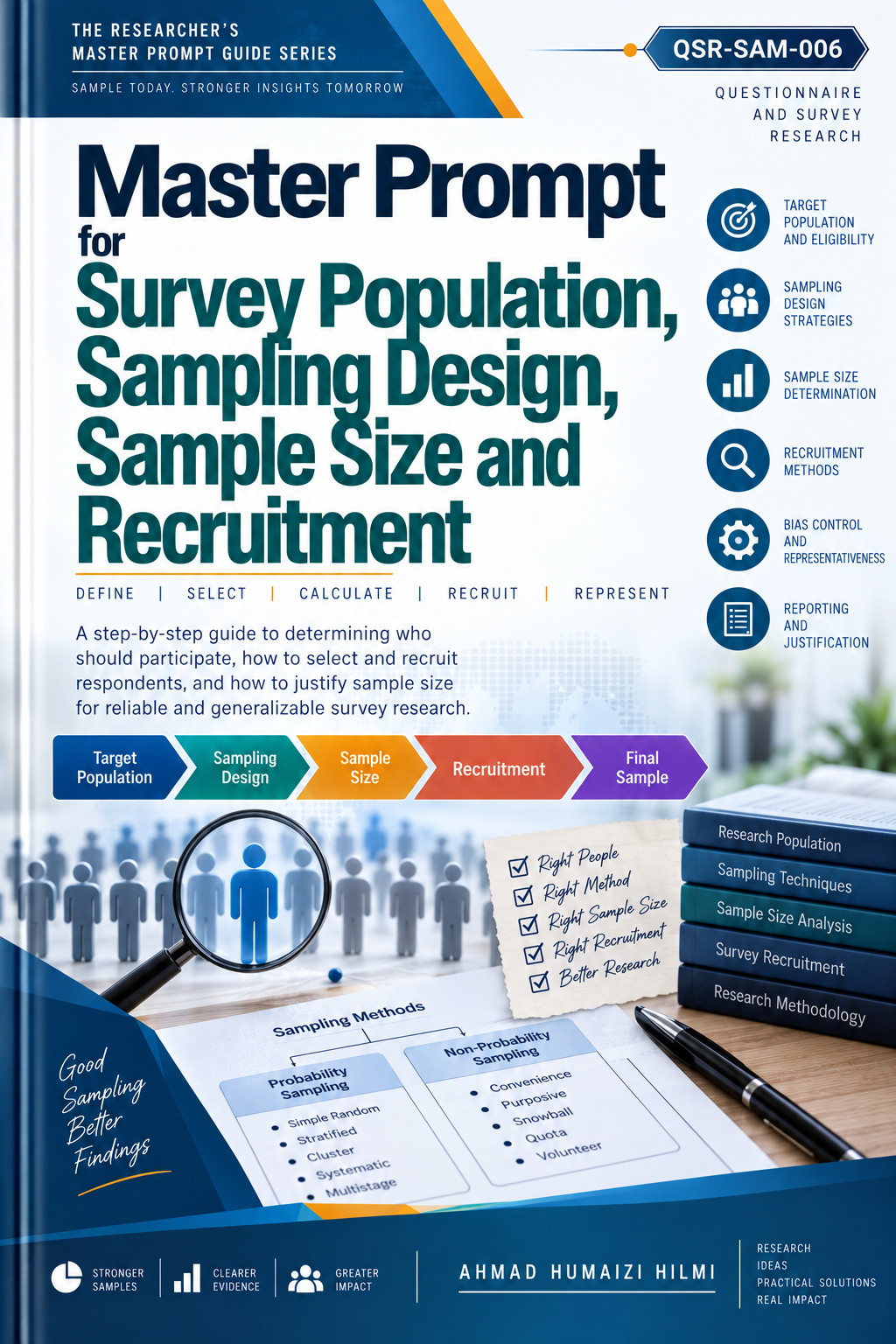
6. QSR-SAM-006 — Survey Population, Sampling Design, Sample Size and Recruitment
Description:
This Master Prompt would focus on determining who should participate in the survey and how respondents should be selected and recruited. It would guide researchers in defining the target population, accessible population, sampling frame, eligibility criteria, sampling unit, inclusion and exclusion criteria, probability and non-probability sampling strategies, stratification, clustering, systematic selection, convenience sampling, purposive sampling, snowball sampling, sample-size justification, recruitment procedures, and representativeness.
A major emphasis would be placed on distinguishing sample size from sampling quality. A large number of respondents does not automatically make a survey representative. Researchers would evaluate coverage error, selection bias, sampling-frame limitations, subgroup representation, recruitment pathways, and the implications of probability versus non-probability selection. The uploaded national-survey literature demonstrates probabilistic sampling from a defined sampling frame and subsequent recruitment modification when initial recruitment was insufficient. Other studies in the collection employ convenience and snowball sampling, illustrating why the sampling strategy must be reported when judging generalizability.