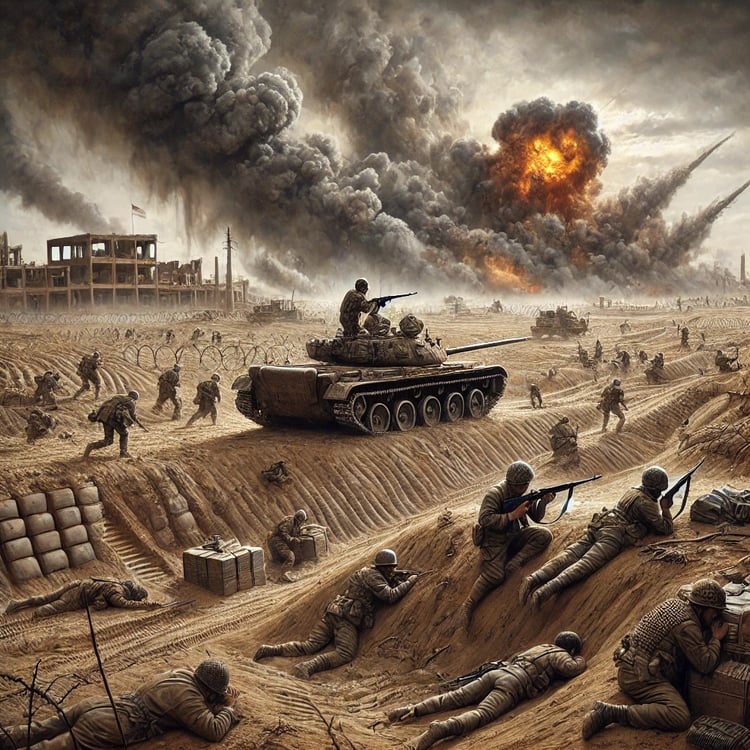
Searing Skies: Unveiling the Crucible - A Chronicle of the Kosovo War (1998-1999)
Chapter 1: Igniting Tensions
Seeds of Conflict: Historical Background and Ethnic Dynamics
The Kosovo War of 1998-1999 stands as a harrowing testament to the complex historical background and intricate ethnic dynamics that fueled one of the most devastating conflicts in the Balkans during the late 20th century. Rooted in centuries of history, the seeds of conflict in Kosovo were sown by a confluence of historical grievances, ethnic tensions, and geopolitical factors.
Kosovo, a region in the heart of the Balkans, has long been a melting pot of cultures and civilizations. In the late 14th century, it was the heartland of the Serbian medieval empire, a fact that remains deeply ingrained in the collective consciousness of the Serbian people. However, by the late 20th century, Kosovo had a predominantly Albanian population, a result of centuries of Ottoman rule and subsequent Albanian migration. The Albanian population sought greater autonomy and recognition of their cultural identity within Yugoslavia, while the Serbs clung to the historical and emotional significance of Kosovo.
The rise of nationalism in the late 1980s and early 1990s added fuel to the simmering tensions. Serbian leader Slobodan Milošević tapped into the collective memory of Serbs and portrayed Kosovo as the heart of their heritage, advocating for greater Serbian control over the region. This further alienated the Albanian population and exacerbated the already strained relations between the two ethnic groups. The revocation of Kosovo's autonomy in 1989 only deepened the divide, as Albanians were systematically excluded from political and economic life.
The 1990s brought with them the disintegration of Yugoslavia, a multi-ethnic federation held together by a fragile balance. As the federal government weakened, different regions sought to assert their independence. Kosovo, too, yearned for self-determination, with Albanian leaders demanding full independence or, at the very least, autonomy within a federated Yugoslavia. Negotiations between Serb and Albanian leaders failed to yield any meaningful compromise, leading to a cycle of escalating violence.
By 1998, the Kosovo Liberation Army (KLA), an Albanian nationalist guerrilla group, emerged as a force seeking to end Serbian repression and secure greater autonomy for Kosovo's Albanian population. Their actions, though aimed at achieving a just cause, often spiraled into violent clashes with Serbian security forces. The Serb response was marked by heavy-handed crackdowns, human rights abuses, and displacement of civilians. The cycle of violence had escalated to a point where international intervention became inevitable.
The NATO intervention in 1999 was triggered by the deteriorating humanitarian situation and the fear of a full-blown ethnic cleansing campaign. The 78-day air campaign aimed to halt Serbian military operations and protect the Albanian population. While it succeeded in ending the immediate violence, it also exposed the complexity of international interventions in conflicts with deep historical roots.
The Kosovo War underscores the profound impact of historical narratives on contemporary conflicts. The deep-seated historical grievances and ethnic tensions that fueled the conflict highlighted the importance of addressing root causes rather than merely managing the symptoms. Long-standing narratives and collective memories played a central role in shaping the perspectives and motivations of the involved parties, making it challenging to find common ground.
In conclusion, the Kosovo War of 1998-1999 was a tragic manifestation of the historical background and ethnic dynamics that had been brewing for centuries in the Balkans. The clash between Serbian attachment to historical heritage and Albanian aspirations for self-determination created a volatile mix, further exacerbated by the dissolution of Yugoslavia and the rise of nationalism. The conflict's legacy serves as a stark reminder of the power of history and identity in shaping the course of events, emphasizing the need for nuanced understanding and peaceful resolution of deeply ingrained disputes.