
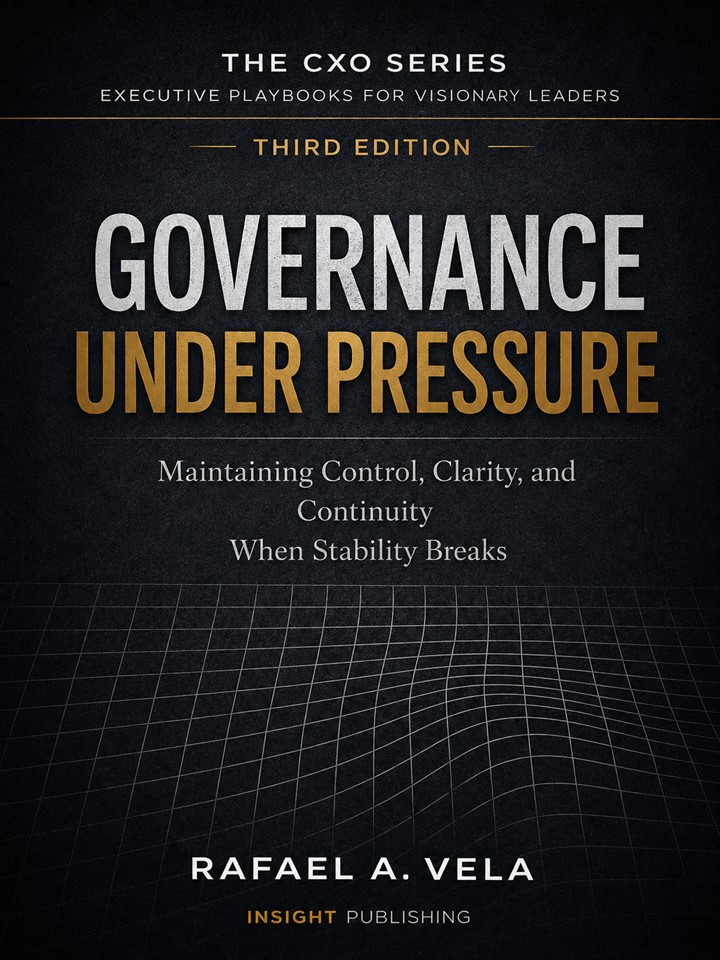
Governance Under Pressure - Maintaining Control, Clarity, and Continuity When Stability Breaks - Third Edition (226 pages)
GOVERNANCE UNDER PRESSURE
How to Maintain Control, Accountability, and Decision-Making Capability When Conditions Become Demanding
Third Edition
Governance is often evaluated under conditions of stability.
Processes function as expected. Responsibilities appear clear. Decisions follow established paths. Organizational structures seem aligned with business objectives.
Yet the true nature of governance does not reveal itself when conditions are favorable.
It reveals itself when time compresses, information becomes incomplete, consequences intensify, and uncertainty expands.
Governance Under Pressure examines what happens when governance structures are subjected to the conditions that matter most. Through a rigorous executive-level analysis, this book explores how authority, accountability, escalation, information, and decision-making behave when organizations can no longer rely on stability to compensate for structural weaknesses.
Rather than focusing on compliance, administrative frameworks, or governance theory, this third edition addresses a more fundamental question:
Does governance continue to function when pressure increases?
Throughout the book, readers will discover:
- Why authority often weakens when decisions become more consequential
- How accountability becomes fragmented precisely when ownership matters most
- Why information can remain available while becoming less useful for decision-making
- How informal governance structures emerge and gradually replace formal systems
- The difference between governance designed for stability and governance designed for stress
- The mechanisms that allow organizations to preserve control, clarity, and disciplined decision-making under uncertainty
This new edition also includes practical governance assessment tools, decision-rights and escalation mapping frameworks, and a pressure-tested governance model that can be applied across industries, organizational structures, and operating environments.
Written for board members, C-suite executives, senior leaders, governance professionals, transformation leaders, and decision-makers responsible for organizational performance, Governance Under Pressure provides a structured perspective on one of leadership's most critical responsibilities:
Maintaining control when conditions no longer make control easy.
Because governance is not proven when everything is working.
It is proven when everything is being tested.
TABLE OF CONTENTS
Preface — Governance Is Not Tested in Stability
PART I — THE CONDITIONS THAT EXPOSE GOVERNANCE
Chapter 1 — When Governance Becomes Visible
• Governance as an invisible structure
• Why it is only recognized at the point of failure
• The gap between designed governance and actual behavior
• Closing Perspective — Visibility Comes Too Late
Chapter 2 — Pressure as a Structural Force
• Time compression and decision velocity
• Increased consequence intensity
• Volatility as a destabilizing factor
• Why pressure changes how organizations behave
• Closing Perspective — Pressure Reveals What Stability Conceals
Chapter 3 — The Illusion of Control
• Why organizations believe governance is working
• Stability as a false indicator of control
• Fragility hidden beneath performance
• Closing Perspective — Control Is Not Proven By Performance
PART II — HOW GOVERNANCE BREAKS UNDER PRESSURE
Chapter 4 — Decision Rights Under Stress
• Distortion of authority under pressure
• Informal overrides and silent shifts in power
• Loss of clarity at the point of decision
• Closing Perspective — Authority That Shifts is Authority Not Held
Chapter 5 — Escalation Breakdown
• Over-escalation vs non-escalation
• Decision bottlenecks at the top
• When escalation structures collapse or become irrelevant
• Closing Perspective — What Rises Defines Control
Chapter 6 — When Accountability Dissolves
• Diffusion of responsibility under time pressure
• The illusion of shared accountability
• Why ownership weakens when it is most needed
• Closing Perspective – Accountability Cannot Be Shared
Chapter 7 — When Information Stops Supporting Decisions
• Delayed, filtered, or unusable information
• Signal vs noise under pressure
• Decision-making without clarity
• Closing Perspective – Clarity is a Structural Capability
Chapter 8 — The Rise of Informal Governance
• Shadow structures replacing formal systems
• Power shifting outside defined channels
• The risks and inevitability of informal control
• Closing Perspective — Control Does Not Disappear. It Moves
PART III — THE EXECUTIVE TEST & GOVERNANCE DESIGN
Chapter 9 — The Executive Test of Governance
• Authority under pressure
• Decision-making with incomplete information
• Continuity vs reaction
• The cost of hesitation and overcorrection
• Closing Perspective – Governance is Confirmed at the Point of Decision
Chapter 10 — Designing Governance That Holds
• Governance for stability vs governance for stress
• Clear decision rights and escalation design
• Embedded accountability mechanisms
• Information structures that enable decision velocity
• Governance as an enforced system, not a framework
• Closing Perspective – Governance Must Hold When Conditions Do Not
Conclusion — Control Is Proven Under Pressure
APPENDICES
Appendix A — Governance Under Pressure Diagnostic
Appendix B — Decision Rights & Escalation Mapping Framework
Appendix C — Pressure-Tested Governance Model