

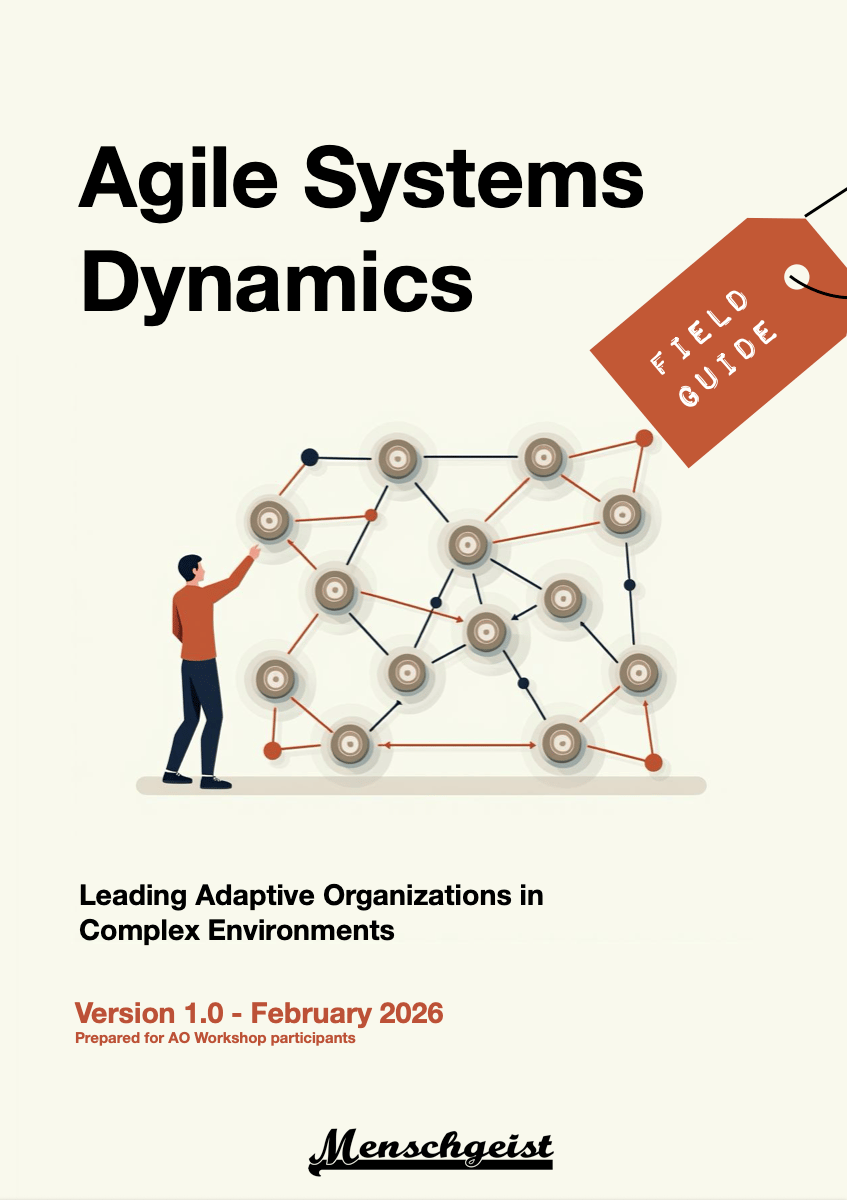
Agile Systems Dynamics - Field Guide
This book invites you to see “agile” not as a framework for delivery, but as the evolving behaviour of a complex social system — a living network of agents, objectives, interactions, and constraints. It explores agility as an emergent property of collective intelligence, drawing on the lenses of Cynefin, systems thinking (Senge, Luhmann, Ashby), and the Adaptive Organization (AO) Method to reveal how organizations continuously adapt, learn, and reinvent themselves in response to complexity.
Many organisations today can recite agile vocabulary in their sleep. They have sprints, stand‑ups, product owners, Scrum Masters, Kanban boards, and PI planning events. On paper, the organisation looks agile. In day‑to‑day reality, the lived experience is often different: dependencies still trap teams, decisions still take weeks, incidents still trigger firefighting, and major initiatives still drag on longer than anyone expected.
This gap creates cynicism. People say, “We do agile, but nothing really changed.” Leaders feel pressured to “strengthen governance” or “roll out a better framework” as if a more precise recipe would finally unlock agility. Teams start treating ceremonies as theatre: they show up, but they no longer expect them to change anything important.
Agile Systems Dynamics begins by taking this disappointment seriously. It suggests that we have been looking in the wrong place. Instead of asking “Are we doing agile correctly?”, it invites questions like:
- How does work actually flow through this system?
- Who talks to whom when something unexpected appears?
- Where do decisions really get made – and how long does that take?
- How does the system behave when it is under pressure?
The core shift is from methods to behaviour. An organisation is seen as a living system, not just a set of processes and roles. Agile is not a badge or a checklist; it is a particular pattern of interaction that may or may not emerge given the way people, structures, and constraints are arranged. Agile Systems Dynamics is a way of seeing and shaping those patterns, so that the system’s behaviour becomes more adaptive, not just more decorated.