
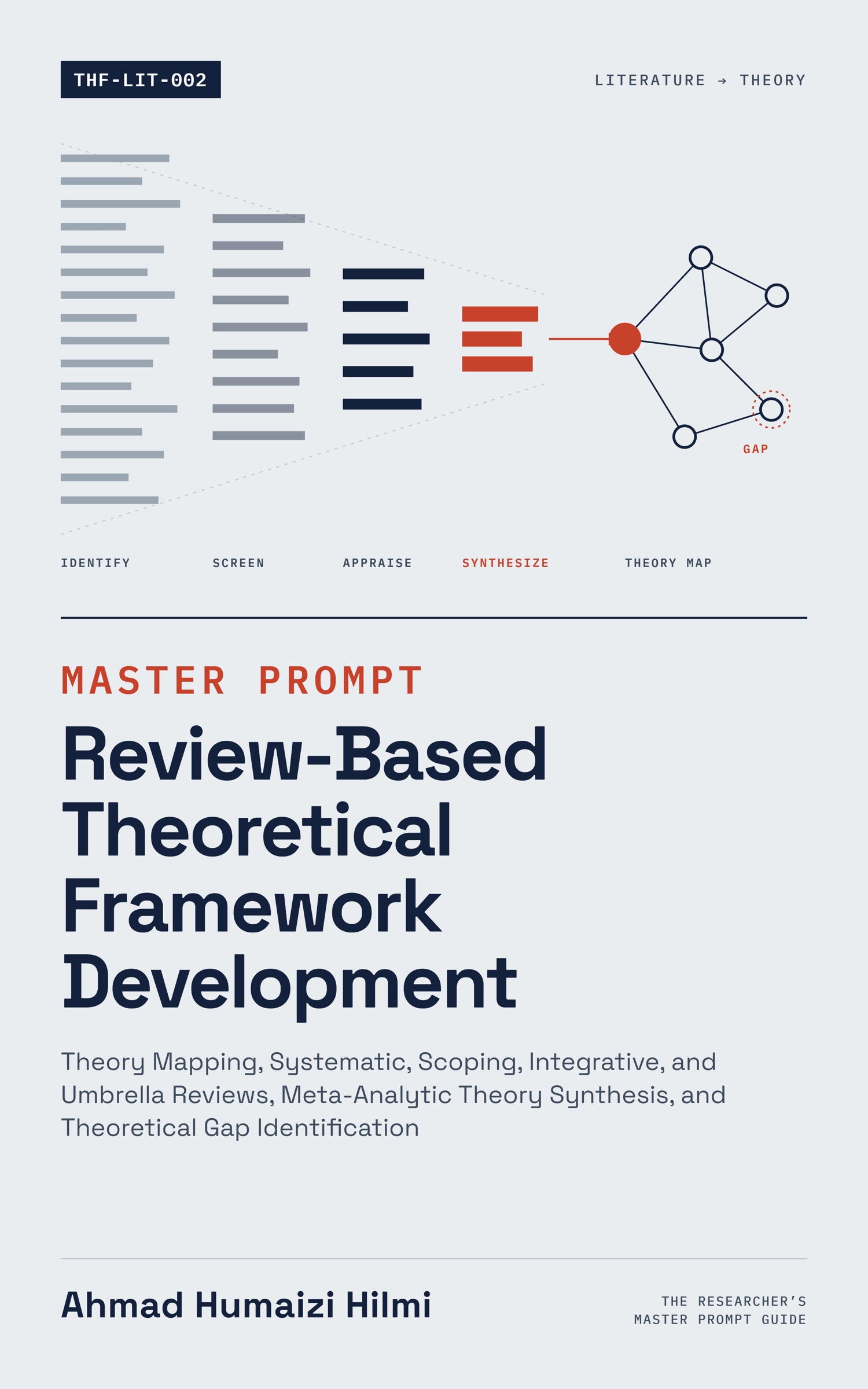
THF-LIT-002 — Review-Based Theoretical Framework Development, Theory Mapping, Systematic, Scoping, Integrative, and Umbrella Reviews, Meta-Analytic Theory Synthesis, and Theoretical Gap Identification
Description
This Master Prompt theme focuses on developing academically rigorous theoretical frameworks through the systematic identification, critical evaluation, classification, and synthesis of theories in the published literature. It examines systematic, scoping, integrative, narrative, umbrella, and rapid reviews, critical interpretive synthesis, meta-ethnography, framework synthesis, meta-analysis and meta-analytic structural equation modelling of theoretical predictors, bibliometric and topic-modelling analysis, social network analysis of theory use, and long-range reviews tracing how theories evolve within a field. The theme addresses how reviews catalogue the theories used in a field, assess how faithfully those theories were applied, identify explanatory mechanisms and active ingredients, examine alignment between theory, measurement, and practice, and translate review findings into an integrated or updated theoretical framework, testable propositions, and a research agenda. Particular attention is given to distinguishing the frequency of theory use from explanatory adequacy, the citation of a theory from its genuine application, thematic recurrence from causal evidence, review-derived frameworks from empirically tested theory, and genuine theoretical gaps from a simple absence of publications. Researchers will be guided in developing review protocols, PRISMA flow diagrams, theory extraction matrices, theory-use classification schemes, appraisal tables, theory maps, network diagrams, meta-analytic models, and transparent review-to-theory pathways. Applications extend across education, healthcare, nursing, management, sustainability, engineering, information science, and the social sciences.