
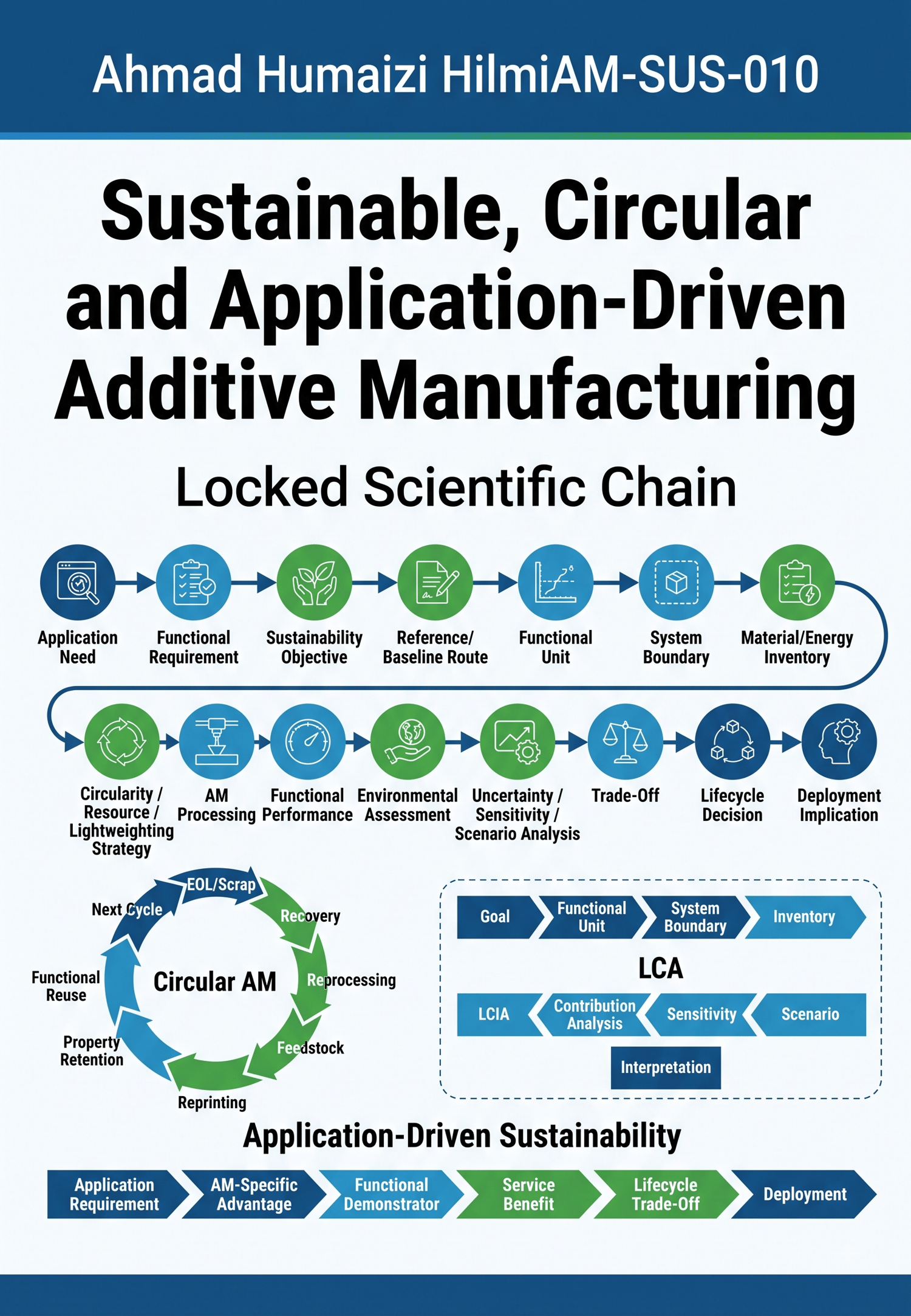
AM-SUS-010 Sustainable, Circular and Application-Driven Additive Manufacturing
Assalamualaikum and good day for you all.
The intention of this master prompt is to help you make draft papers that suitable for your study needs. Frequently journal submissions are being rejected because of inadequate facts and also because of improper writing styles. I had studied papers related to the Master Prompt themes and make the master prompt for it. It is hope that the generated contents may help your research planning in doing experiments, inserting equations, tables, graphs and etc. It is also hope that the journal submission may be accepted at first time.
How to use this book
1. Upload your research proposal into your favourite A.I such as Chatgpt or Gemini or others.
2. Select Master Prompt that you desire that fits your studies.
3. Copy the Master Prompt into the chat so that the A.I will know what to do.
4. Copy the section Prompt one by one beginning with abstract until conclusion. Save the results into Word document
5. The complete contents is the draft for your paper which you may submit for journal submission and others. Revise it, put related figures, tables, graphs, equations, charts as suggested by the prompts.
This is the Master Prompt Series on Additive Manufacturing. The book that you purchase is a part of Master Prompt for Additive Manufacturing. The list of other Master Prompts are as below
AM-PRO-001 — Additive Manufacturing Process Development, Parameter Optimization and Process-Window Control
Covers laser power, scanning speed, feed rate, deposition rate, layer thickness, hatch spacing, overlap, build orientation, preheating, process stability, printability, parameter interactions and optimization. This is strongly represented by studies linking manufacturing conditions with stability, surface roughness and defect formation.
AM-MIC-002 — Microstructure Evolution, Solidification and Process–Structure–Property Relationships in Additive Manufacturing
Covers melt-pool/thermal history, rapid solidification, grain structure, texture, phase transformations, precipitation, segregation, interfaces, anisotropy and resulting mechanical or functional properties. Many of the metallic AM abstracts use precisely this process → microstructure → property logic.
AM-DEF-003 — Defect Formation, Porosity, Residual Stress and Failure Mechanisms in Additive Manufacturing
Covers pores, lack of fusion, keyholing, cracking, distortion, residual stress, geometric imperfections, anisotropy, fatigue cracks, fracture, hydrogen embrittlement and other manufacturing-induced failure mechanisms. The uploaded literature repeatedly treats defects as mechanistically distinct phenomena rather than simply reporting density.
AM-POST-004 — Post-Processing, Heat Treatment and Surface Engineering of Additively Manufactured Materials
Covers heat treatment, annealing, aging, HIP, remelting, friction stir processing, polishing, coating, nitriding and other treatments used to alter defects, microstructure, surface condition and performance. The abstracts show that post-processing frequently constitutes the paper's main scientific contribution rather than merely a final manufacturing step.
AM-DES-005 — Design for Additive Manufacturing, Topology Optimization, Lattice Structures and Toolpath Engineering
Covers DfAM, topology optimization, lattice and TPMS structures, lightweight design, conformal structures, fiber orientation, slicing, non-planar deposition, path planning, supports and manufacturability constraints. The uploaded papers include topology–fiber co-optimization, variable-density lattices and stress-driven print paths.
AM-MULTI-006 — Multi-Material, Composite, Functionally Graded and Hybrid Additive Manufacturing
Covers dissimilar materials, material gradients, composites, continuous-fiber systems, particle reinforcement, hybrid processes, interface formation, diffusion, bonding and multi-material compatibility. The abstracts specifically show that multi-material AM requires a dedicated material → interface → structure → property treatment because successful deposition does not automatically imply a reliable interface.
AM-MOD-007 — Computational Modeling, Simulation and Multiphysics Analysis of Additive Manufacturing
Covers FEM, thermal modelling, melt-pool modelling, solidification, fluid flow, sintering, residual stress, deformation, constitutive modelling, process simulation and experimentally validated predictive models. One example in the collection develops physics-informed sintering modelling for AM densification and deformation.
AM-AIML-008 — Artificial Intelligence, Machine Learning, Digital Twins and Intelligent Additive Manufacturing
Covers ML prediction, physics-informed ML, computer vision, generative AI, inverse design, intelligent optimization, digital twins, explainable AI, closed-loop manufacturing and data-driven process–structure–property modelling. The abstracts already extend from physics-informed prediction to generative inverse design and intelligent AM systems.
AM-QUAL-009 — In-Situ Monitoring, Non-Destructive Evaluation, Quality Assurance and Qualification in Additive Manufacturing
Covers process monitoring, sensing, image analysis, defect detection, NDT, CT, ultrasonic methods, dimensional verification, source identification, uncertainty, repeatability, qualification and certification. The collection even includes ML-based identification of the printer, material, build and build location from manufactured-part images, showing that AM quality assurance is becoming a distinct research field.
AM-SUS-010 — Sustainable, Circular and Application-Driven Additive Manufacturing
Covers recycling and reprocessing, life-cycle assessment, energy and material efficiency, circular manufacturing, economic assessment, resource utilization and deployment into biomedical, aerospace, construction, energy and other functional applications. The collection contains both lifecycle comparisons and recycling-focused AM, showing that sustainability should extend beyond simply reporting reduced material waste.