
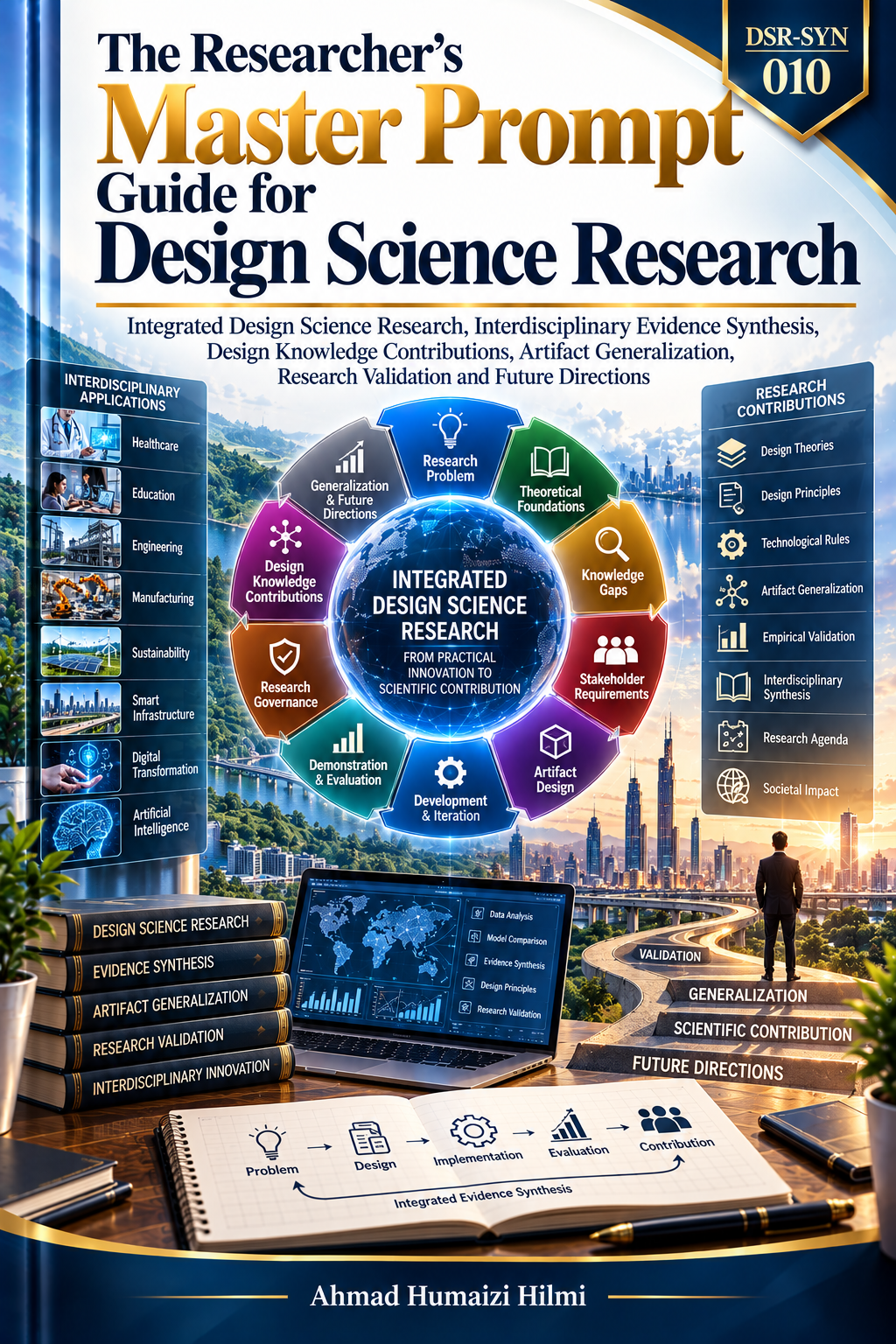
10. DSR-SYN-010 — Integrated Design Science Research, Interdisciplinary Evidence Synthesis, Design Knowledge Contributions, Artifact Generalization, Research Validation and Future Directions
Description
This Master Prompt provides an integrated and interdisciplinary framework for synthesizing theoretical perspectives, methodological approaches, artifact development strategies, evaluation findings and scientific contributions across the major domains of contemporary Design Science Research. It examines the relationships among research problem identification, theoretical foundations, knowledge gaps, stakeholder requirements, artifact conceptualization, design principles, iterative development, demonstration, empirical evaluation, research governance and the generation of transferable design knowledge. Particular emphasis is placed on integrating explanatory and prescriptive knowledge, evaluating the compatibility of theoretical foundations, synthesizing artifact design and evaluation evidence, identifying recurring design principles, and establishing the scientific significance of artifact-oriented research outcomes. The framework supports systematic literature reviews, scoping reviews, bibliometric analysis, meta-analysis where methodologically appropriate, comparative artifact analysis, design theory synthesis, cross-domain methodological evaluation, interdisciplinary conceptual modeling and mixed-method research integration. Researchers are guided in comparing Design Science Research methodologies, evaluating artifact classifications, synthesizing design requirements, identifying common evaluation criteria, assessing methodological rigor and analyzing the relationships among artifact characteristics, implementation contexts, stakeholder outcomes and scientific contributions. The Master Prompt also addresses design knowledge accumulation, artifact generalization, theoretical abstraction, design principles, technological rules, boundary conditions, research reproducibility, evidence triangulation, sensitivity analysis, methodological limitations and the transferability of research findings across different problem environments. It supports the development of integrated Design Science Research frameworks, cross-disciplinary conceptual models, comparative methodology matrices, artifact taxonomy diagrams, research synthesis tables, evaluation evidence maps, design knowledge contribution frameworks and future research roadmaps. Particular attention is given to distinguishing context-specific artifact success from generalizable design knowledge, identifying unresolved methodological debates, evaluating the strength of scientific contributions and developing research agendas involving Artificial Intelligence, digital transformation, intelligent systems, sustainability, healthcare, engineering and socio-technical innovation. The framework provides a comprehensive foundation for developing rigorous, transparent, interdisciplinary and publication-oriented Design Science Research that connects practical innovation with theoretical advancement, empirical validation, ethical responsibility and scientifically defensible contributions.