

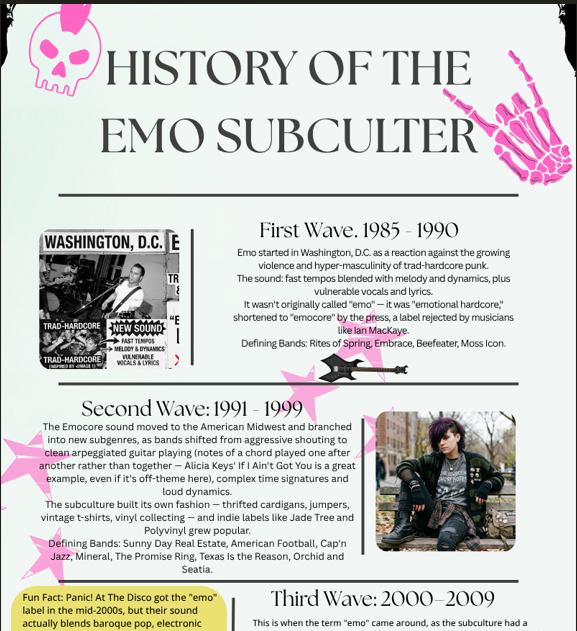
Infographic: History of Emo
Today in society, a lot of bands we classify as “emo” aren’t actually emo, which I find fascinating because I thought they were until I did my deep-dive research for this article, so I hope you all enjoy this Monthly Monday Analysis.
We will be covering the history of the music subculture, music theory and lyrics (what defines the subculture within its genre) and the mix-up of bands.
Please share with others who may find this subject interesting, and don’t forget to subscribe!
So, let’s start at the very beginning -
Introduction
Emo came from the hardcore punk scene in Washington, D.C., in the 1980s, and what made the big difference between the punk scene and Emo was the lyrics, because Emo covers topics of emotions and introspective topics (deep analysis of our personal selves).
Edit: I forgot to mention something very important: within the 80s, it wasn’t called “emo”; it was known as Emotional Hardcore Punk!
Emo grew throughout America within the 90s as it began to become popular; bands started to experiment with different sounds, and a lot of bands started to gain the “emo” label when some took it willingly, others not so much. (We will be talking about the bands in the next chapter).
What I also noticed from the late 90s up until now is that there is a lot of music subculture mumbo jumbo mix-up from punk, un-metal, goth, etc.
But before we go there, to understand more about this music subculture, we should explore the different waves of how it evolved.