
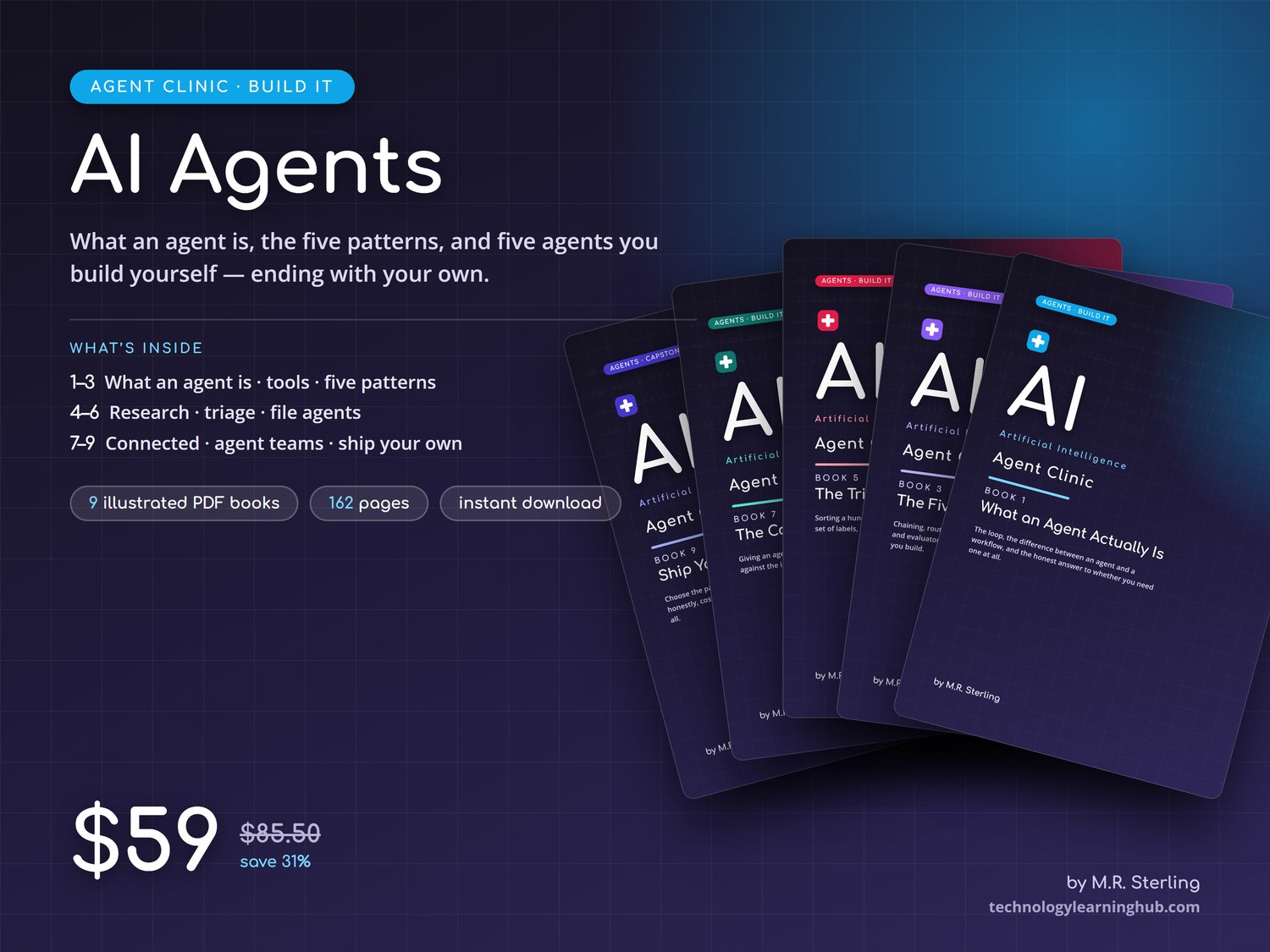
AI Agent Clinic - Complete - 9 books
"AI agent" is used to mean at least four different things, and the confusion is
expensive: people build autonomous agents for jobs a single prompt would have done better
and more cheaply.
So this series starts with the vocabulary. What the agent loop actually is. How tools work
— and why a tool's *description* does more work than the code behind it. The five named
patterns almost every real system is made of: prompt chaining, routing, parallelisation,
orchestrator-workers and evaluator-optimiser. By the time you build anything, you can say
in one sentence what shape it is.
Then five projects, each teaching a different shape. A research agent that knows when to
stop and never cites a page it hasn't opened. A triage agent that sorts a hundred messages
cheaply and lets a human press send. A file agent working on a folder you care about,
under an approval loop. A connected agent, with a serious chapter on prompt injection —
including why the hostile text is as likely to come from your own calendar as from a
malicious server. And a team of agents, where the synthesis step finally gets the
attention it deserves.
it tells you not to build one. Book 1 opens with a student
who wasted a weekend building an agent for a job a prompt did better. Book 3 points out
that four of the five patterns are workflows. Book 9 ends by asking what would break if
you switched yours off.