
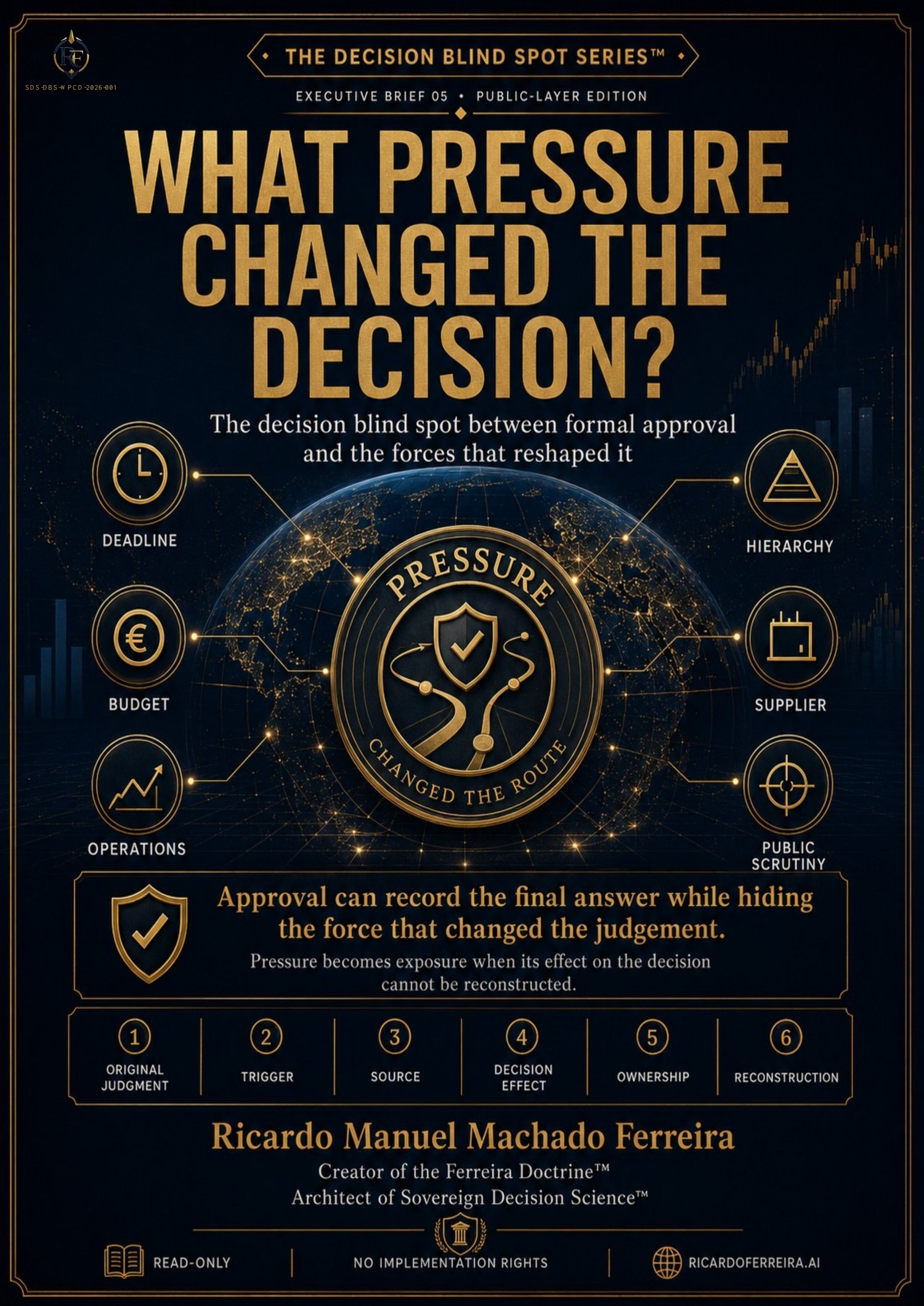
WHAT PRESSURE CHANGED THE DECISION?
𝗪𝗛𝗔𝗧 𝗣𝗥𝗘𝗦𝗦𝗨𝗥𝗘 𝗖𝗛𝗔𝗡𝗚𝗘𝗗 𝗧𝗛𝗘 𝗗𝗘𝗖𝗜𝗦𝗜𝗢𝗡?™
𝘛𝘩𝘦 𝘥𝘦𝘤𝘪𝘴𝘪𝘰𝘯 𝘣𝘭𝘪𝘯𝘥 𝘴𝘱𝘰𝘵 𝘣𝘦𝘵𝘸𝘦𝘦𝘯 𝘧𝘰𝘳𝘮𝘢𝘭 𝘢𝘱𝘱𝘳𝘰𝘷𝘢𝘭 𝘢𝘯𝘥 𝘵𝘩𝘦 𝘧𝘰𝘳𝘤𝘦𝘴 𝘵𝘩𝘢𝘵 𝘳𝘦𝘴𝘩𝘢𝘱𝘦𝘥 𝘪𝘵
A controlled public-layer executive briefing by Ricardo Manuel Machado Ferreira, Creator of the Ferreira Doctrine™ and Architect of Sovereign Decision Science™.
Most material decisions are not made under neutral conditions.
Deadlines tighten.
Budgets close.
Leaders escalate.
Suppliers threaten withdrawal.
Operations warn of interruption.
Public attention grows.
Teams fear delay, blame, service failure or reputational consequence.
The final approval may appear complete while the forces that reshaped the decision remain outside the formal record.
𝗪𝗛𝗔𝗧 𝗣𝗥𝗘𝗦𝗦𝗨𝗥𝗘 𝗖𝗛𝗔𝗡𝗚𝗘𝗗 𝗧𝗛𝗘 𝗗𝗘𝗖𝗜𝗦𝗜𝗢𝗡?™ is a concise executive briefing for leaders and professionals who need to distinguish legitimate constraint from hidden decision pressure.
This is not an argument against urgency, authority or executive intervention.
Pressure is real.
The problem begins when a material force changes the decision, closes alternatives, alters the evidence standard or transfers exposure — but disappears from the final written record.
𝗪𝗛𝗬 𝗧𝗛𝗜𝗦 𝗕𝗥𝗜𝗘𝗙𝗜𝗡𝗚 𝗠𝗔𝗧𝗧𝗘𝗥𝗦
Formal approval does not prove independent judgement.
A recommendation may be properly signed and procedurally valid while failing to disclose:
→ what the original decision route was;
→ what event or instruction changed it;
→ who introduced or amplified the pressure;
→ which option, timetable, criterion or control was altered;
→ whether the person applying pressure had authority to change the decision;
→ what trade-off or residual exposure was accepted;
→ whether challenge and dissent remained possible;
→ who owned the revised decision after approval.
That creates a serious governance problem.
𝘛𝘩𝘦 𝘰𝘳𝘨𝘢𝘯𝘪𝘴𝘢𝘵𝘪𝘰𝘯 𝘮𝘢𝘺 𝘣𝘦 𝘢𝘣𝘭𝘦 𝘵𝘰 𝘱𝘳𝘰𝘷𝘦 𝘸𝘩𝘢𝘵 𝘸𝘢𝘴 𝘢𝘱𝘱𝘳𝘰𝘷𝘦𝘥 𝘸𝘩𝘪𝘭𝘦 𝘳𝘦𝘮𝘢𝘪𝘯𝘪𝘯𝘨 𝘶𝘯𝘢𝘣𝘭𝘦 𝘵𝘰 𝘦𝘹𝘱𝘭𝘢𝘪𝘯 𝘩𝘰𝘸 𝘵𝘩𝘦 𝘥𝘦𝘤𝘪𝘴𝘪𝘰𝘯 𝘣𝘦𝘤𝘢𝘮𝘦 𝘸𝘩𝘢𝘵 𝘪𝘵 𝘸𝘢𝘴.
𝗧𝗛𝗘 𝗚𝗢𝗩𝗘𝗥𝗡𝗜𝗡𝗚 𝗤𝗨𝗘𝗦𝗧𝗜𝗢𝗡
𝘊𝘢𝘯 𝘵𝘩𝘦 𝘰𝘳𝘨𝘢𝘯𝘪𝘴𝘢𝘵𝘪𝘰𝘯 𝘴𝘩𝘰𝘸 𝘸𝘩𝘢𝘵 𝘤𝘩𝘢𝘯𝘨𝘦𝘥 𝘵𝘩𝘦 𝘫𝘶𝘥𝘨𝘦𝘮𝘦𝘯𝘵 𝘣𝘦𝘧𝘰𝘳𝘦 𝘵𝘩𝘦 𝘧𝘪𝘯𝘢𝘭 𝘢𝘱𝘱𝘳𝘰𝘷𝘢𝘭 𝘢𝘱𝘱𝘦𝘢𝘳𝘦𝘥?
𝗪𝗛𝗔𝗧 𝗧𝗛𝗜𝗦 𝗕𝗥𝗜𝗘𝗙𝗜𝗡𝗚 𝗘𝗫𝗔𝗠𝗜𝗡𝗘𝗦
Inside this executive briefing, the reader will examine:
→ why formal approval does not automatically prove independent judgement;
→ what conventional approval records capture — and what they may leave outside;
→ the difference between constraint, influence, material pressure, hidden override and defensible adaptation;
→ how a valid approval can conceal an invisible decision route;
→ the eight questions a defensible pressure record must answer;
→ the public-layer purpose of Pressure Log™;
→ the role of Written-Only Governance™ when material instructions, exceptions and accelerated routes affect a decision;
→ why influence, authority, execution and ownership must remain distinguishable;
→ how hidden pressure appears across Procurement, Finance, Legal, Operations, Risk, Technology, AI, Projects, public institutions and the Board;
→ a non-scored executive exposure test;
→ the next blind spot: accountable decision ownership.
𝗧𝗛𝗘 𝗣𝗥𝗘𝗦𝗦𝗨𝗥𝗘 𝗣𝗔𝗧𝗛
A defensible record should be able to explain:
→ 𝗢𝗿𝗶𝗴𝗶𝗻𝗮𝗹 𝗷𝘂𝗱𝗴𝗲𝗺𝗲𝗻𝘁 — What was recommended before material pressure appeared?
→ 𝗧𝗿𝗶𝗴𝗴𝗲𝗿 — What deadline, threat, dependency, instruction or event altered the decision context?
→ 𝗦𝗼𝘂𝗿𝗰𝗲 — Who introduced, transmitted or amplified the pressure?
→ 𝗗𝗲𝗰𝗶𝘀𝗶𝗼𝗻 𝗲𝗳𝗳𝗲𝗰𝘁 — Which option, criterion, timetable, assumption, control or accepted exposure changed?
→ 𝗔𝘂𝘁𝗵𝗼𝗿𝗶𝘁𝘆 — Who had the power to accept the revised route?
→ 𝗧𝗿𝗮𝗱𝗲-𝗼𝗳𝗳 — What value was protected and what exposure was accepted?
→ 𝗢𝘄𝗻𝗲𝗿𝘀𝗵𝗶𝗽 — Who remained accountable for the changed decision?
→ 𝗥𝗲𝗰𝗼𝗻𝘀𝘁𝗿𝘂𝗰𝘁𝗶𝗼𝗻 — Can an independent reviewer distinguish the original judgement from the final pressured outcome?
𝗧𝗛𝗜𝗦 𝗕𝗥𝗜𝗘𝗙𝗜𝗡𝗚 𝗛𝗘𝗟𝗣𝗦 𝗟𝗘𝗔𝗗𝗘𝗥𝗦 𝗨𝗡𝗗𝗘𝗥𝗦𝗧𝗔𝗡𝗗
→ why urgency does not automatically prove necessity;
→ why senior authority does not remove the need for a defensible record;
→ how supplier leverage can be converted into an apparently unavoidable decision;
→ how budget deadlines become decision deadlines without explicit justification;
→ how operational dependency can silently eliminate alternatives;
→ how pressure can weaken challenge before the formal approval is written;
→ why the person influencing a decision may not own its consequence;
→ why written visibility protects both authority and accountability;
→ why a final approval record can be accurate but still incomplete.
𝗜𝗟𝗟𝗨𝗦𝗧𝗥𝗔𝗧𝗜𝗩𝗘 𝗘𝗫𝗣𝗢𝗦𝗨𝗥𝗘
Consider a critical technology-service renewal.
The evaluation team initially recommends a competitive re-tender because of concentration risk, weak recovery evidence and increasing cost.
Before expiry:
→ the incumbent warns that continuity cannot be guaranteed without immediate renewal;
→ Operations states that migration is not ready;
→ Finance requires commitment before the budget closes;
→ a senior executive directs the team to prevent public disruption.
The final paper recommends renewal.
But the record does not preserve:
→ the earlier re-tender position;
→ whether the supplier warning was tested;
→ how previous planning decisions created the dependency;
→ why the budget date became a decision deadline;
→ how executive pressure changed the available options;
→ who accepted ownership of the resulting concentration and continuity exposure.
The renewal may still be the correct decision.
𝘛𝘩𝘦 𝘰𝘳𝘨𝘢𝘯𝘪𝘴𝘢𝘵𝘪𝘰𝘯 𝘮𝘢𝘺 𝘯𝘦𝘷𝘦𝘳𝘵𝘩𝘦𝘭𝘦𝘴𝘴 𝘣𝘦 𝘶𝘯𝘢𝘣𝘭𝘦 𝘵𝘰 𝘥𝘦𝘮𝘰𝘯𝘴𝘵𝘳𝘢𝘵𝘦 𝘸𝘩𝘺 𝘵𝘩𝘦 𝘤𝘩𝘢𝘯𝘨𝘦𝘥 𝘥𝘦𝘤𝘪𝘴𝘪𝘰𝘯 𝘳𝘦𝘮𝘢𝘪𝘯𝘦𝘥 𝘥𝘦𝘧𝘦𝘯𝘴𝘪𝘣𝘭𝘦.
𝗪𝗛𝗢 𝗧𝗛𝗜𝗦 𝗕𝗥𝗜𝗘𝗙𝗜𝗡𝗚 𝗜𝗦 𝗙𝗢𝗥
This briefing is relevant to:
→ Procurement;
→ Supply Chain;
→ Finance and CFO functions;
→ Legal and Contract Management;
→ Operations and COO functions;
→ Risk and Compliance;
→ Audit;
→ Technology and Cybersecurity;
→ AI Governance;
→ Projects and PMO;
→ public institutions;
→ regulated organisations;
→ executive leadership teams;
→ boards and board committees.
𝗧𝗛𝗜𝗦 𝗕𝗥𝗜𝗘𝗙𝗜𝗡𝗚 𝗖𝗢𝗡𝗡𝗘𝗖𝗧𝗦 𝗗𝗜𝗥𝗘𝗖𝗧𝗟𝗬 𝗧𝗢
This is the fifth briefing in The Decision Blind Spot Series™ and connects directly to:
→ Who Owned the Decision?™
→ An Audit Trail Is Not an Evidence Chain™
→ Supplier Performance Is Not Supplier Integrity™
→ What Risk Registers Cannot See™
→ Why TCO Stops Too Early™
It also connects to the wider public-layer decision route:
→ The Executive Decision Defensibility Audit™
→ The Public Decision Record Pack™
→ The 72-Hour Decision Readiness Test™
→ The Boardroom Consequence Brief™
→ The Procurement Decision Failure Test™
→ Supplier Failure Before Impact™
→ The Contract Exposure Note™
→ Decision Integrity Exposure Brief™ — When One Update Stops the World™
→ The Hormuz Decision Test™
→ When Hormuz Moves, Every Contract Moves™
→ Executive Decision Defensibility Review™
Relevant catalogue bundles include:
→ The Decision Blind Spot Starter Bundle™
→ Procurement Exposure Starter Bundle™
→ Executive Governance Shift Bundle™
→ Complete Shift Series Bundle™
𝗧𝗛𝗘 𝗖𝗘𝗡𝗧𝗥𝗔𝗟 𝗣𝗥𝗜𝗡𝗖𝗜𝗣𝗟𝗘
𝗔𝗽𝗽𝗿𝗼𝘃𝗮𝗹 𝗰𝗮𝗻 𝗿𝗲𝗰𝗼𝗿𝗱 𝘁𝗵𝗲 𝗳𝗶𝗻𝗮𝗹 𝗮𝗻𝘀𝘄𝗲𝗿 𝘄𝗵𝗶𝗹𝗲 𝗵𝗶𝗱𝗶𝗻𝗴 𝘁𝗵𝗲 𝗳𝗼𝗿𝗰𝗲 𝘁𝗵𝗮𝘁 𝗰𝗵𝗮𝗻𝗴𝗲𝗱 𝘁𝗵𝗲 𝗷𝘂𝗱𝗴𝗲𝗺𝗲𝗻𝘁.
Pressure is not automatically misconduct.
The governance failure is allowing a material force to change the decision without preserving:
→ its source;
→ its decision effect;
→ its authority;
→ its trade-off;
→ its ownership;
→ its future defensibility.
𝗧𝗛𝗘 𝗡𝗘𝗫𝗧 𝗕𝗟𝗜𝗡𝗗 𝗦𝗣𝗢𝗧
Visible pressure does not automatically create accountable ownership.
The record may show what changed and who approved the revised route while still leaving no recognised person accountable for the decision as a continuing institutional obligation.
The natural next briefing is:
→ 𝗪𝗛𝗢 𝗢𝗪𝗡𝗘𝗗 𝗧𝗛𝗘 𝗗𝗘𝗖𝗜𝗦𝗜𝗢𝗡?™
𝗥𝗘𝗖𝗢𝗠𝗠𝗘𝗡𝗗𝗘𝗗 𝗡𝗘𝗫𝗧 𝗦𝗧𝗘𝗣
Readers seeking deeper public-layer understanding should continue with:
→ Who Owned the Decision?™
→ An Audit Trail Is Not an Evidence Chain™
→ The Public Decision Record Pack™
→ The 72-Hour Decision Readiness Test™
→ The Boardroom Consequence Brief™
→ The Executive Decision Defensibility Audit™
Readers requiring a qualified written assessment of a defined decision, supplier exposure, contract position, technology dependency, governance exposure or continuity risk can continue to:
→ Executive Decision Defensibility Review™
𝗣𝗥𝗢𝗗𝗨𝗖𝗧 𝗜𝗡𝗙𝗢𝗥𝗠𝗔𝗧𝗜𝗢𝗡
Document ID: SDS-DBS-WPCD-2026-001
Series: The Decision Blind Spot Series™
Brief: Executive Brief 05
Edition: Controlled Public-Layer Edition
Format: 15-page executive PDF briefing
Language: English
Delivery: Immediate digital download
Access: Individual read-only controlled public-layer access
Price: €9.90
𝗜𝗠𝗣𝗢𝗥𝗧𝗔𝗡𝗧 𝗥𝗜𝗚𝗛𝗧𝗦 𝗔𝗡𝗗 𝗨𝗦𝗘 𝗕𝗢𝗨𝗡𝗗𝗔𝗥𝗬
This is a paid controlled public-layer written product for individual reading and executive awareness.
Purchase grants the individual purchaser a personal, non-transferable, read-only right to access the published briefing.
Purchase does not grant rights to:
→ organisational implementation;
→ pressure-governance architecture;
→ pressure-classification systems;
→ scoring or threshold systems;
→ escalation architecture;
→ ownership-allocation systems;
→ internal or external training;
→ consultancy or advisory reuse;
→ reproduction, extraction, repackaging or redistribution;
→ resale or sublicensing;
→ adaptation or derivative development;
→ operational templates;
→ software translation or embedding;
→ dashboard or workflow development;
→ ERP or MRP integration;
→ API development;
→ AI or LLM ingestion, training, modelling, retrieval or dataset use;
→ institutional, commercial or governmental deployment.
No formula, mathematical model, weighting, coefficient, threshold, score band, classification rule, decision gate, calibration method, custody protocol, protected taxonomy, executable sequence, implementation workflow, software logic, Evidence Architecture or integration mechanism is transferred through this product.
Formal written licensing is required for institutional, implementation, training, software, AI, workflow, derivative or organisational use.
No licence, implementation right, software right, training right, deployment right, derivative right, AI/LLM ingestion right or institutional-use right is granted unless expressly agreed in writing under separate scope, separate pricing and formal written authorisation.
This product is not legal advice, governance advice, audit advice, financial advice, procurement consultancy, compliance advice, training, software, an operational template package or an implementation system.
𝘛𝘩𝘦 𝘱𝘶𝘣𝘭𝘪𝘤 𝘭𝘢𝘺𝘦𝘳 𝘦𝘹𝘱𝘭𝘢𝘪𝘯𝘴 𝘵𝘩𝘦 𝘦𝘹𝘱𝘰𝘴𝘶𝘳𝘦.
𝘛𝘩𝘦 𝘌𝘹𝘦𝘤𝘶𝘵𝘪𝘷𝘦 𝘙𝘦𝘷𝘪𝘦𝘸 𝘤𝘳𝘦𝘢𝘵𝘦𝘴 𝘲𝘶𝘢𝘭𝘪𝘧𝘪𝘦𝘥 𝘥𝘪𝘢𝘨𝘯𝘰𝘴𝘪𝘴.
𝘐𝘯𝘴𝘵𝘪𝘵𝘶𝘵𝘪𝘰𝘯𝘢𝘭 𝘭𝘪𝘤𝘦𝘯𝘴𝘪𝘯𝘨 𝘢𝘶𝘵𝘩𝘰𝘳𝘪𝘴𝘦𝘴 𝘤𝘰𝘯𝘵𝘳𝘰𝘭𝘭𝘦𝘥 𝘰𝘳𝘨𝘢𝘯𝘪𝘴𝘢𝘵𝘪𝘰𝘯𝘢𝘭 𝘶𝘴𝘦.
𝗢𝗙𝗙𝗜𝗖𝗜𝗔𝗟 𝗔𝗖𝗖𝗘𝗦𝗦
Official website:
https://www.ricardoferreira.ai/
Institutional licensing:
General contact:
Rights and intellectual property:
𝗥𝗶𝗰𝗮𝗿𝗱𝗼 𝗠𝗮𝗻𝘂𝗲𝗹 𝗠𝗮𝗰𝗵𝗮𝗱𝗼 𝗙𝗲𝗿𝗿𝗲𝗶𝗿𝗮
Creator of the Ferreira Doctrine™
Architect of Sovereign Decision Science™