
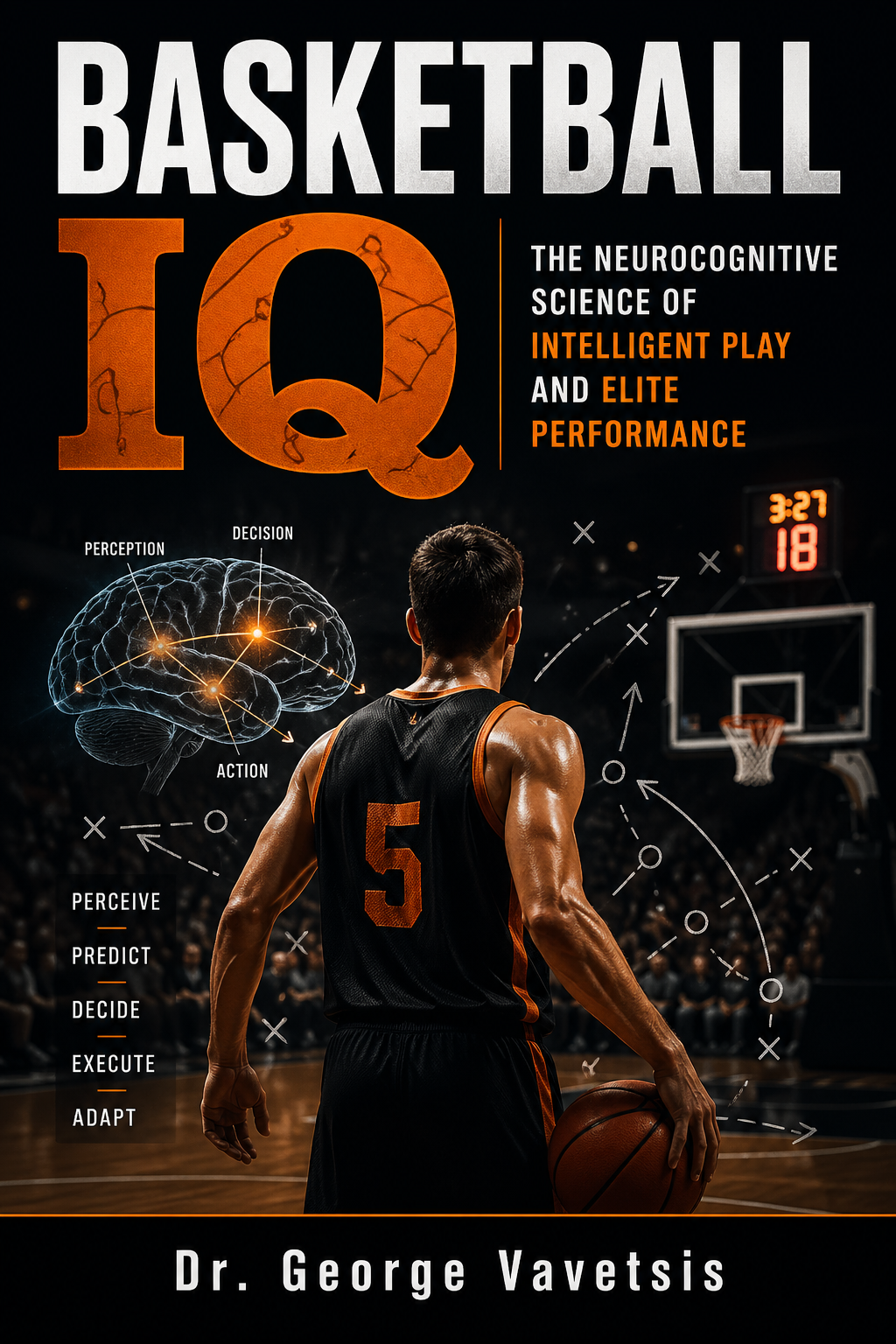
Basketball IQ
Pages: 1115
Basketball has often been described through the language of instinct, talent, rhythm, feel, and creativity. Coaches speak of players who “understand the game,” commentators praise athletes with “high basketball IQ,” and spectators instinctively recognize the difference between a player who merely performs movements and one who truly interprets the dynamic logic of competition. Yet despite the universal use of this terminology, the concept of Basketball IQ has remained largely undefined, trapped between anecdotal observation and abstract interpretation. This book was written to bridge that gap.
The purpose of this work is to examine Basketball IQ not as a mystical or purely intuitive characteristic, but as a measurable neurocognitive performance system emerging from the interaction of perception, action, decision-making, movement organization, environmental constraints, tactical adaptation, and neural efficiency. Basketball is among the most demanding open-skill sports ever created. It requires the continuous integration of sensory information, rapid prediction of unfolding events, anticipatory movement control, executive decision-making under pressure, and the synchronization of individual behavior within a constantly evolving collective system.
Unlike closed-skill activities where movement patterns can be stabilized and repeated under predictable conditions, basketball unfolds within a chaotic ecological environment. The athlete must continuously process visual, vestibular, proprioceptive, auditory, and tactical information while simultaneously solving spatial-temporal problems under severe time pressure. Every possession becomes a neurocognitive challenge. Every defensive rotation, passing lane, transition sequence, closeout, or weak-side cut represents a dynamic interaction between the brain, the body, teammates, opponents, and the competitive environment.
The modern game has evolved far beyond the simplistic interpretation of technical skill acquisition. Shooting mechanics, dribbling ability, passing accuracy, and athleticism remain essential, but they are no longer sufficient to explain elite performance. The difference between average and elite players increasingly lies in the speed and sophistication of information processing. Elite athletes perceive game affordances earlier, anticipate opponent intentions more accurately, regulate attentional focus more efficiently, and execute tactical decisions with greater precision under fatigue and emotional stress.
This book therefore approaches Basketball IQ through the lens of neuroscience, motor control, biomechanics, ecological dynamics, cognitive psychology, systems theory, and performance science. The central premise is that tactical intelligence is not a singular attribute located in one isolated region of the brain or one specific psychological capacity. Rather, it is an emergent property arising from the integration of multiple neurobiological and environmental systems.
Throughout these chapters, the reader will encounter concepts traditionally associated with advanced scientific disciplines: predictive coding, perception–action coupling, executive function, neural efficiency, affordance perception, attentional gating, motor anticipation, cortico-cerebellar coordination, ecological adaptability, and dynamic systems theory. These concepts are not introduced merely for theoretical sophistication. They are presented because modern basketball itself demands them.
At the elite level, the game operates at velocities where conscious analytical thought alone is insufficient. Decisions must often emerge before complete information becomes available. Players do not simply react; they predict. They do not merely execute movements; they continuously reorganize movement solutions under evolving constraints. They do not process isolated stimuli; they integrate multiple layers of tactical information simultaneously while maintaining biomechanical efficiency and emotional control.
The greatest players in basketball history have demonstrated extraordinary capacities for anticipatory intelligence. Their genius often appears effortless because years of deliberate exposure, neural adaptation, tactical pattern recognition, and perceptual refinement have transformed conscious processing into automatic expertise. What appears instinctive on the surface is frequently the result of deeply organized neurocognitive architecture.
Importantly, this book also argues that Basketball IQ is trainable.
For decades, talent identification systems have frequently treated tactical intelligence as an innate characteristic—something an athlete either possesses or lacks. Such assumptions limit player development. Neuroplasticity research demonstrates that the brain continuously adapts to environmental exposure, deliberate practice, attentional demands, and cognitive stressors. Tactical decision-making, perceptual speed, pattern recognition, and anticipatory behavior can all be systematically developed when training environments are appropriately designed.
This perspective carries profound implications for coaches, strength and conditioning specialists, sport scientists, psychologists, rehabilitation professionals, and performance departments. If Basketball IQ can be enhanced through targeted interventions, then player development must evolve beyond traditional repetitive technical drills toward integrated neurocognitive ecosystems.
Training design should therefore incorporate constraint-led learning environments, variable decision-making tasks, ecological game simulations, perceptual overload strategies, attentional manipulation, reaction-based conditioning, fatigue-integrated tactical execution, and movement solutions requiring continuous adaptation. The future of basketball development belongs not merely to stronger or faster athletes, but to athletes capable of processing and organizing information more efficiently under competitive stress.
In many ways, basketball represents one of the purest expressions of human adaptive intelligence. The court becomes a living laboratory of perception, anticipation, emotional regulation, timing, spatial interpretation, and cooperative problem-solving. Within seconds, athletes transition between offensive and defensive identities, reorganize movement behavior, interpret uncertainty, and create order within chaos.
The challenge for modern performance science is to understand these processes without reducing the beauty of the game into mechanistic simplification. Basketball remains an art form as much as a scientific phenomenon. The elegance of a perfectly timed assist, the anticipation of a passing lane steal, the manipulation of defensive spacing, or the synchronization of collective movement transcends numerical analysis alone. Yet scientific understanding can illuminate the hidden structures that support such artistry.
This book was written for those who wish to study basketball at its deepest levels: coaches searching for more effective developmental models, sport scientists seeking interdisciplinary integration, neuroscientists interested in open-skill expertise, performance specialists designing advanced training systems, and athletes striving to expand the limits of tactical awareness.
The chapters that follow aim not merely to explain Basketball IQ, but to redefine it.
Basketball intelligence is not simply knowledge of plays, memorization of tactical systems, or the ability to recognize patterns. It is the integrated orchestration of neural prediction, perceptual attunement, executive regulation, biomechanical coordination, and adaptive movement behavior under dynamic competitive constraints.
Ultimately, Basketball IQ represents the capacity to perceive possibilities before they fully emerge, to organize action under uncertainty, and to transform complexity into intelligent performance.