
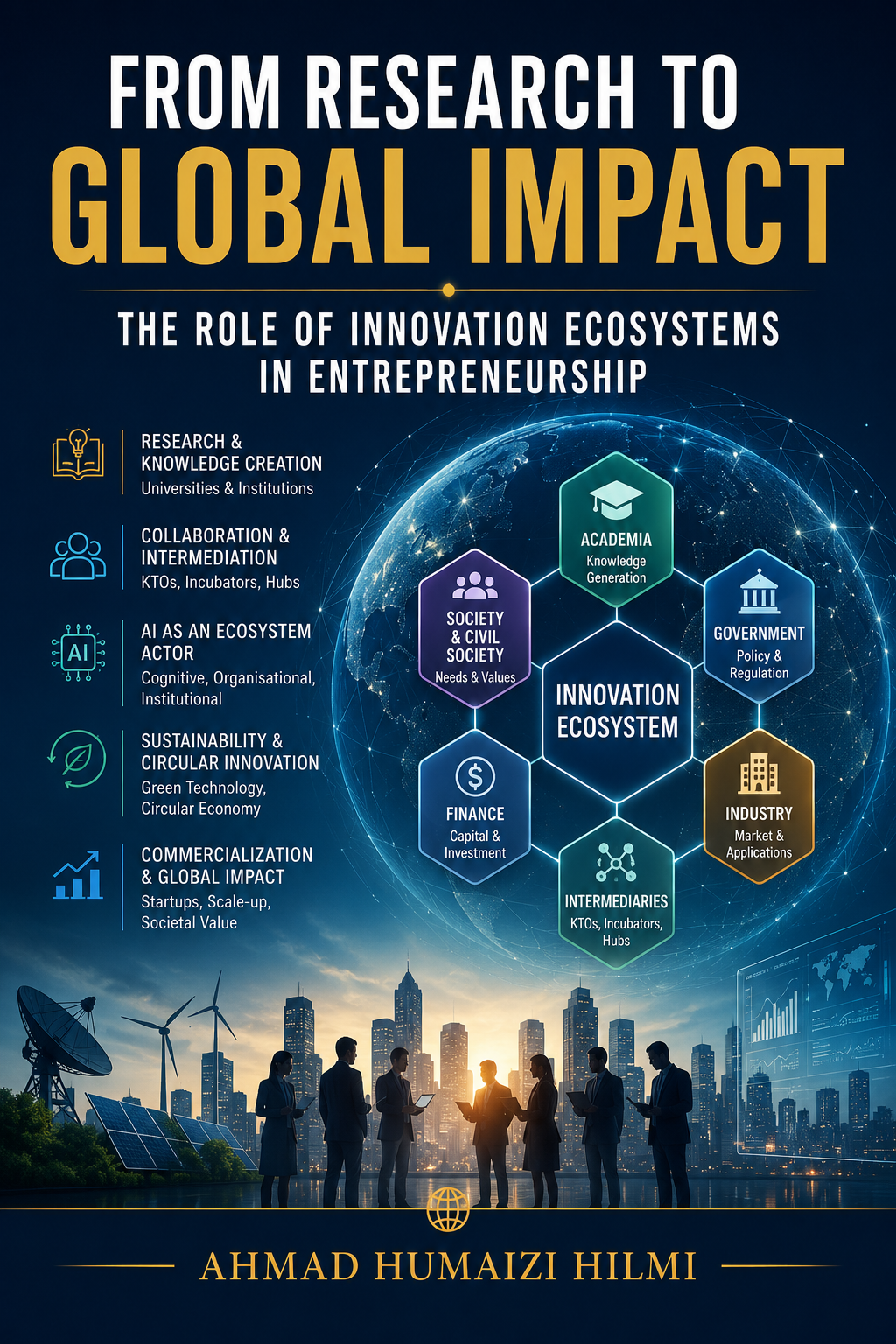
From Research to Global Impact The Role of Innovation Ecosystems in Entrepreneurship
This review synthesizes conceptual and empirical work on innovation ecosystems to identify how actor configurations, mechanisms and validation practices shape innovation trajectories in emerging economies. It compares extensions of the Triple-Helix, including a Six-Helix framing, with multi-level accounts that treat artificial intelligence as a cognitive, organisational and institutional actor. Methodologically the literature spans bibliometric mapping, grounded process models, multiple-case fieldwork, large-N analyses and applied machine learning, each illuminating different parts of the pipeline from knowledge production to market outcomes. Repeated findings show intermediaries and Knowledge Transfer Offices reduce transaction costs, coordinate regulatory and reimbursement planning, and operationalize university-to-market translation. Innovation studies distinguish product, process, service, management and business-model change, and highlight complementarities between green-technology investment and circular practices. Prototype and commercialization evidence, notably MediGate in MedTech and lightweight ML detectors for edge deployment, stress early regulatory, safety and stakeholder alignment alongside technical metrics. Financing and scale-up benefit from staged instruments and AI-assisted investor screening but remain conditioned by local institutions. The review identifies priority gaps: harmonised KPI sets, longitudinal and cross-country datasets, and empirical audits of algorithmic governance and fairness to support more inclusive, sustainable innovation policy.