
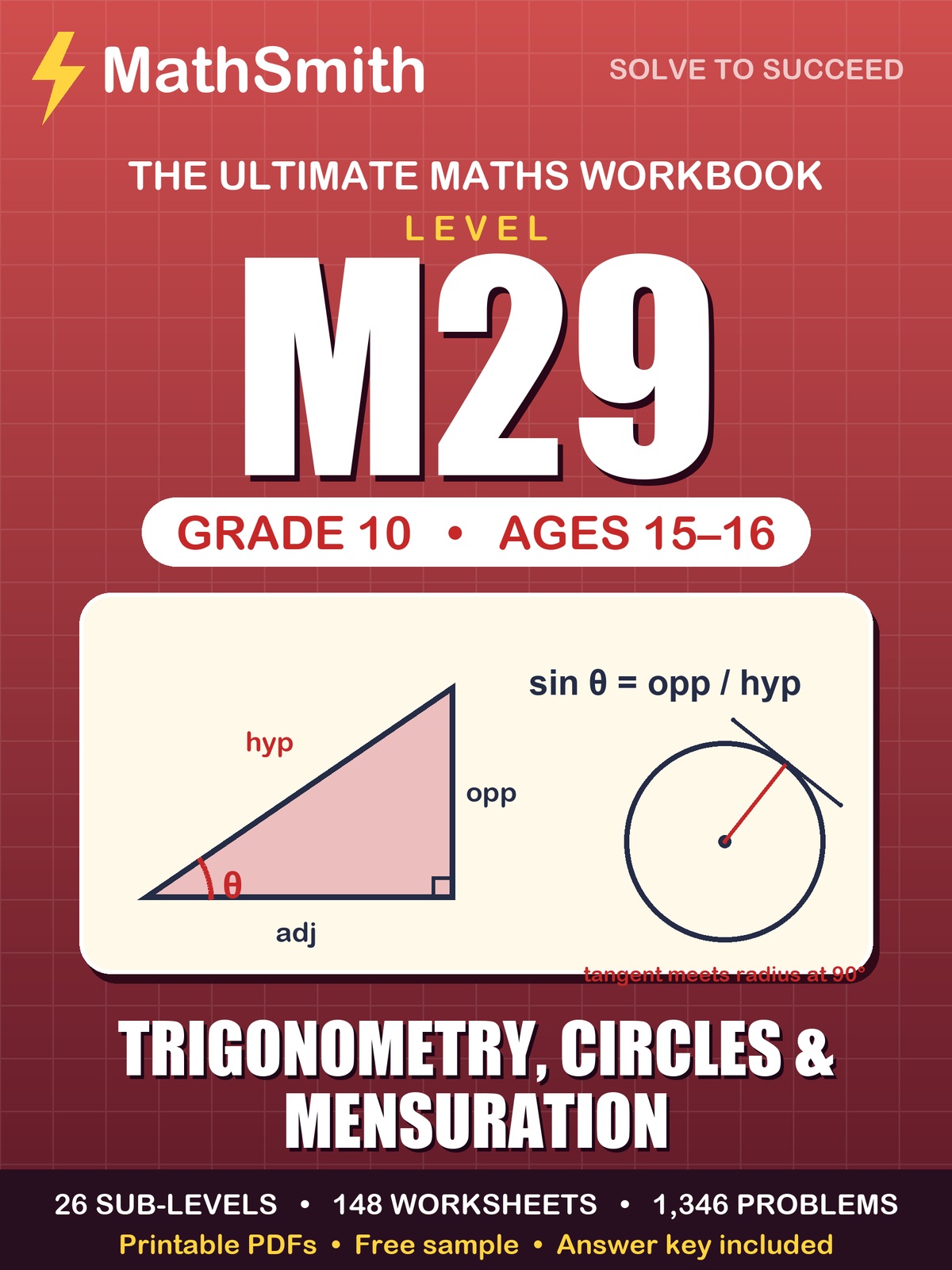
Gr 10 Maths Worksheets (Ages 15-16) | Level M29: Trigonometry, Circles & Mensuration
🎓 Launch offer: 80% OFF every MathSmith workbook with code LAUNCH80 (first 1000 orders). Click Add to Cart, then enter LAUNCH80 in the discount box before you pay.
Not sure which level your child needs? Take the free 40-question placement test: https://ebooks.thecodecrafters.net/placement
See free sample pages first: https://ebooks.thecodecrafters.net/
Help your child build absolute confidence and mastery in mathematics. This comprehensive workbook from MathSmith takes a highly structured, "one-rung-at-a-time" approach to Trigonometry, Circles and Mensuration, ensuring students fully understand concepts before moving forward.
Instead of overwhelming learners with random equations, this workbook uses a carefully scaffolded, predictable learning ladder. It is perfect for homework, structured independent study, or mastery practice.
📊 What Is Included?
1 Complete Level (Level M29)
26 Structured Sub-levels for gradual progression
148 Printable Worksheets
1,346 Total Problems for thorough practice
Full Answer Key online, unlocked by the order ID on your Payhip receipt, for quick, stress-free marking
🗺️ Curriculum Breakdown
This collection focuses deeply on mastering Trigonometry, Circles and Mensuration through a carefully curated system:
The sides, and the six numbers they make between them (2 Sub-levels): Two rungs, and the first of them is the level's notation. The hypotenuse belongs to the triangle - it faces the right angle and it is the same side whichever corner you stand at. Opposite and adjacent belong to the ANGLE: walk to the other acute corner and the two of them swap with not one line of the drawing changed, which is M28's order-of-the-letters one storey up. Then the six ratios, each two of the three sides divided one by the other - and the reason any of them is worth a name, which is that every right triangle with that angle in it is similar to every other, so the answer is the same for all of them.
The angles whose ratios can be written down exactly (4 Sub-levels): Three rungs on the table and one on using it. Half an equilateral triangle gives 30 and 60 degrees; half a square gives 45; and squashing the triangle flat or opening it right out gives 0 and 90. Half of these answers cannot be written without a root sign, which is M22 coming back with a job to do, and one of them cannot be written at all: tan 90 degrees is NOT DEFINED, which is an answer rather than a gap and the only place in the series where the answer is that the question has none. Nothing is measured and nothing is rounded - an expression built out of exact values has an exact answer, and 0.9999999 is not one.
Four rungs where the ratios are compared with each other (4 Sub-levels): The two acute angles of a right triangle add to 90 degrees, so each is the complement of the other - and the side opposite one is the side adjacent to the other. That makes sin of an angle equal to cos of its complement, which is what the co in cosine has meant all along. Then the identities, which are one theorem and not three: Pythagoras divided by the hypotenuse squared, by the adjacent squared, and by the opposite squared. Which side you divided by is the whole of the difference between them. Proving one is M24's discipline in algebra - one side at a time, because working on both at once assumes the thing being shown.
Measuring something nobody can reach (4 Sub-levels): Four rungs, and the notation is the horizontal. An angle of elevation is measured between the line of sight and the ground, which is a real side of the triangle. An angle of DEPRESSION is measured against a horizontal that leaves the top of the tower and touches nothing at all - so it is drawn dashed and it lies outside the triangle, and a child who marks it inside has marked its complement and will get a wrong answer off a right method. Then the point of the whole strand: a height off a length and an angle. And then two sightings of one height, where neither triangle can be solved alone and the side they share is what joins them.
The edge of a circle rather than the inside of it (3 Sub-levels): One fact carries three rungs: a tangent touches at exactly one point, and the radius drawn there is at right angles to it. That right angle is a CLAIM, so the figures draw it as a square on a corner that really is one - the point of contact is worked out rather than typed - and it is why every tangent question turns into a right-triangle question. How many tangents there are is decided by where the point is, so the drawing prints the distance rather than leaving it to the eye. And from an outside point the two tangents are equal, which is two right triangles on one shared hypotenuse.
Three things made with the instruments (3 Sub-levels): M13's bargain again: a workbook cannot mark a child's drawing, so the figure shows the arcs SO FAR and stops, and the question is which one comes next and why. The tangent from an outside point is built on a circle theorem - the angle in a semicircle is a right angle - so the right angle is MADE rather than measured. Then a segment cut in a given ratio, where the count of equal steps is m plus n and never either of them on its own, and the same construction carried onto a whole triangle, which is M28's similarity built rather than argued about.
A share of a circle, and areas that are differences (3 Sub-levels): A sector is a SHARE and the share is taken twice - of the circumference for the arc, of the area for the area. Its perimeter includes the two radii, because an arc closes nothing on its own. Then the segment, which is the first area on the level that is a DIFFERENCE: sector take away triangle. A chord cuts a circle into two segments, so the one meant is shaded - asked in words alone the question has two right answers and a key can print only one. Then shapes added and cut out of each other, where the shading is the question: the same lines on the paper are two different questions.
Two solids joined, and what stops being surface (2 Sub-levels): The level's quietest wrong answer, and the one that looks most like care: adding the two surface areas up. Where a cone sits on a cylinder, two circles have stopped being surface - they are inside the solid now and cannot be painted - so the total is never the sum of the two. The drawing says so by dashing the seam all the way round, because there is no near half of it that anybody can see. And then the rung that is set beside it on purpose: volumes DO add, because the join has no thickness, and melting a solid down keeps its volume and nothing else at all.
The closing rung, and a solid that is a difference (1 Sub-level): A cone with its top cut off. Every rule for a frustum remembers the small cone that went - its curved surface is the big cone's sheet with the little one's taken out, and its volume is the same subtraction. Its slant height is on its surface and its vertical height is not, which is M25's notation met on a shape with two radii instead of one, and the slant is the hypotenuse of a right triangle whose legs are the height and the DIFFERENCE of the two radii - the small cone that left, drawn as a triangle.
🎯 Who Is This For?
Parents looking to provide structured math support at home.
Homeschoolers searching for a sequential curriculum to guarantee zero gaps in math skills.
Teachers & Tutors looking for bite-sized, scaffolded printables for classroom morning work or targeted intervention.
📖 How To Use This Workbook
Print the workbook, read each rung's method page, and let your child work inside the printed frame. Then check the answers your way: in the printable answer-key PDF included in this download, or online, one page at a time, with the order ID on your Payhip receipt (valid for six months). Please keep the answer key for the adult marking the work and do not share it with your child: the workbook only works if they have worked each answer out for themselves.
Step-by-step manual and video guide: https://ebooks.thecodecrafters.net/manual/
Check the answers: https://ebooks.thecodecrafters.net/answers
⚙️ Digital Delivery Details
Format: four instant-download PDFs (free sample, sample answers, workbook, full answer key). The answer key is also available online.
Print Ready: Easily printable on home or school printers.
Usage: Licensed for individual family or single-classroom use.