
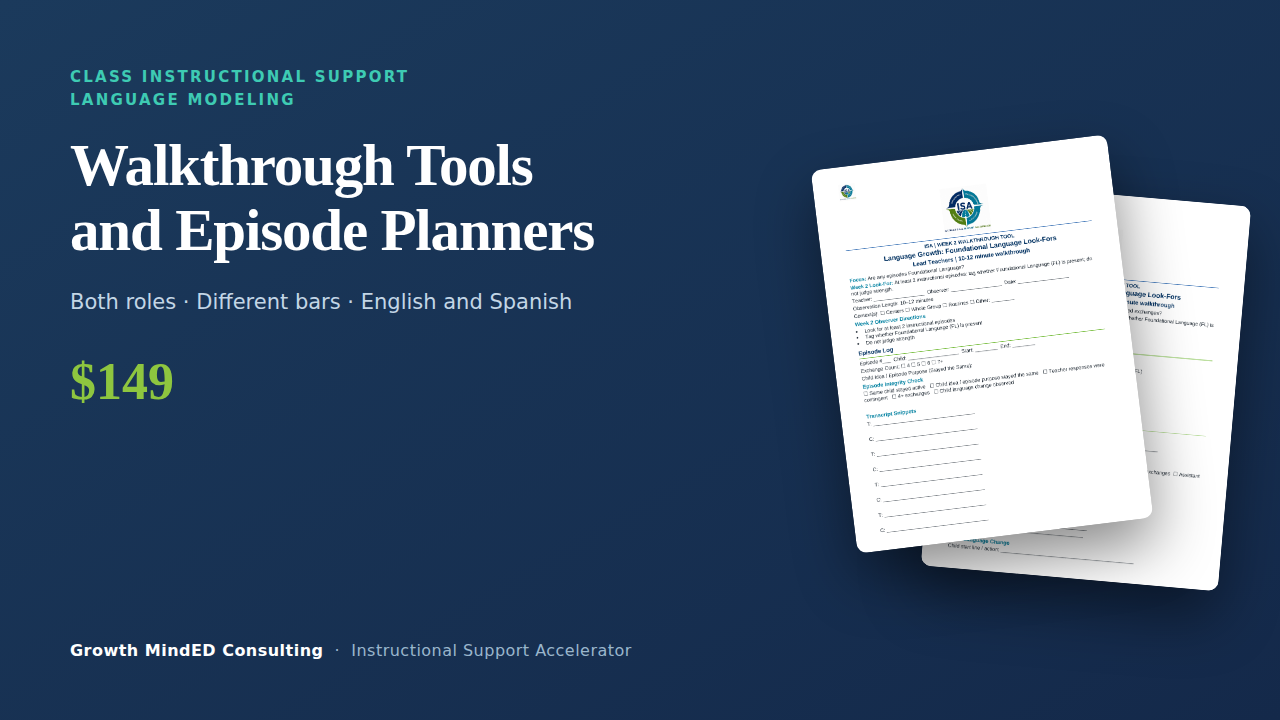
Language Modeling: Walkthrough Tools and Episode Planners
Most PreK rooms have two adults and most walkthrough tools hold both to the same bar. These do not.
Lead Teachers are observed for a full episode: four or more back and forth exchanges. Associate and Assistant Teachers are observed for a connected exchange: two to three exchanges on the same child idea. Holding an assistant to a lead teacher's standard and calling the result data is the most common walkthrough failure there is, and these tools are built so it does not happen.
Also includes the blank episode planner, so the exchange gets built before the lesson instead of hoped for during it.
Episode first. ISA trains one unit of practice: the instructional episode. Same child idea, four or more back and forth exchanges, each adult move shaped by what the child just said, and the child's language observably different by the end. The research calls these sustained or extended exchanges. Strategies alone do not move Instructional Support, because a teacher can ask a strong question and stop.
How this lines up with CLASS. ISA names three indicators inside CLASS Language Modeling so a leader can teach and observe one at a time. Foundational Language is parallel talk, self talk, repetition, and recasting. Expanded Language is extensions, back and forth conversation, and contingent follow ups. Conceptual Language is advanced vocabulary, precise language, and explanations in context.
Twenty six documents, English and Spanish. Every tool comes twice: a print ready PDF that holds its layout on any printer, and an editable Word version so you can add your logo or line the look-fors up with the framework your program already uses. Ten to twelve minutes per observation.
This covers one of the three CLASS Instructional Support dimensions. The other two are sold separately. Licensed to one educator in one classroom. School wide or multi observer use requires a site license.
Includes the ISA Episode Detector through June 30, 2027. Your access code is in the download.
Paste a transcript of any adult and child interaction into the tool and it tells you whether the interaction met all four parts of the ISA episode definition, which growth strand it belongs to, and which indicator it demonstrates. It quotes the transcript back to you for every judgment it makes, so you can argue with it.
Three ways it works with these tools and planners.
1. Check a planned episode before it is ever taught. A teacher writes an episode on the planner. Paste the planned exchange in and find out whether what they designed is actually an episode, while there is still time to change it. This is the highest value use of the whole tool.
2. Confirm what you saw before you coach it. After a ten minute walkthrough, type the exchange from your episode log into the detector and find out whether it cleared the bar before you name it in a coaching conversation.
3. Settle a disagreement without pulling rank. When two people read the same exchange differently, this is a fast third opinion that quotes the transcript back at you. The times it disagrees with your team are the most useful minutes you will spend.
It is a thought partner, not a scorer. It is almost always right when an interaction is clearly an episode or clearly not one, and the edge cases are exactly where your team's judgment should be doing the work. Never use it for evaluation or accountability purposes.