
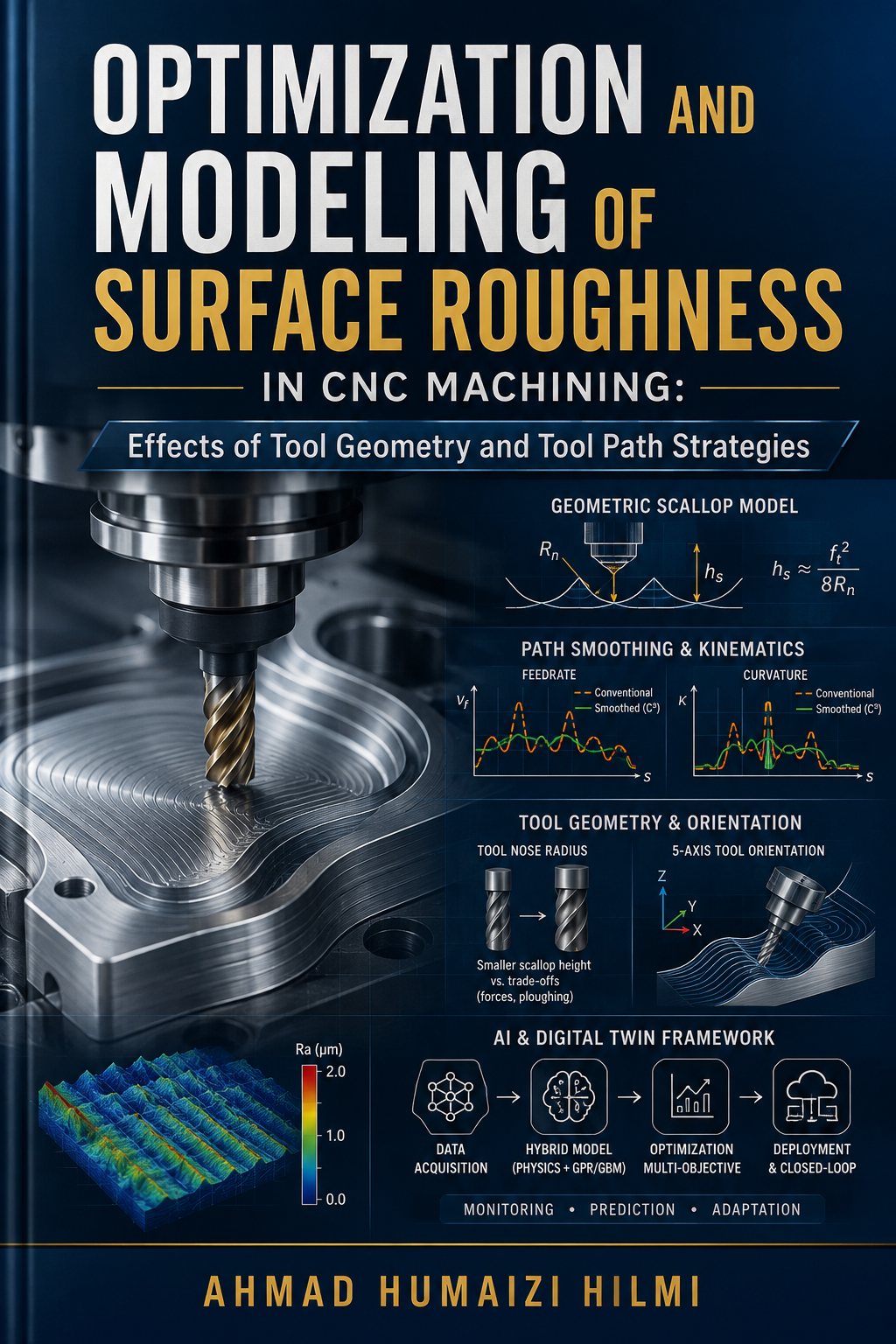
Optimization and Modeling of Surface Roughness in CNC Machining: Effects of Tool Geometry and Tool Path Strategies
This paper synthesises recent advances in surface‑generation, tool‑path planning, tool geometry and digital‑integration research to inform an integrated approach for predictable surface quality in CNC finishing. We classify work into four themes: geometric/topography models and surrogate roughness predictors, path generation and smoothing under kinematic limits, cutter‑geometry and five‑axis orientation effects, and AI/digital‑twin frameworks for monitoring and closed‑loop control. Comparative evidence shows that geometric scallop models explain a first‑order component of Ra, while feed per tooth and feed‑rate variability, curvature discontinuities and process phenomena (BUE, adhesion, chatter) dominate residual roughness. Spline‑based C3 smoothing, constant‑scallop spacing and jerk‑limited time‑parameterisation consistently reduce feedrate spikes and lower Ra; increasing tool nose radius reduces scallop height but may trade off with ploughing and tool forces. Hybrid architectures that combine a physics core with GPR/GBM corrections and calibrated uncertainty, together with surrogate‑assisted multi‑objective optimisation and edge‑deployed inference within a digital twin, appear promising for shop‑floor deployment. We identify gaps in multi‑material coverage, tool‑geometry breadth and industrial‑scale validation and define five research contributions to address these limitations.
Keywords: surface roughness, tool-path smoothing, tool geometry, five-axis kinematics, hybrid physics-data prediction, digital twin