


Backtesting Explained — Measured (PDF Guide)
Your backtest came back excellent and you could not say why you did not believe it. Nobody has ever shown you a result being wrong on purpose, so you have no calibration for how good a figure has to look before it is a bug.
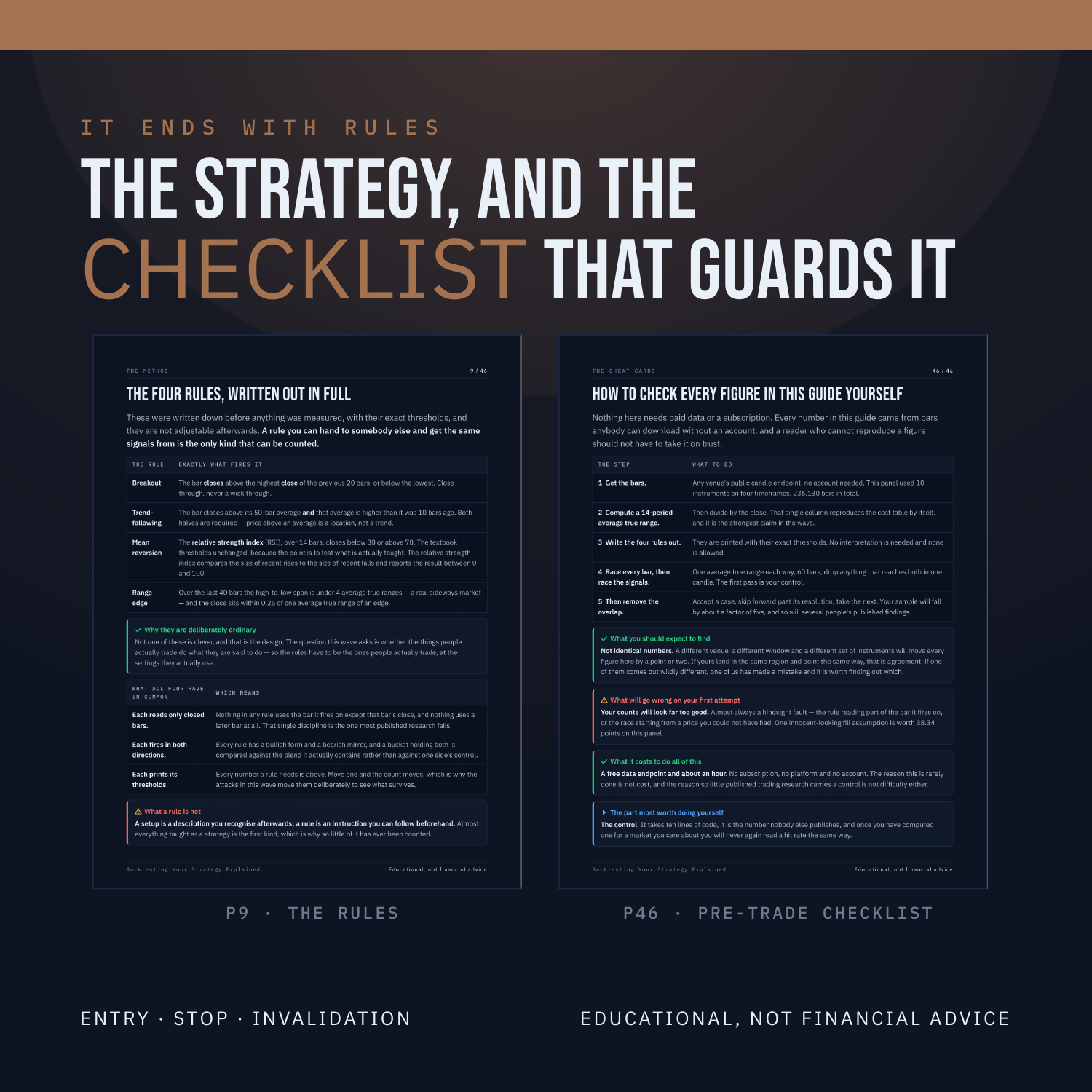
This guide makes two errors deliberately, measures exactly what each is worth, and then prints the two this study made in its own measurement. It teaches by demonstration rather than by rules, because a reader who has never watched a result go wrong cannot judge one that has not. This is a 46-page PDF that teaches Backtesting from the first thing you see on the screen through to a written strategy with an entry, a stop and an explicit rule for when the trade is wrong.
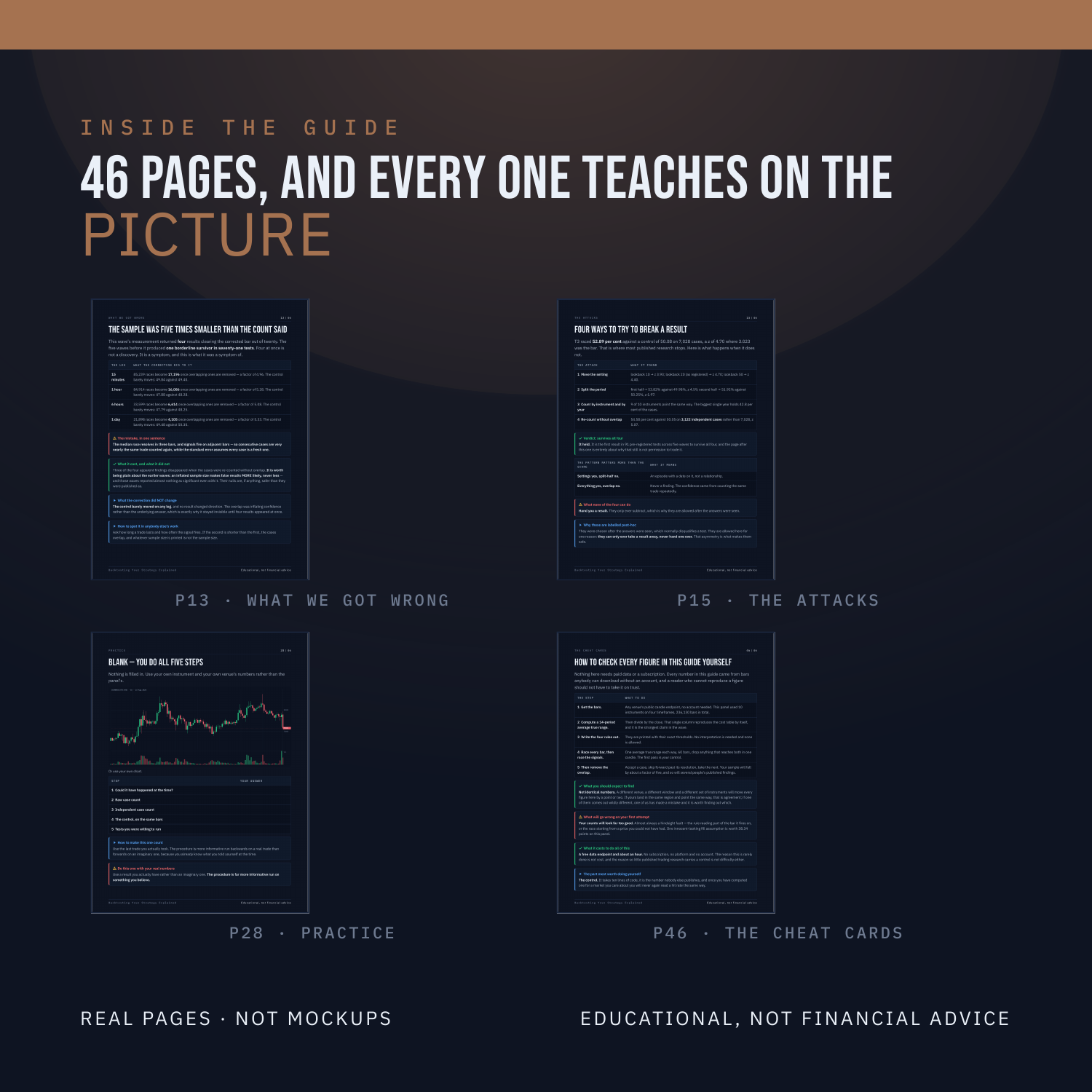
Nothing is taught underneath a chart. Every label sits on the candle, the line or the level it is describing, on real BTC, ETH, SOL and LINK charts. There are three quizzes on real charts, each followed by the same chart re-shown annotated with the reasoning, plus faded practice pages where the first steps are filled in and you finish the rest.
WHAT'S INSIDE
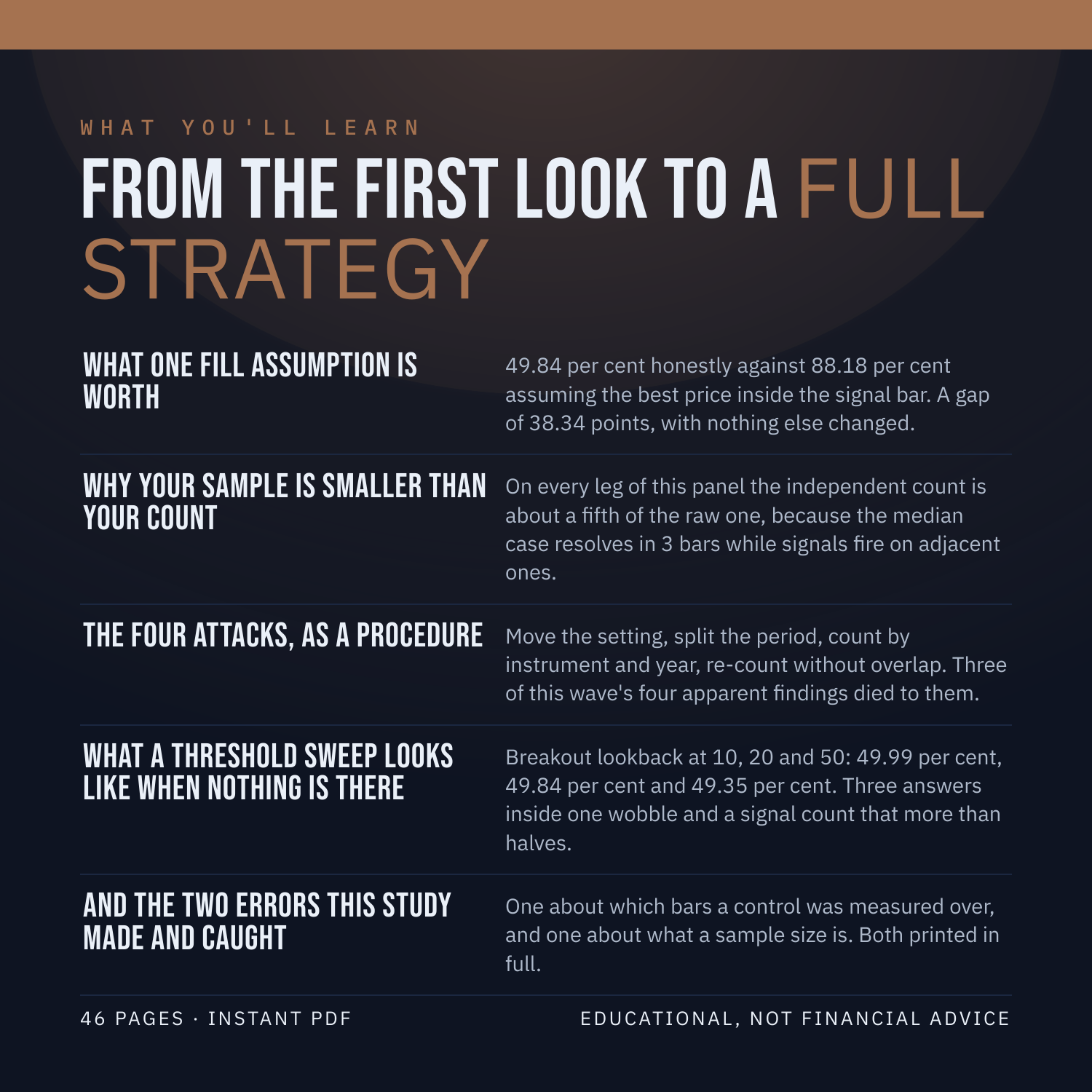
What one fill assumption is worth -- 49.84 per cent honestly against 88.18 per cent assuming the best price inside the signal bar. A gap of 38.34 points, with nothing else changed.
Why your sample is smaller than your count -- On every leg of this panel the independent count is about a fifth of the raw one, because the median case resolves in 3 bars while signals fire on adjacent ones.
The four attacks, as a procedure -- Move the setting, split the period, count by instrument and year, re-count without overlap. Three of this wave's four apparent findings died to them.
What a threshold sweep looks like when nothing is there -- Breakout lookback at 10, 20 and 50: 49.99 per cent, 49.84 per cent and 49.35 per cent. Three answers inside one wobble and a signal count that more than halves.
And the two errors this study made and caught -- One about which bars a control was measured over, and one about what a sample size is. Both printed in full.
WHAT YOU'LL BE ABLE TO DO
Test your own code for hindsight in five minutes.
Convert a raw case count into an independent one.
Compute a control on the same bars as your test.
Run four attacks on a result and report all four outcomes.
Say what a backtest can and cannot establish.
AN HONEST NOTE
Backtesting is a clue, not a crystal ball. It describes what price has already done. This guide contains no win-rates, no backtest results and no promises about what you will make, because nobody can verify those and you should not trust anyone who prints them. What it hands you instead is a set of rules you can test yourself on TradingView in an afternoon. Educational, not financial advice.
Instant download. 46 pages, PDF.