

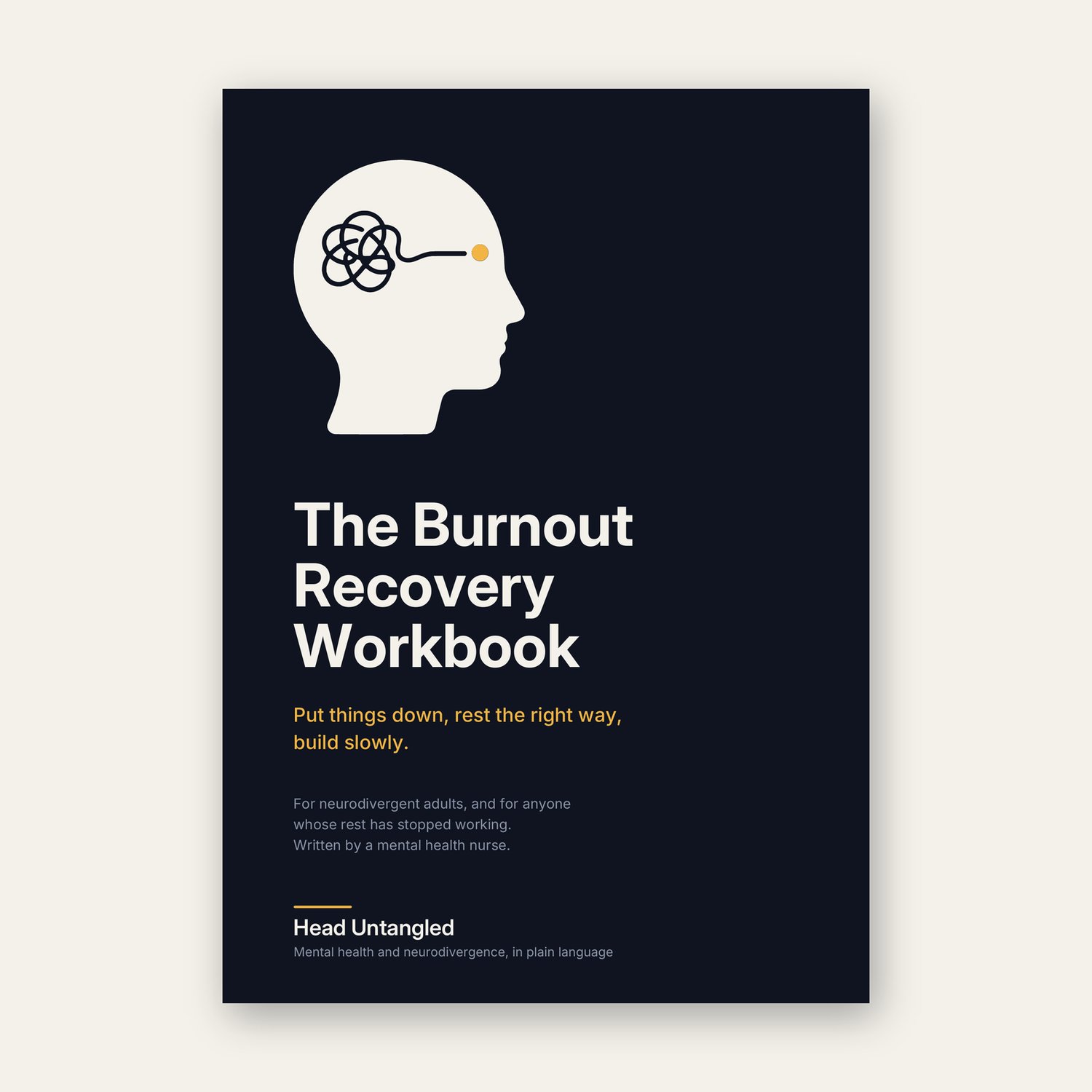
The Burnout Recovery Workbook: put things down, rest the right way, build slowly
If you've rested and you still don't feel recovered, there's a reason, and this workbook takes you through it in an order that helps many people.
Part 1, Where you are: what burnout looks like from the inside (an explained checklist, not a quiz), what's happening underneath, and what recovery is aiming for at the start: from one to two, and stay there.
Part 2, What I'm putting down: why rest on its own often isn't enough, the demand table (stop, pause, shrink, hand over), must and might, and what to do if work is one of them.
Part 3, Which kind of capacity ran out: the five kinds of capacity and the rest that matches each, how loads stack, the hidden-cost list, and your own rest menu.
Part 4, My baseline: what you can do on a bad day without paying for it, good days and the trap at level three, early warning signs, telling people, and a page for the person beside you.
Part 5, Build slowly: pacing that doesn't feel like giving up (leaving a margin, transition cost, alternating loads, deciding once), adding one thing at a time, the weekly forecast, and what to do when it doesn't hold.
Part 6, The daily pages: eight weeks of one thing a day, sixteen weeks of one box a day, and two pages for looking back after a month. Print more whenever you need them.
54 pages, A4 and US Letter both included, laid out for double-sided printing with room for binding, and readable in black and white. Writing lines are spaced for real handwriting. A printable PDF: print it, or write on it in a PDF app that supports annotation (it has no fillable fields).
Written by a UK-registered mental health nurse with over twenty years in inpatient services, who has ADHD, diagnosed late as an adult, and has been through burnout more than once. AI tools assisted with drafting, source-checking and layout; every page was reviewed and approved by the author. Recognised approaches are credited by name: spoon theory (Christine Miserandino), pacing as used in chronic pain and fatigue services, the window of tolerance (Dan Siegel), urge surfing (Alan Marlatt).
It also covers when it might be more than burnout, and when to talk to your GP.
Educational, not advice. Your own clinician knows your situation best. For personal use.