
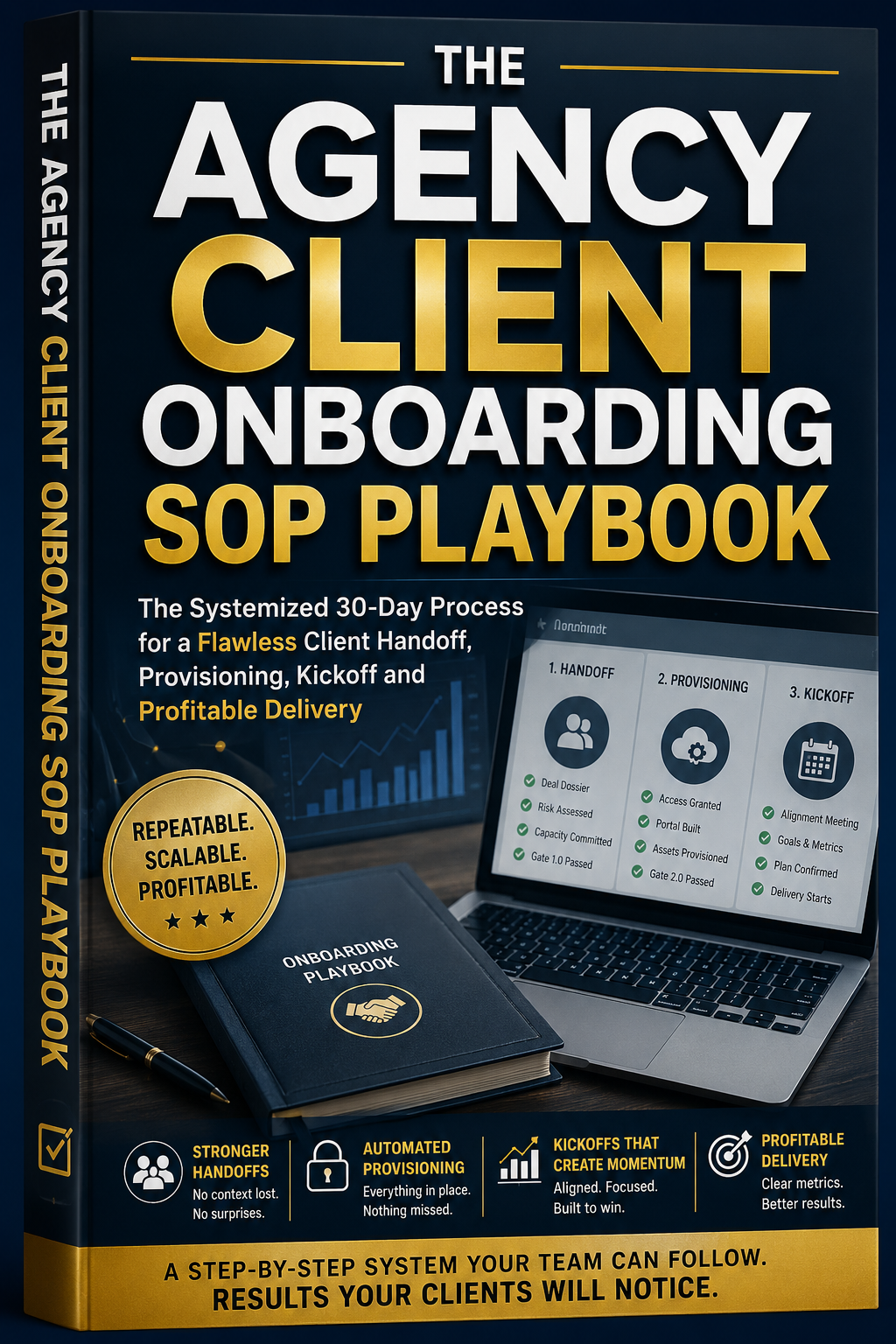
The Agency Client Onboarding SOP Playbook
A Client Onboarding Process for Mid-Size Marketing Agencies — Five Gates, Five Owners, One Clock
Get Instant Access
The moment you should be worried about isn't month three. It's hour one.
A client signs at the peak of their optimism. For weeks they've talked to the most persuasive, most context-rich person at your agency — the one who sold them. That person knows the CMO doesn't trust attribution models, that the last agency got fired over a missed launch, that the real decision-maker never showed up to a single call.
Then the contract is signed. And that person leaves the room.
What happens next isn't a documentation problem — it's a change-of-custody failure, and the client doesn't experience it as "our process needs work." They experience it as: I was sold something by people who won't be doing the work, and the people doing the work don't know what I bought.
That's the moment this playbook is built around. Not the kickoff deck. Not the welcome email. The handoff itself — and the four gates after it that decide whether this client is still yours on day 90.
If any of this sounds familiar, it's not a you problem — it's a structural one. Deal closes, delivery takes over, and a few weeks in the client says some version of "that's not what we discussed." Onboarding touches sales, delivery, and ops, and somewhere between those handoffs, things go missing. Clients get excited and expect work to start immediately — but delivery is stuck waiting on brand assets, logins, and ad-account access nobody asked for at the point of sale. That gap is where momentum dies, and it's exactly what a sales-to-delivery handoff process — the thing this playbook is actually about — is built to close.
Who this is for
You run — or run delivery for — a mid-size marketing, creative, or consulting agency that has grown past the point where "the account manager just knows what to do." You have a sales function and a delivery function, and somewhere between the two, context keeps getting lost: clients repeat themselves in kickoff, credentials show up late, someone promises a deliverable nobody scoped, and the first thirty days quietly decide whether the account renews.
You want a named-owner, gate-based system — not another vague checklist — with the artifacts (JSON schemas, RACI matrices, scripts, trackers) to actually run it.
Who this isn't for
If you're a solo freelancer running one client relationship end-to-end yourself, there's no handoff to protect — you are the handoff. This playbook is written for agencies where sales and delivery are different people, and where a client can be lost in the gap between them.
The six ways onboarding quietly kills accounts (and how to prevent scope creep after signing)
Before this playbook prescribes anything, it names exactly what it's defending against — because "what went wrong?" is the wrong question. The right one is which failure mode was this?
- The Ghost Promise — the client references a deliverable nobody on delivery has ever heard of, because a verbal commitment made late in the sale was never logged. This is how scope creep starts before delivery has even opened the account.
- The Cold Restart — kickoff turns into a discovery call, because context that lived in the salesperson's head was never written down.
- The Vanishing Seller — the client keeps emailing the AE six weeks in, because there was never a relational handoff ceremony.
- The Phantom Buyer — approvals stall on someone the delivery team has never met, because the economic buyer was never identified.
- The Capacity Bluff — work starts, then slips two weeks, because the team committed before anyone checked capacity.
- The Silent Blocker — there's still no platform access by day ten, because access dependencies were never surfaced at the point of sale.
Every one of these has a specific, dated control inside this playbook. None of them are fixed by trying harder next time.
Inside the playbook: five gates, in order
This isn't organized as loose tips. It's structured as five sequential gates — pass/fail checkpoints a new account moves through between "signed" and "stable." Each gate has a named trigger, a named owner (never a team), a clock, required artifacts, and a binary acceptance test with a defined rework loop.
Gate 1 — Post-Sale Handoff Protocol (T+0 to T+5 business days)
The sales-to-delivery handoff, and the RACI matrix that governs it. The three transfers hidden inside every handoff — commercial, contextual, relational — and why agencies routinely nail the first and skip the other two. Includes the Deal Dossier schema, the sales-to-delivery debrief agenda, the warm-introduction script, the delivery capacity commit, the Scope Delta Log, and account risk scoring at handoff.
Gate 2 — Automated Portal & Asset Provisioning (P+0 to P+3 days)
Client access and asset collection, done right the first time. Idempotent, auditable, reversible provisioning — the credential ladder, least-privilege access matrices by platform, the client-facing portal build, naming conventions, and the offboarding-debt register that stops you paying for dead access six months later.
Gate 3 — The Kickoff Meeting Blueprint (T+5 to T+10 days)
A client kickoff meeting agenda built to survive scrutiny. Attendee architecture and the "empty chair" rule, the 48-hour pre-read, a minute-by-minute run of show, facilitation scripts, and how to capture success criteria in language specific enough that day 30 can actually test it — not language vague enough that everyone can claim they hit it.
Gate 4 — Client Communication & SLA Governance (from T+7 days, ongoing)
Client communication governance: SLAs, escalation, and the weekly note. The channel charter, reporting cadence architecture, SLA severity tiers and clocks, the escalation ladder, scope-creep interception, and the five-section weekly note — the single highest-value artifact most agencies quietly stop writing after month one.
Gate 5 — The First 30-Day Value Delivery Milestone (Day 30)
The first 30 days decide first-year client retention. Why the renewal decision is effectively made in the first month, how to select a value event that survives scrutiny, baselining before you change anything, the Day-30 Business Review, and the health-scoring system that hands the account off to steady state.
What you're actually getting
- 118 pages, five chapters plus front matter, structured as a controlled operating document — not a blog post stretched to book length.
- 36 named, ready-to-use templates across all five gates (Deal Dossier skeleton, RACI matrices, access trackers, channel charter, SLA config, escalation card, health-score record, and more) — indexed in one appendix so you can assign or audit the whole kit from a single page.
- A consolidated metrics dictionary and glossary of controlled definitions, so "Delivery Owner," "Economic Buyer," and "Scope Delta" mean the same thing across sales, delivery, and support instead of drifting by department.
- A master checklist at the end of every chapter, built for print or for pasting straight into whatever project tool your delivery team already uses — this is a tool-agnostic system, not a plugin for one platform.
- Every worked example is clearly labeled as illustrative, with invented figures, so you're never mistaking a teaching example for a benchmark you're supposed to hit.
Why this isn't another checklist pack
Search "client onboarding" on Etsy or Gumroad and you'll find two kinds of product: a single editable checklist (intake form, welcome packet, kickoff agenda — pick one), or a giant generic SOP library with a "new client onboarding" section buried in fifty templates for every department in a business. Neither is built around the specific place agencies actually lose clients: the handoff between the person who sold the account and the person who now owns it.
This isn't a checklist and it isn't a generic template pack. It's a field manual for one specific failure point — the gap between closed-won and stable — with the accountability structure (named owners, RACI, escalation ladders, SLA tiers) that a single-page checklist can't carry.
FAQ
One with named owners at every stage, not just a checklist. This playbook breaks it into five gates — handoff, provisioning, kickoff, communication governance, and a 30-day value review — each with a person accountable, a deadline, and a pass/fail test.
Most scope creep doesn't start in month three — it starts at handoff, when a verbal promise made late in the sale never gets logged anywhere delivery can see it. Gate 1's Scope Delta Log exists specifically to catch this before it becomes a dispute.
Gate 4 covers this directly: severity tiers with their own clocks, a defined escalation path, and breach handling — built as a client-facing artifact, not an internal-only policy.
No. A checklist tells you what to do. This defines who does it, by when, with what artifact as proof, and what happens if it doesn't get done — five gates, each with a named owner and a pass/fail test.
Yes. Every template is a plain schema, JSON structure, or document you adapt to whatever CRM, PM tool, or ticketing system you already run — the playbook explicitly names these as "systems of record," not specific software.
It's built for agencies where sales and delivery are separate people and a client can fall through the gap between them. If that's not your situation yet, it will be the day it isn't just you anymore.
Because "the AM handles it" is a person, not a process — and it breaks the moment that person is out sick, overloaded, or replaced. The gates exist so nothing depends on one person's memory: every handoff produces a written artifact (a Deal Dossier, a signed gate record) instead of a conversation that lives in someone's head.
No — and the book says so directly. Every metric target is marked as a starting proposal, not an industry benchmark. You're meant to measure your own accounts for a quarter and set your own targets from that baseline, not import someone else's.
Instant digital download, delivered on purchase.
The Agency Client Onboarding SOP Playbook — Operations Series, Edition 1.0.
Get Instant Access