


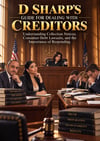
D SHARP’S GUIDE FOR DEALING WITH CREDITORS
CONSUMER CREDIT RIGHTS AND COMMERCIAL PROTECTION
A Practical, Statutory Guide to Credit Reporting, Debt Collection, Documentation, Accounting, Disputes, and Consumer-Claim Defense
This manual is designed for consumers who want to understand how to respond intelligently, lawfully, and methodically when dealing with creditors, banks, mortgage and account servicers, debt buyers, collection agencies, consumer reporting agencies, furnishers of information, and consumer-debt lawsuits.
This is not a theory-based manual. It is not built around internet folklore, recycled “credit repair” scripts, echo-chamber slogans, magic words, or unsupported claims about how commercial law supposedly works.
The foundation of this manual is different:
statutory authority, defined legal procedures, accounting records, documentary evidence, proper classification of the parties and transaction, deadlines, written correspondence, and real-world application.
The objective is to teach the reader how to identify the actual legal issue before choosing a response. A credit-reporting dispute is not automatically a debt-validation dispute. A debt-collection issue is not automatically governed by the U.C.C. A mortgage-servicing error is not the same thing as a challenge to ownership. A billing error is not automatically an identity-theft claim. Different facts activate different statutes, procedures, evidentiary requirements, and remedies.
The same fundamental principles apply throughout:
Identify the transaction. Identify the claimant. Identify the governing law. Examine the accounting. Preserve the evidence. Use the correct procedure. Document receipt. Track the deadlines. Respond in good faith. Preserve your rights.
REAL-WORLD APPLICATION — NOT JUST ABSTRACT RESEARCH
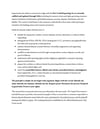
A central feature of this manual is an actual Massachusetts court proceeding: Capital One, N.A. v. Cindy Goncalves, Hingham District Court, Civil No. 2558CV0037.
Capital One commenced a consumer revolving-credit action against Cindy Goncalves. Rather than ignoring the lawsuit or answering it with unsupported theories, Cindy filed a substantive Answer placing issues concerning the claimed contractual obligation, account documentation, ownership, accounting, evidentiary foundation, and the plaintiff’s entitlement to relief before the court.
The official court record reflects that an Answer was filed, the case proceeded to a scheduled Case Management Conference, Capital One failed to appear, and the court entered a Judgment of Dismissal for Cindy Goncalves and against Capital One, N.A.
The case is included for a specific reason: it demonstrates the difference between merely talking about legal concepts and actually organizing research, drafting a response, preserving issues, participating in the judicial process, and creating a record.
It is equally important to understand what the case does not establish. The dismissal should not be represented as a judicial ruling that every defense raised in the Answer was adjudicated on the merits. The documented procedural fact is that Cindy responded, participated in the case, and Capital One subsequently failed to appear, resulting in dismissal. That distinction is consistent with the methodology taught throughout this manual: state the record accurately and do not make the evidence say more than it says.
BUILT AROUND ACTUAL FEDERAL CONSUMER LAW
The manual incorporates the federal consumer-credit framework contained principally in Title 15 and Title 12 of the United States Code, together with the applicable federal regulations and relevant Uniform Commercial Code provisions where those provisions actually govern the transaction.
The material includes extensive treatment of the Fair Credit Reporting Act (FCRA), Fair Debt Collection Practices Act (FDCPA), Truth in Lending Act (TILA), Fair Credit Billing Act, Equal Credit Opportunity Act (ECOA), Electronic Fund Transfer Act (EFTA), Consumer Leasing Act, Real Estate Settlement Procedures Act (RESPA), Regulation V, Regulation F, Regulation Z, Regulation B, Regulation E, Regulation M, Regulation X, and applicable U.C.C. provisions.
This edition is structured around the FCRA and federal consumer-protection framework current through 2026, including statutory and regulatory provisions concerning consumer reports, furnishers, permissible purposes, accuracy, reinvestigations, identity theft, adverse action, debt collection, credit decisions, electronic payments, mortgage servicing, escrow accounting, billing errors, loss mitigation, and civil liability.
The purpose is not to combine every statute into one generalized “consumer law” argument. The manual repeatedly teaches the reader to determine which law actually governs which problem.
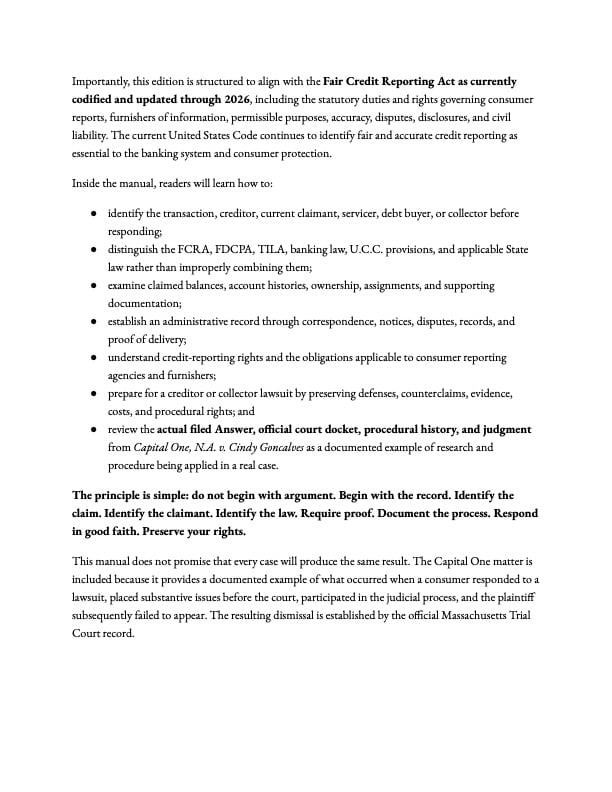
Inside the manual, readers learn how to:
- identify the creditor, servicer, furnisher, CRA, debt buyer, collector, assignee, secured party, mortgage servicer, or other claimant before responding;
- distinguish the FCRA, FDCPA, TILA, FCBA, ECOA, EFTA, RESPA, Regulation V, Regulation F, Regulation Z, Regulation B, Regulation E, Regulation M, Regulation X, applicable U.C.C. provisions, and State law instead of improperly combining them;
- obtain and audit consumer reports, account records, statements, payment histories, delinquency dates, balances, inquiries, assignments, escrow records, payoff calculations, servicing records, and other documentary evidence;
- identify whether the real issue is accuracy, completeness, identity theft, permissible purpose, billing error, improper collection, payment application, unauthorized transfer, adverse action, mortgage servicing, assignment, secured accounting, or another defined legal problem;
- create an organized administrative and evidentiary record through correspondence, notices, disputes, declarations, supporting exhibits, proof of delivery, chronologies, and deadline tracking;
- understand the actual duties imposed upon consumer reporting agencies, furnishers, creditors, debt collectors, servicers, and other regulated actors;
- distinguish a legitimate statutory document request from demands the law does not actually require;
- evaluate claimed balances by following the underlying accounting instead of relying on conclusions;
- prepare for litigation by preserving defenses, claims, records, damages evidence, procedural rights, and the factual chronology;
- understand the difference between assertion and evidence, between filing and proof, and between a legal theory and a statutory right; and
- review the actual Answer, official docket, procedural history, and Judgment of Dismissal from Capital One, N.A. v. Cindy Goncalves as a documented example of research and procedure being applied in a real consumer case.
This manual does not teach consumers to invent disputes, deny legitimate obligations, misuse identity-theft procedures, or send unsupported demands simply because they sound authoritative.
Its approach is based upon:
good faith; clean hands; accuracy; timely response; proper classification; competent documentation; careful accounting; statutory procedure; and preservation of the evidentiary record.
If a balance is accurate, the manual does not teach the reader to call it inaccurate.
If an account is not identity theft, the manual does not teach the reader to claim identity theft.
If a statute does not require an original wet-ink contract, sworn affidavit, or particular document, the manual does not manufacture that requirement.
If the U.C.C. does not govern the particular transaction, the manual does not insert the U.C.C. simply because the matter involves money.
The objective is to understand what the law actually requires and then use that law precisely.
THE CORE PRINCIPLE
Do not begin with argument. Begin with the record.
Identify the claim.
Identify the claimant.
Identify the transaction.
Identify the law.
Follow the accounting.
Require legally appropriate proof.
Document the process.
Respond in good faith.
Preserve your rights.
That methodology applies whether the issue involves a credit report, collection account, credit-card statement, unauthorized ACH transfer, vehicle lease, mortgage-servicing dispute, repossession accounting, adverse credit decision, or consumer-debt lawsuit.
The facts and governing statutes change.
The disciplined method does not.
DISCLAIMER
D Sharp / the author is not an attorney and does not practice law or provide legal representation. This manual is provided solely for educational, informational, and independent-study purposes. Nothing contained in this publication constitutes legal advice, creates an attorney-client relationship, guarantees any particular result, or substitutes for advice from a licensed attorney concerning a specific legal matter. Laws, regulations, court rules, and procedures may change and may vary by jurisdiction. Readers are responsible for reviewing the law applicable to their own facts and circumstances and should consult a qualified licensed professional when legal advice or representation is required.
The inclusion of Capital One, N.A. v. Cindy Goncalves is for educational demonstration of documented research, response, procedure, and recordkeeping. The outcome of that matter does not guarantee or predict the outcome of any other case.