
Family Tax Benefit Calculator 2026-27 – FTB A, B & Balancing
On Sale
A$12.00
A$12.00
See your Family Tax Benefit day by day, and spot a balancing debt before Centrelink does.
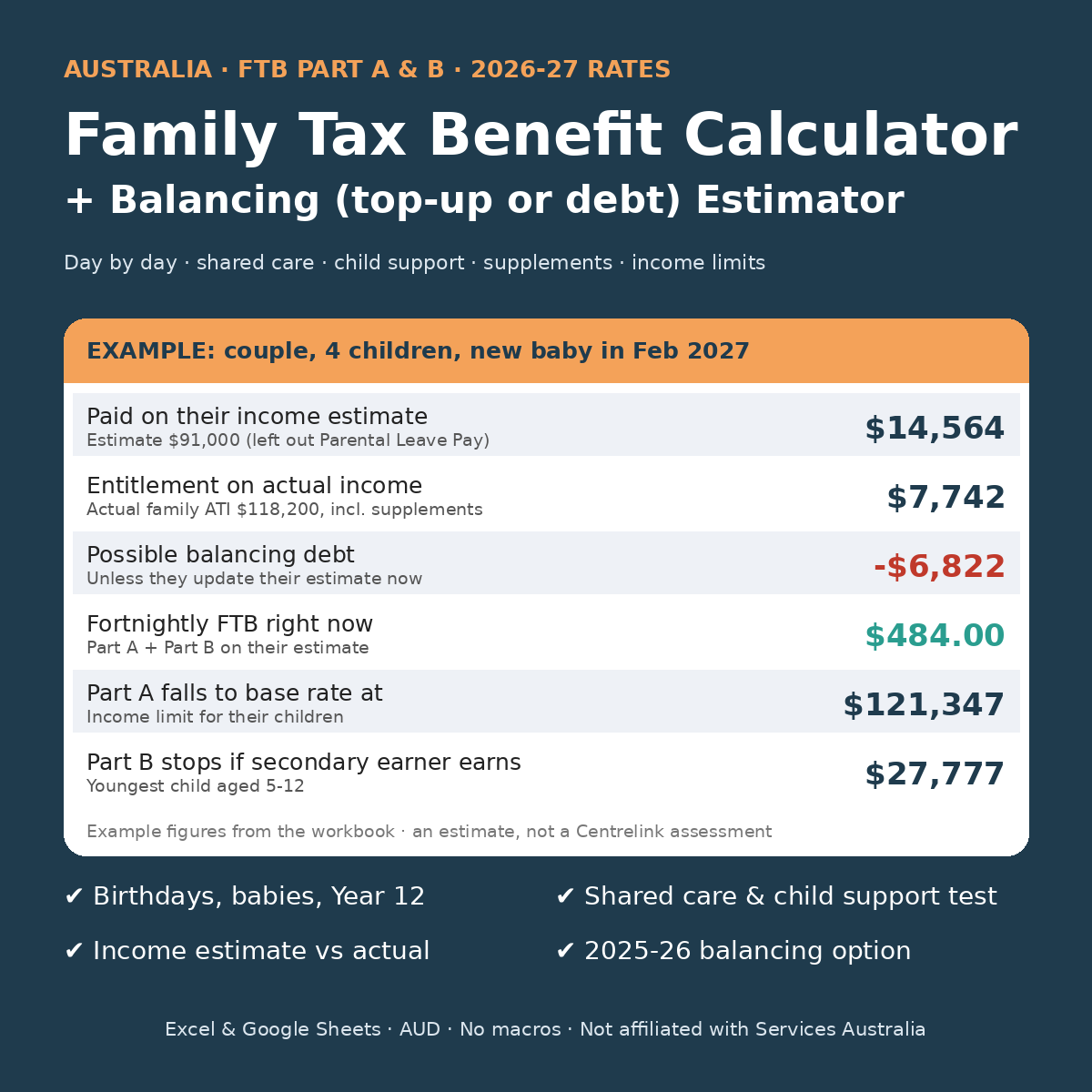
Family Tax Benefit is paid on your income estimate. After the year it's balanced against your actual income. If your income went up, a child turned 13, or Parental Leave Pay wasn't in your estimate, the difference can come back as a debt. This spreadsheet works out FTB Part A and Part B for your family with the 2026-27 rates (or 2025-26, the year being balanced now), and shows what you should be paid now and what balancing is likely to look like.
Built for Australian families getting FTB, including blended and shared-care families.
What it does
- Day-by-day calculation for the whole year: birthdays (13 and 16), a new baby, finishing Year 12, a child joining or leaving your care, and Parental Leave Pay days all change the rate from that day.
- FTB Part A: Method 1 and Method 2, the 20c and 30c income tests, the base rate, and the Part A supplement with the $80,000 family income limit.
- FTB Part B: youngest child under 5 or 5+, couples (primary earner limit and the secondary earner taper) and single parents. No Part B on Parental Leave Pay days.
- Shared care: your care % is turned into the FTB shared care % using the official table.
- Child support received: the maintenance income test, with the free area for one or both partners and each extra child.
- Income estimate vs expected actual vs what-if: a full adjusted taxable income (ATI) helper for each of you (fringe benefits, salary sacrifice, investment losses and more). Includes a switch for families on an income support payment all year.
- Balancing estimate: what you'd be paid on your estimate (or what you've actually been paid so far), against your entitlement on actual income including supplements. Shows a likely top-up or possible debt, and the estimate to give Centrelink.
- Your family's income limits: where Part A drops to the base rate, where it stops, and where Part B stops.
- Income ladder: FTB from $40,000 to $200,000 family income.
- Checks: missing details, shared care under 35%, couples whose youngest is 13+, estimate well below actual income, child support with no child marked, rates changed from the official figures, and more.
What you get
- 1 Excel workbook (.xlsx) that works in Excel, LibreOffice and Google Sheets
- Tabs: Instructions, Settings, Income, Children, Summary, Income Ladder, Checks, Daily, Rates, Rules
- A worked EXAMPLE family to type over: 4 children, including a new baby, a child turning 13, a 5th birthday and a teen in 40% shared care with child support, plus Parental Leave Pay left out of the estimate
- Up to 6 children. All 2026-27 and 2025-26 rates are on an editable Rates tab. No macros, no add-ins, no login. AUD.
Good to know
- Rates and rules were checked against the DSS Family Assistance Guide and Services Australia on 23 November 2026. Rates change each 1 July.
- Not included:
- Rent Assistance
- Newborn Supplement and Newborn Upfront Payment
- Multiple Birth Allowance
- the Part B return-to-work rule
- the Maintenance Income Credit
- immunisation and health-check reductions
- grandparent, approved care organisation and residency rules
- a change of partner part-way through the year
- debts, offsets and withheld amounts
- It's a planning estimate, not a Centrelink assessment. It's general information, not financial advice, and it isn't affiliated with Services Australia or the Department of Social Services.