
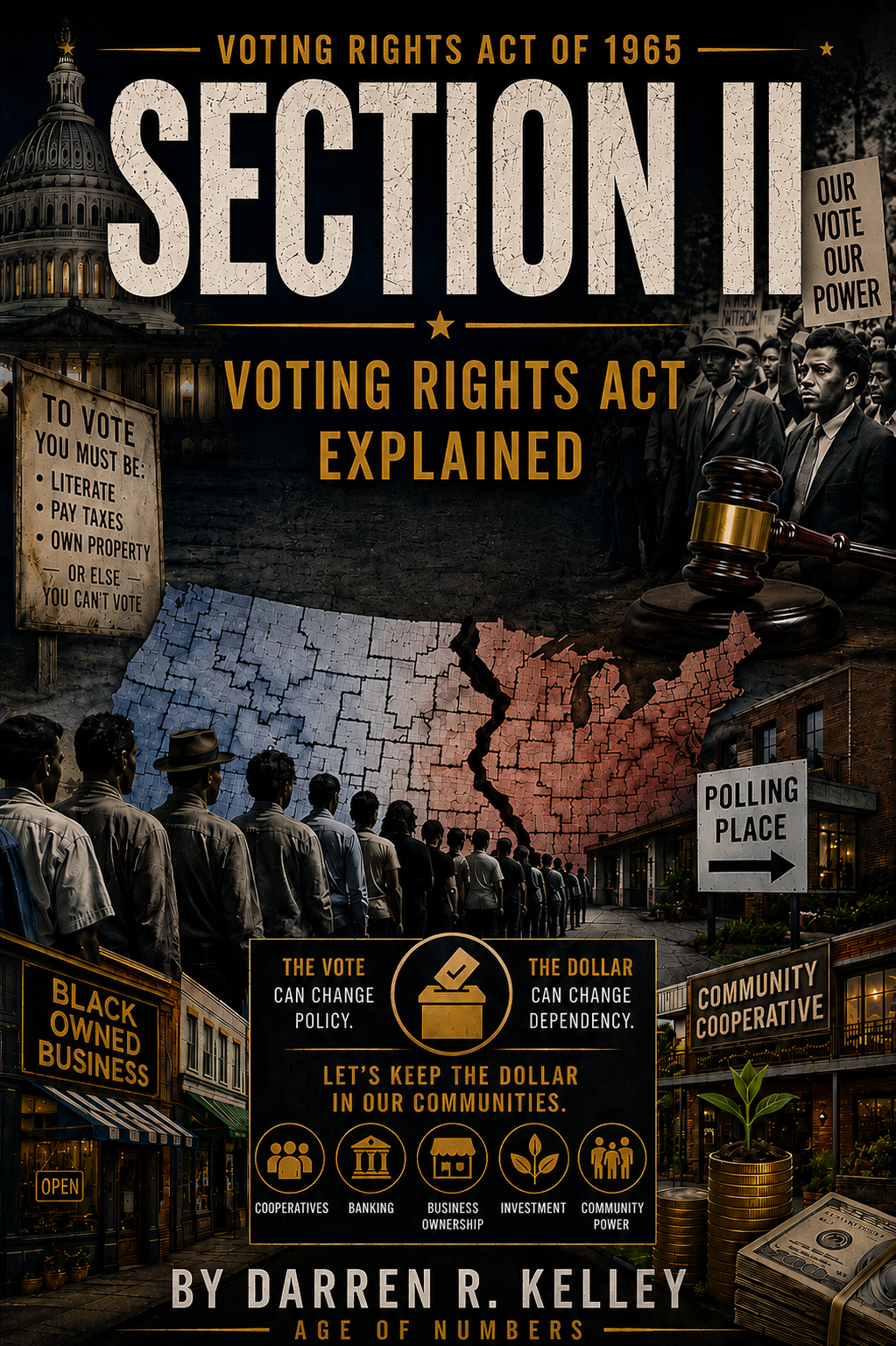
Voting Rights- Section II
There are many Americans who know the phrase “Voting Rights Act of 1965,” yet far fewer understand why specific protections such as Section II became necessary in the first place.
The common discussion often begins too late in history.
It begins with lawsuits, district maps, and political parties, while overlooking the deeper conditions that produced those conflicts: racial violence, exclusion from political systems, economic retaliation, and deliberate efforts to weaken Black political influence after the Civil War.
Black districts were not created in a vacuum.
They emerged after decades of suppression, fragmentation, intimidation, and legal restructuring designed to prevent Black populations from converting citizenship into meaningful representation. Even after constitutional amendments guaranteed voting rights, systems evolved to dilute those rights in practice.
The battle changed forms over time.
In one era, the obstacle was explicit violence.
In another, it became literacy tests and poll taxes.
Later, it became district lines, at-large voting systems, and vote dilution.
The methods changed, but the underlying struggle over political power remained.
This book focuses heavily on Section II because it became one of the primary legal tools used to challenge voting systems that weakened minority representation. Supporters viewed it as essential protection against discrimination disguised through “neutral” political structures. Critics often viewed it as government overreach or racial preference embedded into law.
Understanding this conflict requires examining both history and structure.
But this book also argues that voting alone may not fully solve the long-term challenges facing communities. Political representation without economic strength can become fragile. Communities that lack ownership, internal investment, business development, land control, or financial circulation often remain dependent even when representation improves.
For this reason, the conversation must expand beyond voting alone.
The next battlefield may involve:
- cooperative economics
- ownership
- local business ecosystems
- community investment
- institutional development
- economic circulation within communities
The ballot remains important.
But the dollar may determine whether political victories can endure.