
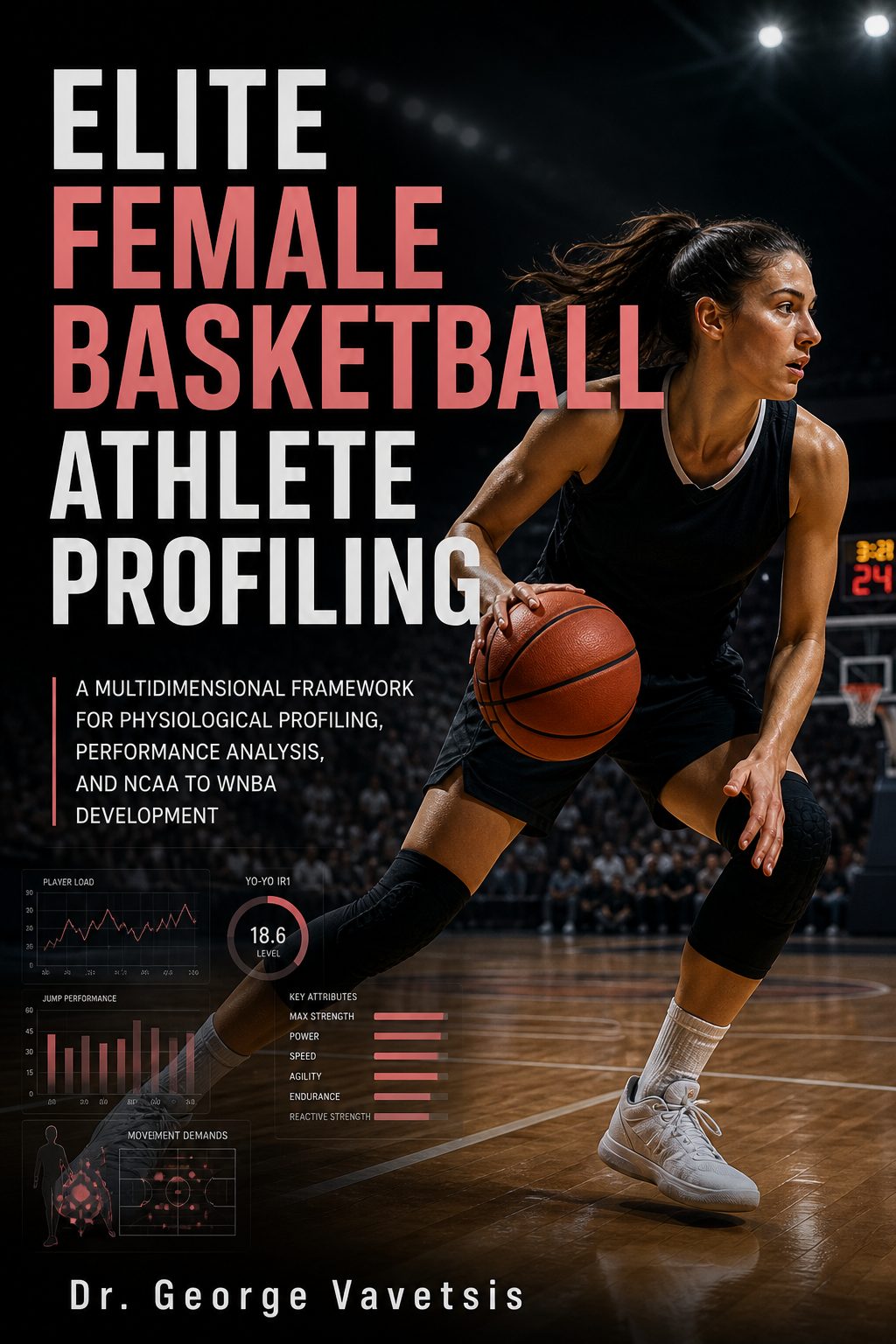
Elite Female Basketball Athlete Profiling
Pages: 1073
Elite female basketball has entered a transformative era characterized by accelerated physicality, tactical sophistication, advanced sports-science integration, and unprecedented professional visibility. The modern women’s game is no longer defined merely by technical proficiency or traditional positional archetypes. Instead, performance at the highest level now emerges from the interaction of neuromuscular efficiency, biomechanical optimization, physiological readiness, tactical intelligence, psychological resilience, anthropometric suitability, and longitudinal athlete management. This evolution has created an urgent need for a comprehensive and scientifically rigorous framework dedicated specifically to the profiling and development of elite female basketball athletes.
The central philosophy underlying this work is that female basketball athletes must be evaluated, developed, and monitored through models that reflect the unique realities of women’s basketball rather than adaptations of male-derived frameworks. Historically, much of the sports science literature surrounding basketball physiology, strength and conditioning, tactical profiling, and performance analytics has been extrapolated from male populations. Although foundational principles of human performance remain universal, the physiological, hormonal, biomechanical, anthropometric, and sociocultural characteristics of elite female athletes necessitate sport-specific and sex-specific interpretation. High-performance preparation in women’s basketball therefore requires a multidimensional approach capable of integrating the complexity of the female athlete into applied performance systems.
The contemporary female basketball environment imposes extraordinary demands on athletes across all competitive levels, including NCAA Division I basketball, EuroLeague Women, FIBA international competition, and the Women's National Basketball Association. Players are repeatedly exposed to high-frequency accelerations, decelerations, multidirectional movements, collision contact, reactive decision-making, repeated jump sequences, and intense metabolic fluctuations throughout training and competition. At the same time, female basketball athletes must navigate unique considerations involving hormonal fluctuations, recovery management, injury susceptibility patterns, travel stress, psychological readiness, energy availability, and long-term athletic development trajectories.
As a result, athlete profiling in women’s basketball can no longer be limited to isolated testing batteries or simplistic statistical interpretation. Effective profiling requires integrated systems capable of synthesizing anthropometric data, neuromuscular diagnostics, physiological markers, movement mechanics, tactical-role demands, external and internal training loads, readiness indicators, and performance trends across time. Such systems allow coaches, sport scientists, performance directors, athletic trainers, physiotherapists, and medical staff to move beyond generalized assumptions toward individualized performance architecture.
Throughout these chapters, the reader will explore the physiological and tactical determinants that differentiate elite female basketball players according to position, role, competitive level, and developmental stage. Special emphasis is placed on the positional identities of guards, wings, forwards, and posts, recognizing that each role carries distinct biomechanical demands, movement densities, collision profiles, metabolic requirements, and neuromuscular characteristics. Understanding these distinctions is fundamental for designing individualized strength and conditioning interventions, recovery systems, monitoring strategies, and long-term development plans.
Equally important is the recognition that elite performance is deeply contextual. Tactical systems, coaching philosophy, playing tempo, competition structure, travel schedules, and psychological stressors all interact with athlete physiology. Consequently, profiling models must remain adaptable and ecologically valid. The goal is not merely to identify isolated strengths and weaknesses, but to understand how the athlete functions within the complete performance environment.
The scientific foundation of this book integrates applied biomechanics, exercise physiology, strength and conditioning, motor control, performance analytics, sports medicine, athlete monitoring, and long-term athletic development theory. However, the emphasis throughout remains practical and performance-oriented. Every profiling framework, testing strategy, monitoring concept, and developmental model presented in this text is intended to support applied decision-making in real-world elite basketball settings.
A major objective of this work is also to bridge the gap between research and practice in women’s basketball. Despite the rapid growth of the female game, substantial limitations still exist within the scientific literature related specifically to elite female basketball athletes. Many performance models continue to rely heavily on male datasets or generalized athletic populations. This book seeks to contribute toward a more specialized performance-science language for women’s basketball—one capable of supporting the next generation of athletes, coaches, and practitioners operating at the highest levels of competition.
Importantly, athlete profiling should never be interpreted solely as a mechanism for talent selection. While profiling undoubtedly contributes to identification and recruitment processes, its greater value lies in optimization, protection, and long-term sustainability. Effective profiling allows practitioners to enhance readiness, reduce injury risk, individualize loading strategies, support athlete availability, and maximize performance longevity across demanding competitive calendars.
The future of elite female basketball will increasingly depend upon interdisciplinary collaboration. Strength and conditioning coaches, sport scientists, performance analysts, physiotherapists, nutritionists, psychologists, physicians, and technical coaches must operate within integrated systems where data interpretation translates directly into actionable coaching decisions. Athlete profiling represents one of the foundational pillars of this integrated-performance model.
Ultimately, this book is written for practitioners and scholars who seek a deeper understanding of elite women’s basketball performance. It is intended for those committed to advancing the scientific sophistication of the female game while simultaneously respecting the individuality, complexity, and competitive demands of the athletes themselves.
Elite female basketball deserves performance models built specifically for elite female basketball.
It is my hope that this work contributes meaningfully to that progression and supports the continued evolution of applied sports science within the women’s game.