

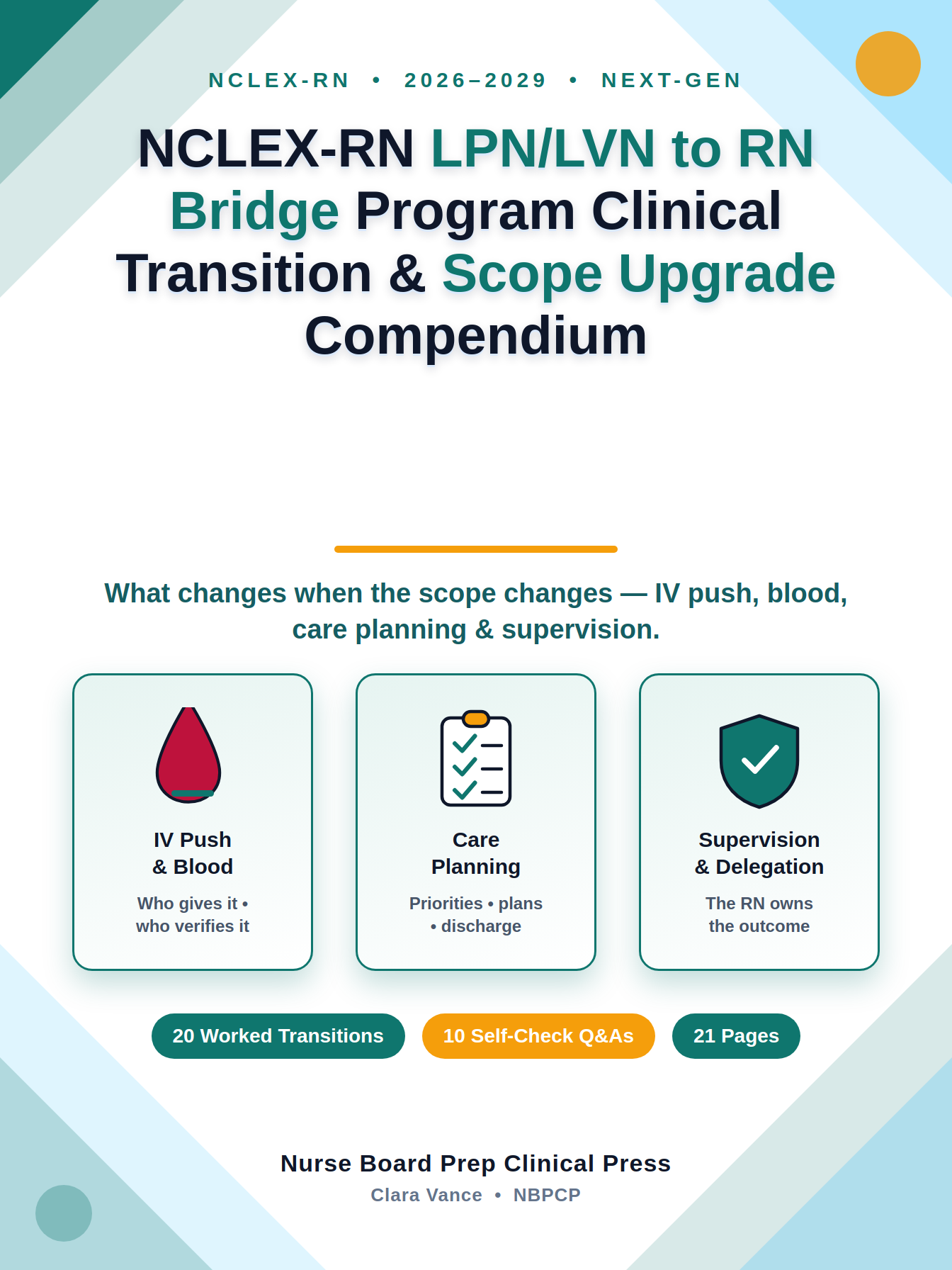
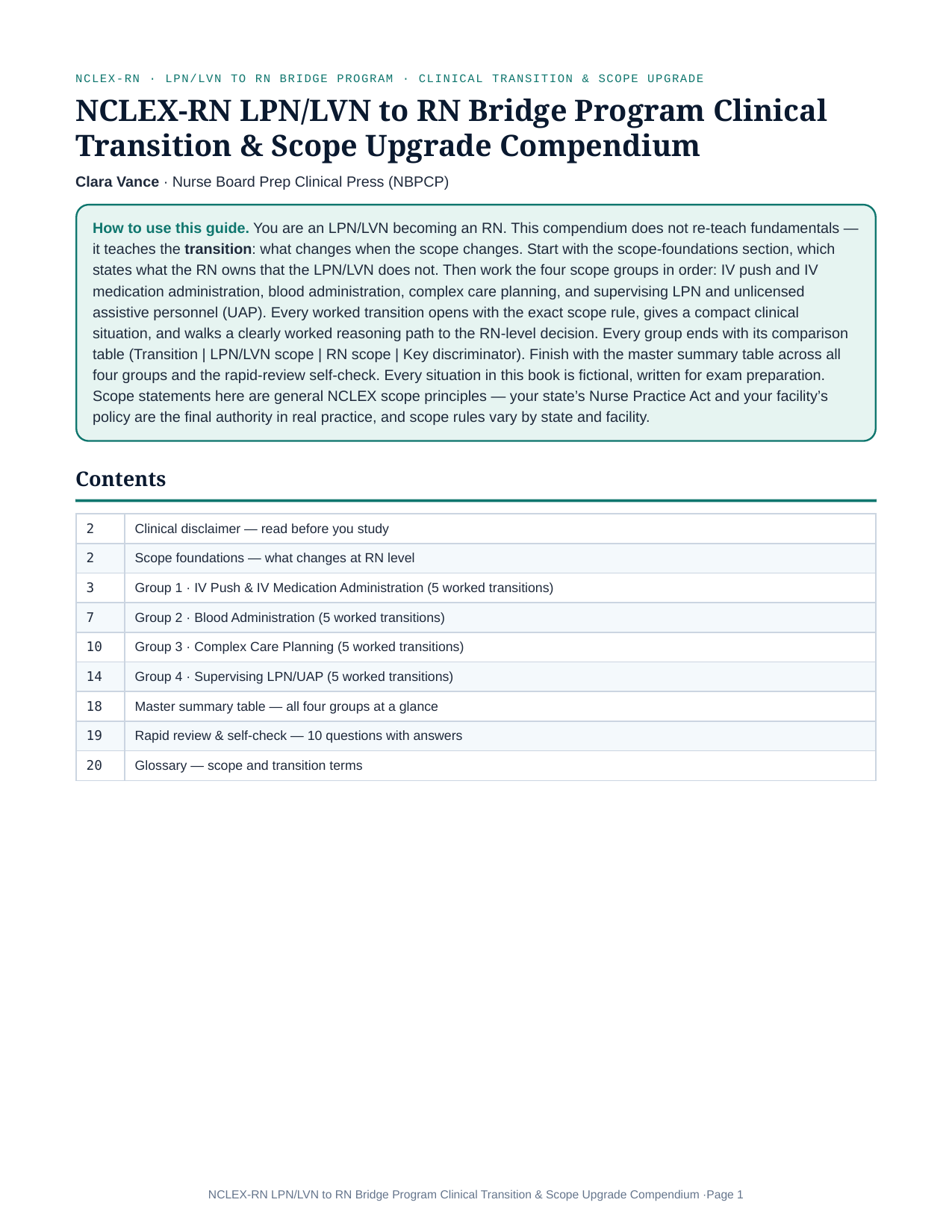
NCLEX-RN LPN/LVN to RN Bridge Program Clinical Transition & Scope Upgrade Compendium
The LPN/LVN to RN transition for the Next-Gen NCLEX-RN — what changes when the scope changes, made testable. Every worked transition opens with the exact scope rule, gives a compact clinical situation, and walks a clearly worked reasoning path to the RN-level decision.
Inside:
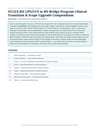
- Scope foundations: what the RN owns that the LPN/LVN does not — assessment, planning, evaluation, accountability — plus the five rights of delegation
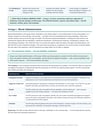
- Group 1 — IV push & IV medication administration (5 worked transitions): IV push medications, IV compatibility, central-line medication administration, high-alert IV drugs, changing an IV infusion rate
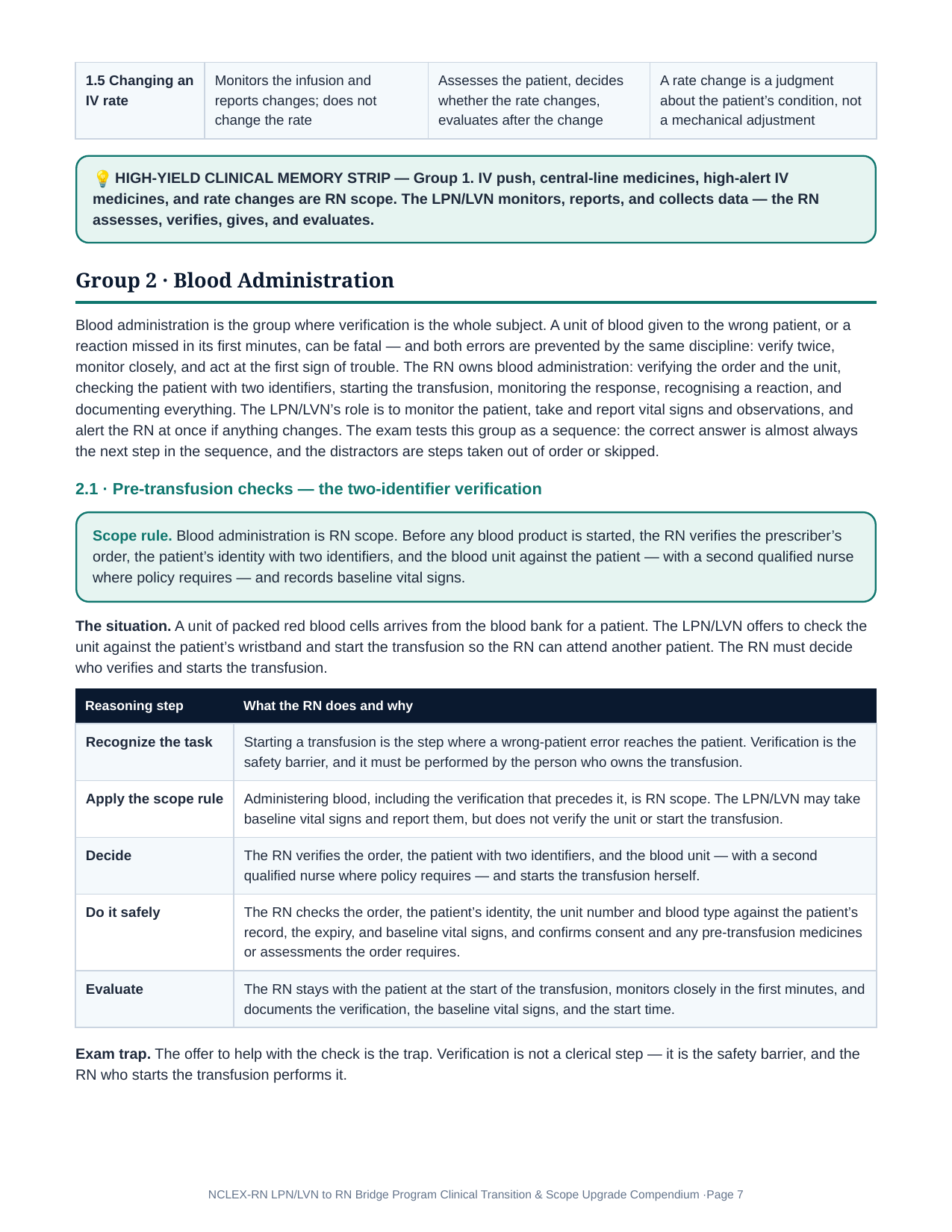
- Group 2 — Blood administration (5 worked transitions): pre-transfusion two-identifier checks, transfusion reactions (first action: STOP), blood product administration, monitoring during transfusion, documentation
- Group 3 — Complex care planning (5 worked transitions): multi-system care planning, prioritisation, delegation within the plan, care coordination, discharge planning
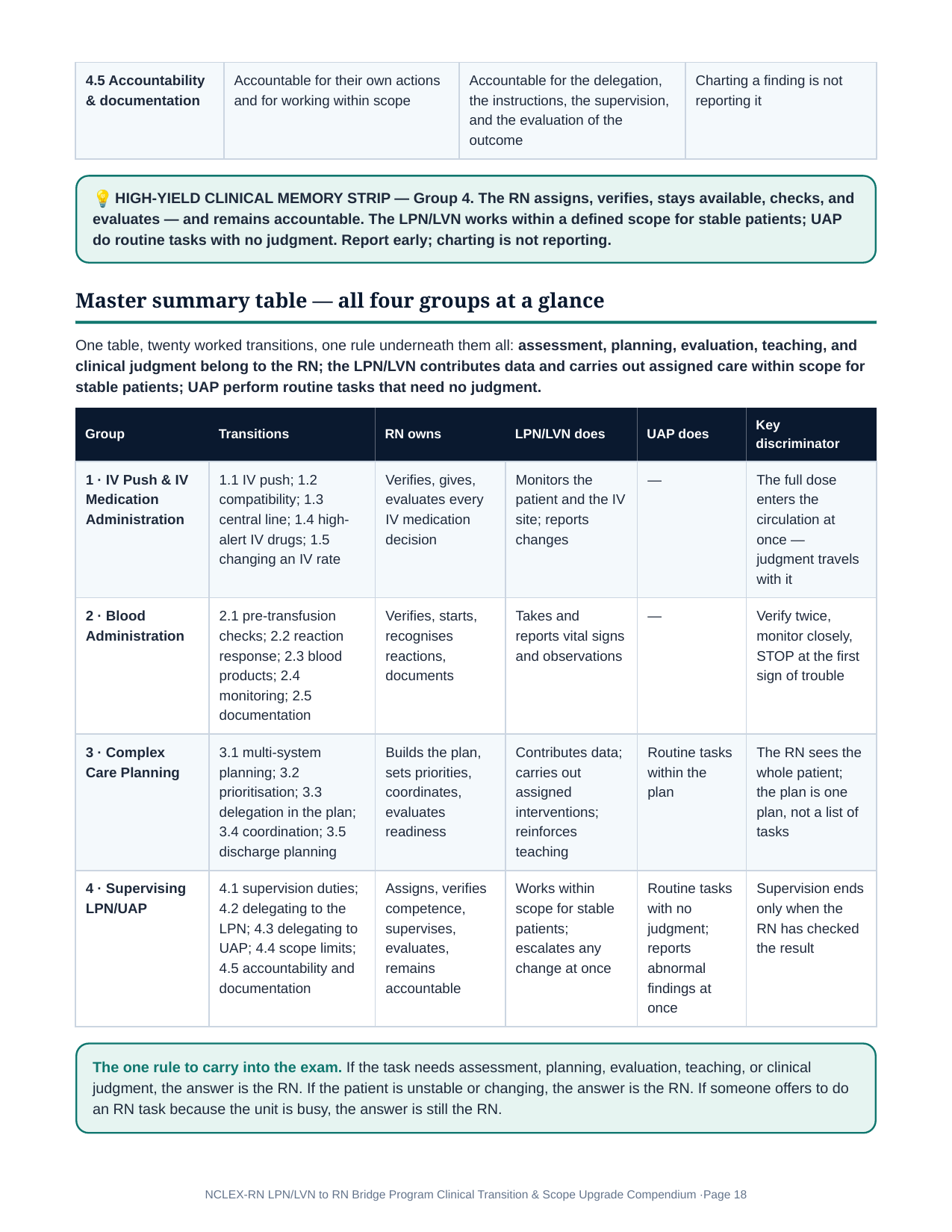
- Group 4 — Supervising LPN/UAP (5 worked transitions): RN supervision duties, delegating to the LPN and to unlicensed assistive personnel, scope limits, accountability and documentation
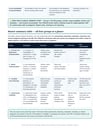
- A comparison table for every group (Transition | LPN/LVN scope | RN scope | Key discriminator), a master summary table across all four groups, 10 rapid-review self-check questions with answers, and a glossary
Scope statements are general NCLEX scope principles — your state's Nurse Practice Act and your facility's policy are the final authority in real practice. No medicine doses are asserted in this book — dosing is prescriber-ordered and product-specific. Original teaching situations written for exam practice. This guide is not affiliated with NCSBN and does not guarantee a pass. If you find an error, a corrected version will be sent free.