Your Cart
Loading

How to Write for LLM Evaluation

Your text is excellent... For a human reader.

The evaluator will use an LLM.

Make sure your work stands out in all human or algorithmic evaluations.

Learn how to prepare your text so the LLM extracts exactly what you want the evaluator to see.

Your strongest evidence can disappear before the human reads it

An LLM will enter the evaluation chain.

It will screen, summarise, compare and match your text against evaluation criteria.

It does not read like a human.

Storytelling can hide the main claim.

Vocabulary variation can disconnect ideas that belong together.

Evidence presented later can become separated from the conclusion it supports.

When the LLM misses those connections, the evaluator receives a weaker version of your work.

The problem is not that your text lacks evidence. The problem is that the LLM will not find it.

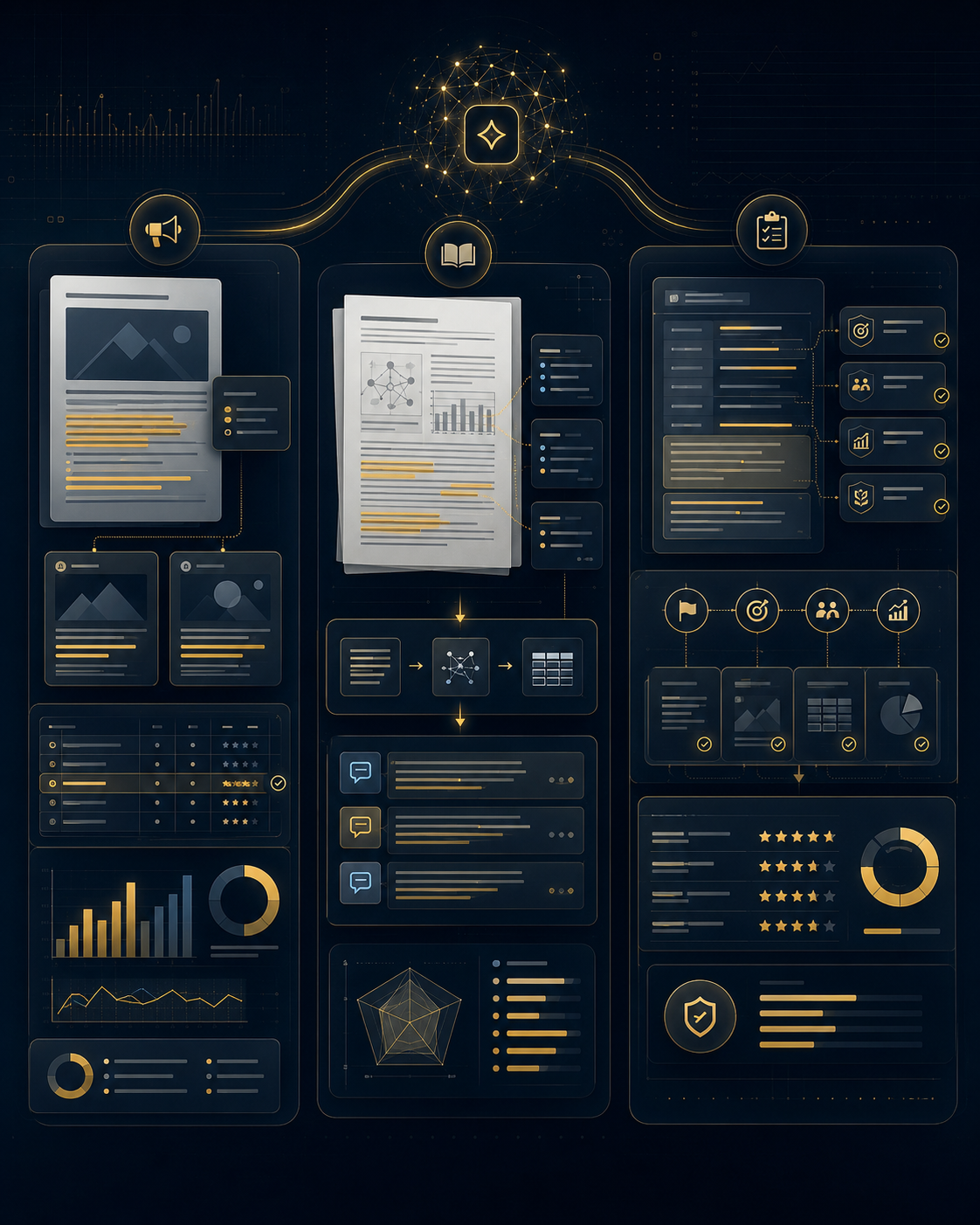
LLM evaluation is already happening

Marketing

An LLM will compare headlines, test message alignment, rank campaign alternatives and decide which ideas deserve human attention.

A strong campaign can be downgraded before the client sees it because the LLM extracted the wrong message.

Academic journals

An editor or reviewer will use an LLM to summarise the contribution, extract the method, compare the paper with previous research and prepare evaluation comments.

An original paper can look generic when the LLM fails to extract the precise contribution.

Grant applications

An LLM will map the proposal against the call, extract objectives, indicators and evidence, flag inconsistencies and support scoring.

A fundable proposal can look weak when the LLM cannot connect the criterion, the claim and the proof.

The human may make the final decision. But the LLM will decide which version of your work reaches the human first.

AI does not get stories

Humans infer meaning across a story.

They understand analogies, subtle references, delayed conclusions and changes in vocabulary.

LLMs extract:

  • claims;
  • evidence;
  • criteria;
  • indicators;
  • relationships;
  • scoring signals.

Techniques that work well for human readers can hide what the LLM needs to find:

  • storytelling;
  • analogies and metaphors;
  • varied vocabulary;
  • avoiding repetition;
  • implicit causal links;
  • pronouns and indirect references;
  • evidence dispersed across several paragraphs;
  • conclusions that arrive too late;
  • synonyms instead of the formal scoring language.

Good writing for humans can become bad writing for LLM evaluation.

This does not mean writing like a machine.

It means making your claims, evidence and relationships impossible to miss.

This is not another ChatGPT course

You will not learn generic ChatGPT tricks or collect random prompts.

You will use one real section from your own work.

First, you will test what the LLM extracts.

Then you will find the claims, evidence and connections it missed.

You will rewrite the section, test it again and produce a final version that works for both LLM extraction and human judgment.

You finish with real work improved, not another course completed.

The seven steps

1. Understand the new evaluation chain

See where LLMs already shape decisions in marketing, academic publishing, grants and other professional contexts.

2. Learn how LLMs read

Identify the writing techniques that hide claims, evidence and relationships from the machine.

3. See what the LLM sees

Test one real section and discover what the LLM finds, misses or distorts.

4. Map the scoring criteria

Connect each criterion to the claim, evidence, result and indicator the evaluator must find.

5. Rewrite for extraction

Reorganise the text so the LLM extracts exactly what matters.

6. Test again

Check what the rewritten text makes the LLM find, summarise, compare and evaluate.

7. Produce the final version

Combine clear extraction with persuasive writing for the human evaluator.

One real section. Tested, rewritten and ready for LLM-assisted evaluation.


What you leave with

By the end, you will have:

  • one real section from your own work;
  • the initial LLM evaluation test;
  • a diagnosis of hidden or disconnected evidence;
  • a map of the scoring criteria;
  • the rewritten section;
  • the second evaluation test;
  • the final version prepared for humans and LLMs;
  • a reusable checklist for future documents.

You will also receive the worksheets, prompts and templates needed to repeat the process.

You are not paying to learn about LLMs. You are paying to improve real work you need evaluated.

Built from real applications

This method was developed while preparing several funding applications submitted in 2026 across Erasmus+, CERV, HE and European innovation programmes.

Each application was tested against its formal evaluation criteria, rewritten and tested again.

In one anonymised Capacity Building application, a broad narrative about teaching, employability and sustainability was transformed into:

  • three explicit gaps;
  • three measurable objectives;
  • 6 programmes and 10 courses;
  • 40 trained staff;
  • 6 pilots;
  • 150 participating students.

The project did not change.

What the evaluator could extract from the project changed.

Official evaluation results are still pending. This is proof of the method being applied to real high-stakes documents, not proof of approval.

Who this is for

This experience is for professionals whose work will be summarised, compared or evaluated with the help of an LLM.

Including:

  • marketing professionals and copywriters;
  • academic authors and researchers;
  • proposal writers and grant consultants;
  • EU project coordinators and innovation managers;
  • tender and procurement teams;
  • consultants and authors of strategic reports.

It is not a generic AI course, a prompt library or a full review of your document.

You will apply the method to your own work.

If an LLM extracted only five points from your document, would it find the five points you need the evaluator to see?

Your next important document will enter the new evaluation chain

Your next campaign, paper or proposal will not wait until you understand how LLM evaluation works.

An LLM will screen, summarise, compare or evaluate it.

The only question is whether it will find what makes your work strong.

Use one real section.

See what the LLM sees.

Find what it misses.

Rewrite it.

Test it again.

Produce the final version.

Enrollment for the First Edition closes on 31 August 2026.

Access opens on 1 September 2026.

No future reopening date has been announced.

The evaluator will use an LLM. Make sure it extracts the evidence that makes your work shine.

First Edition

€299