
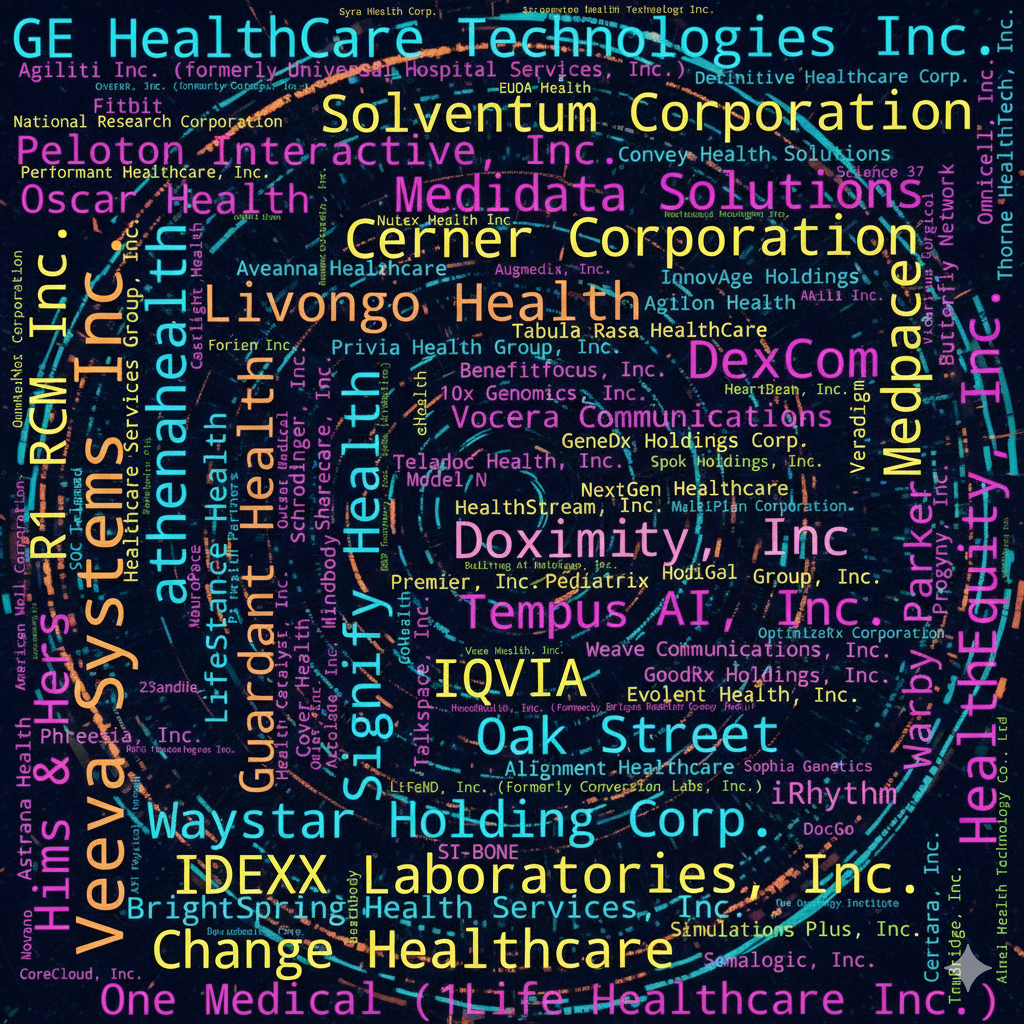
Comprehensive List of 191 U.S.-Listed, Publicly Traded Digital Health and Health AI Companies, both Dead and Alive, and 859 Investors in These Companies
This is the most comprehensive list of 191 U.S. exchange-listed, publicly traded digital health and health AI companies, matched with their 1440 investors.
Last update: August 31, 2026.
For those fascinated by digital health, AI in healthcare, or looking to understand the systemic issues in American healthcare and how to fix them, this spreadsheet complements my recent Substack article, "How Venture Capital Mass Murdered Digital Health Startups."
In the spreadsheet, I outline 191 digital health companies that have been listed on U.S. public markets for at least the past six years, and their 1440 investors: venture capital firms, private equity firms, corporations and their investment arms, hedge funds, institutional investors, investment banks, asset managers, sovereign wealth funds, endowments, foundations, angel investors, and individuals.
Note: Only U.S.-exchange publicly traded healthcare companies where AI and/or information technology are integral to their operations or revenue are included in this list. For example, a biotech company using deep learning to develop new gene therapies would qualify as digital health and therefore be included. However, a biotech company that does not utilize AI or IT for its core business, even if it is otherwise tech-savvy, would not be part of this list.
For each company, the following fields are included:
- Company name
- Ticker
- Funding source: VC-backed (VC), private equity (PE), corporate (CORPORATE), institutional / hedge fund (INST), angel (ANGEL), bootstrapped (BOOT), parent (PARENT), or spun off (SPIN).
- Status: Active (ACT), delisted (DELIST), bankrupt (DEAD), or acquired/merged (ACQ)
- IPO date
- Delisting/M&A date
- Net earnings Y(0) (in $) - Net earnings (also referred to as net income or net loss) in the final year of the company's existence.
- Net earnings Y(-1) (in $)
- Net earnings Y(-2) (in $)
- Net earnings Y(-3) (in $)
- Net earnings Y(-4) (in $)
- Net earnings Y(-5) (in $)
- Net earnings over 6 years (in $ mln) - The total net earnings during the final six years of the company's existence.
- 6-year net earnings growth (%)
- 6-year excess net earnings growth over S&P 500 (%)
- Pre-IPO funds raised (in $ mln) - total outside capital raised (both equity and debt) from the company inception to its IPO, not including PIPE, SPAC, and IPO financing
- Market value at IPO (in $ mln)
- Market value Y(-6) (in $ mln) - Market value 6 years ago, provided the company existed at that time.
- Market value last (in $ mln) - The company's latest market value: as of the close of business on 2/13/2026 if it still exists as a separate entity, acquisition value if it was acquired/merged, or zero if the company is bankrupt or defunct.
- Market value change (in $ mln) - The change from either the market value at the IPO or 6 years ago (whichever is more recent) to the latest market value.
- Market value change (in %) - I.e., the company's market return calculated from either its IPO or 6 years ago, whichever is more recent.
- Reference 1
- Reference 2
- Reference 3
- Reference 4
- Revenue Multiple (P/S) - based on trailing 12 months (TTM)
- Revenue Multiple (P/S) Source
- Next 1440 columns show 1440 investors who invested in these 191 companies from inception through IPO, excluding PIPE, SPAC, and IPO financing. These investors include venture capital firms, private equity firms, corporations and their investment arms, hedge funds, institutional investors, investment banks, asset managers, sovereign wealth funds, endowments, foundations, angel investors, and individuals. Because companies are listed in rows, the cell corresponding to Company A and Investor B indicates that Investor B invested in Company A at some point between the company’s inception and its IPO. Each investment is scored using a points system. For each investment, 1 point is assigned. If Investor B invested three times as a new investor, the score would be 3. If Investor B was the lead investor in a given funding round, that round is scored as 2 points instead of 1. If Investor B invested starting from Company A’s inception, an additional point is assigned. If Investor B was a major shareholder in Company A during that time period, another additional point is assigned. Company founders are automatically assigned 5 points. As a result, some investors can receive 6, 7, 8, 9, or even 10 points for a given company, indicating heavy involvement across multiple rounds and roles.
- Because of unusual circumstances, one company received additional attention: Teladoc Health, Inc. Since its 2020 acquisition of Livongo Health, Teladoc’s business became significantly influenced by Livongo, by about 43.4%. For the purposes of the scoring system, Livongo investors were treated as 43.4% Teladoc investors. So if an investor’s Teladoc score was originally 3, and their Livongo score was 5, then the adjusted Teladoc score becomes 5.17 = 3 + 0.434 × 5. In other words, the Teladoc investor receives 3 points for investing in Teladoc pre-IPO, plus 5 points for investing in Livongo, scaled by Livongo’s approximate share of Teladoc’s business post-acquisition, 43.4%.
Data Sources:
- Earnings Data: Yahoo Finance and the SEC.
- Market Data: Yahoo Finance and stockanalysis.com.
- For market values at acquisition/merger, I referenced press releases and related news articles.
- Funding Source Data: Compiled from multiple sources, including Tracxn, Pitchbook, and Crunchbase.
Cross-Sectional Sample Distribution:
Sample Overview:
- Total: 191 U.S. exchange-listed digital health companies.
Key Funding Types:
- VC-backed: 84 companies.
- PE-backed: 30 companies.
- Institutionally backed: 11 companies.
- Corporate backed (including venture capital and private equity arms of corporations): 4
- Non-VC-, PE-, corporate-, or institutionally-backed: 62 companies, further divided into:
- Bootstrapped (i.e. self-financed): 45 companies.
- Angel-funded: 8 companies.
- Parent financing entity: 3 companies.
- Spun off: 6 companies.
Outcomes:
- Bankrupt: 15 companies.
- Delisted: 8 companies (primarily due to value destruction to nearly zero).
- Merged or Acquired: 53 companies.
Thank you for supporting my research. If you ever have questions, concerns, or feedback, please don’t hesitate to reach out. I’m always happy to hear from you.
Warm regards,

Sergei Polevikov
P.S. Connect with me on LinkedIn, Substack, X (formerly Twitter), and TikTok.
P.P.S. Before purchasing this product, please note that Halle Tecco, a highly respected digital health expert, offers her own list of digital health companies, which also includes private ones: https://halletecco.gumroad.com/l/digital-health-startups. While I believe our products are complementary, I want to clarify that I have no affiliation with Halle's product. I hold her work in the highest regard and thought you might also find her resource valuable.