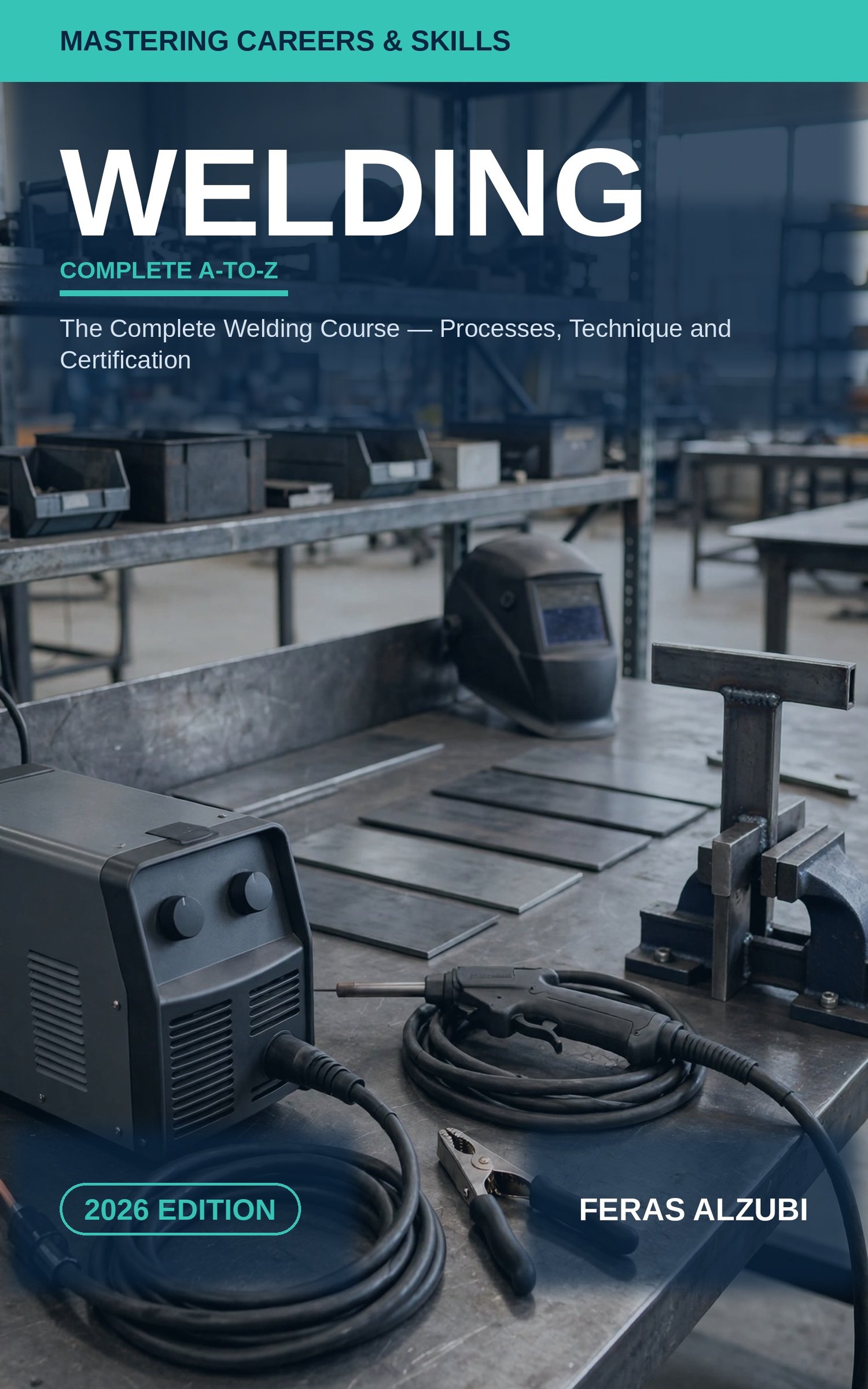
Welding
Welding — Complete A-to-Z, Taught End to End
What this book teaches. The whole craft of welding — taught A to Z in one volume, following one fictional training shop, the Meridian fabrication shop, from the first safety habit to a complete fabrication job. The foundations come first: what welding is and where welders work, safety as a set of non-negotiables — eye, face, skin and body protection, fumes and ventilation, fire prevention and the fire watch, electrical safety and cylinder handling — then drawings, weld symbols and joint design, and metals and metallurgy in plain language: the steels welders meet every day, the heat-affected zone, strength, hardness, ductility, and what changes with stainless and aluminum. The four core arc processes follow, one chapter each: shielded metal arc welding (SMAW), gas metal arc welding (GMAW), flux-cored arc welding (FCAW), and gas tungsten arc welding (GTAW) — how each works, its equipment and electrodes or wire, how to strike and run it, and where each earns its place and meets its limits — then cutting and gouging with oxyfuel and plasma. The technique stretch covers setup, electrodes and machine settings, polarity and current, beads and passes — root, fill and cap — welding positions from flat to overhead, and distortion: why metal moves and the planning, restraint and balanced-welding habits that prevent it. The book closes with the professional half of the trade: weld defects and inspection, testing — visual, nondestructive and destructive — welder performance qualification, codes, procedures and paperwork (AWS D1.1 named as the structural welding code for steel; the WPS and the PQR), the welding shop and the job site, a capstone that runs a stated fabrication job end to end — drawing, cutting, fit-up, welding in sequence, inspection, records and handover — and portfolios, practice and next steps. Standards are stated only at the durable level the book's verified sources support — the general welding-safety requirements of OSHA 29 CFR 1910.252 and 1910.253 in outline, and AWS D1.1 by name and scope — with no invented clause numbers, acceptance values, or statistics anywhere, and technique taught by what to watch and what to adjust, in which direction.
Who it is for. The complete beginner who has never struck an arc and wants the whole trade taught in the order the craft itself builds; the trainee or apprentice whose shop practice works but has gaps — symbols, metallurgy, positions, distortion, qualification — and who wants them closed in one connected course; and the working welder who needs the craft taught whole and honestly, with sound technique, honest inspection, and professional practice as the standard from the first chapter to the last.
What's inside (every count verified against the actual book):
Complete course — 20 chapters, the first safety habit to a complete fabrication job
340 practice questions — every answer explained, right and wrong
40-question diagnostic — know where you stand before you start
240 chapter questions — a 12-question check closes every chapter
60-question final review — sampling the whole craft of welding
40 labeled figures — the anatomy of a weld symbol, the five basic joint types, the four positions and the capstone job at a glance, two in every chapter
150-term glossary · 8 cheat sheets · 3 study plans — Plan A, the four-week steady plan; Plan B, the two-week intensive; and Plan C, the weekend refresher
Six worked examples derived step by step from the book's stated givens so you can check every result yourself — reading a weld symbol on a Meridian drawing, reading the E7018 electrode classification, planning passes and weld length, diagnosing a defect from stated symptoms, planning a qualification pathway, and the capstone fabrication job counted end to end
Every one of the 340 questions is original, written for this book, and every explained answer tells you why the right answer is right and why each wrong answer is wrong. The book's facts rest on verified sources, listed in a Sources & Verification Note at the back of the book: the American Welding Society's published process descriptions, electrode classification explanation, position and terminology references, and AWS D1.1 named by scope, and OSHA's welding, cutting and brazing requirements at 29 CFR 1910.252 and 1910.253 in outline. This book contains no invented statistics and no prices, salaries, or market figures anywhere — every number in its pages is either a documented fact stated at the level those sources support or a stated given inside a worked example or a practice question whose arithmetic was verified. This book teaches inspection as the working welder needs it — what inspectors look for and how to produce welds that pass; inspector certification itself is a separate subject, covered by its own exam-prep book.
Read the first chapter free — the sample on this page is Chapter 1 of this book, exactly as it appears in the full edition.
From the Mastering Careers & Skills library — complete A-to-Z professional teaching books for careers, trades, and certifications.
This book is an independent teaching work, and no credential comes from this book: this book does not itself confer a certificate, a qualification, or a certification.
Refunds: Please read the free sample chapter before you buy. This is a digital ebook, delivered instantly by download. If the file is defective, or you cannot open or download it and we cannot fix the problem, you will receive a full refund — email us within 14 days of purchase. Because the book is delivered instantly as a downloadable file, all other sales are final.
How to read this book (EPUB format): After checkout, download the EPUB file, then open it in any free ebook reader app. On iPhone or iPad: Apple Books — it is already on your device. On Android phones and tablets: Google Play Books (free: https://play.google.com/store/apps/details?id=com.google.android.apps.books) — upload the file in the app — or ReadEra (free). On a Windows or Mac computer: Thorium Reader (free: https://thorium.edrlab.org) or Adobe Digital Editions (free). On Kindle: use Amazon's free Send to Kindle (https://www.amazon.com/sendtokindle) to add the file to your Kindle library.