
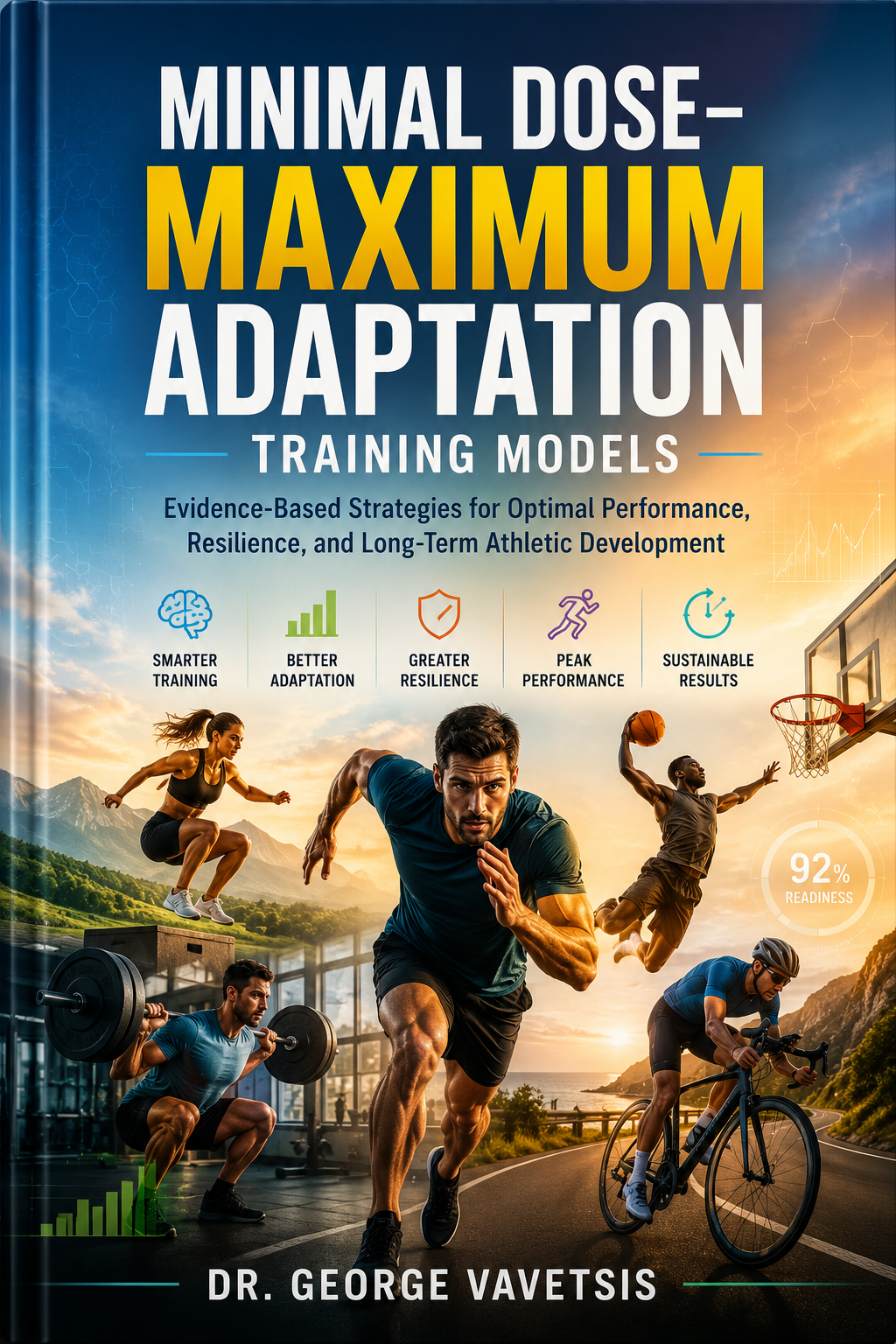
Minimal Dose–Maximum Adaptation Training Models
Pages: 475
In contemporary high-performance sport, the prevailing assumption has long been that greater training volume inevitably produces superior adaptation. Athletes, coaches, and sport scientists have historically pursued progress through accumulation: more repetitions, more sets, more sessions, more mileage, more contacts, and more fatigue. Yet within elite performance environments—where competitive calendars extend across 40–60 weeks annually, where neuromuscular readiness must coexist with tactical demands, and where the margin between adaptation and maladaptation is increasingly narrow—this paradigm has begun to fracture.
The concept of Minimal Dose–Maximum Adaptation Training Models emerges from this fracture not as a reductionist philosophy of “doing less,” but rather as a precision-based reorganization of training logic itself. The central premise of this work is simple yet profoundly disruptive: the organism does not adapt to volume indiscriminately; it adapts to highly specific signals whose magnitude, frequency, density, and timing determine both the quality and sustainability of performance adaptation.
Minimal dose methodology therefore seeks to identify the lowest effective threshold capable of eliciting meaningful physiological, neuromuscular, biomechanical, endocrine, and coordinative adaptation while simultaneously minimizing unnecessary fatigue accumulation. In elite sport, where the preservation of readiness often determines success more than the accumulation of exhaustion, such an approach becomes not merely practical, but essential.
This framework does not reject hard training. On the contrary, it demands exceptionally high-quality training. It emphasizes maximal intent, neural precision, explosive efficiency, and biomechanical fidelity performed under tightly controlled fatigue conditions. The philosophy presented throughout this book recognizes that the nervous system—not simply the musculature—acts as the primary governor of elite athletic expression. Consequently, training systems must be engineered to optimize corticospinal excitability, motor-unit synchronization, electromechanical efficiency, rate-of-force development, reactive stiffness, perceptual responsiveness, and mechanical coordination without chronically destabilizing the organism.
If maximal neural recruitment can be stimulated through ≤20 high-intensity repetitions per session, then excessive volume becomes physiologically redundant. If velocity-loss thresholds above 5–10% degrade neural quality, then fatigue itself becomes a limiter of adaptation rather than a prerequisite for it. If reactive strength qualities can be maintained through 10–30 maximal contacts weekly, or sprint performance preserved through 60–180 meters of high-velocity acceleration exposure, then traditional high-volume conditioning structures demand re-evaluation.
The modern athlete exists within a highly congested adaptive ecosystem. Tactical preparation, travel stress, emotional load, sleep variability, nutritional fluctuations, collision exposure, psychological pressure, environmental stressors, and media obligations collectively interact with physical training. Under such conditions, excessive mechanical loading no longer represents dedication; it often represents poor systems management. Minimal dose systems instead prioritize adaptive efficiency—the capacity to produce maximal transfer with minimal biological disruption.
This text therefore positions minimal dose training as a multidimensional systems model integrating:
- Neural-dominant loading strategies
- Velocity-based fatigue management
- High-frequency microdosing structures
- Reactive neuromechanical exposure
- Tendon-preservation protocols
- Dynamic stiffness regulation
- Sprint and COD microdose programming
- Readiness classification systems
- HRV-guided recovery management
- Ground-reaction-force exposure thresholds
- Cluster-set neural configurations
- Cortical readiness monitoring
- Elastic stretch-shortening-cycle preservation
- Mechanical efficiency maintenance
- Interlimb asymmetry regulation
- Reactive agility perceptual-window training
Rather than chasing generalized fatigue, this book advocates for precision adaptation. The objective is not to survive training, but to preserve the organism’s ability to repeatedly express elite outputs across prolonged competitive periods.
Importantly, this philosophy is especially relevant for modern team sports and open-skill environments. Athletes in basketball, football, rugby, volleyball, handball, combat sports, and high-speed multidirectional sports rarely fail because they lack additional conditioning volume. More commonly, they fail because accumulated fatigue compromises neuromuscular timing, perceptual processing, braking efficiency, dynamic trunk control, or force redistribution under high-velocity conditions. These degradations emerge subtly before overt performance decline becomes visible.
Minimal dose systems therefore rely heavily on continuous monitoring. Countermovement jump suppression, velocity drift, HRV stability, readiness color-zone classifications, ground contact time, braking impulse metrics, and force-time curve variability become not optional technologies, but fundamental navigational tools within adaptive management.
This work also challenges outdated binaries separating strength, power, speed, coordination, and recovery into isolated compartments. The human organism operates as a nonlinear adaptive system in which neural efficiency, mechanical stiffness, tendon behavior, perceptual processing, and metabolic readiness continuously interact. Consequently, the most effective training models are those that preserve synchronization across these systems rather than maximizing stress within one isolated quality.
Throughout this book, the reader will encounter extensive discussion of neural microdosing, explosive intent loading, heavy-light sequencing, low-fatigue plyometrics, sprint potentiation strategies, dynamic trunk stiffness exposure, Olympic lift derivatives, and readiness-based decision frameworks. These are not theoretical abstractions. They are practical structures designed for elite performance environments where adaptation quality must coexist with competitive availability.
The philosophical foundation underpinning this approach is equally important. Minimal dose training is not minimalistic because adaptation is easy; it is minimalistic because elite adaptation is extraordinarily fragile. Biological systems possess finite recovery resources. Every unnecessary repetition, every avoidable velocity decrement, every excessive fatigue exposure consumes adaptive currency that cannot be infinitely replenished. The advanced coach therefore becomes less a producer of fatigue and more an architect of precise biological signaling.
Ultimately, Minimal Dose–Maximum Adaptation Training Models represents a transition away from industrial-era conditioning philosophies toward a contemporary systems-based understanding of athletic performance. It is a model rooted in neuromechanics, complexity science, fatigue management, motor control, and high-performance ecology.
The future of elite sport will not belong to those who can merely tolerate the greatest workloads. It will belong to those who can produce the greatest adaptive efficiency while preserving the integrity of the organism across an increasingly demanding competitive landscape.
This book is written for the coaches, sport scientists, rehabilitation specialists, performance directors, and athletes willing to rethink the relationship between stress and adaptation—and to recognize that, at the highest levels of human performance, precision consistently outperforms excess.