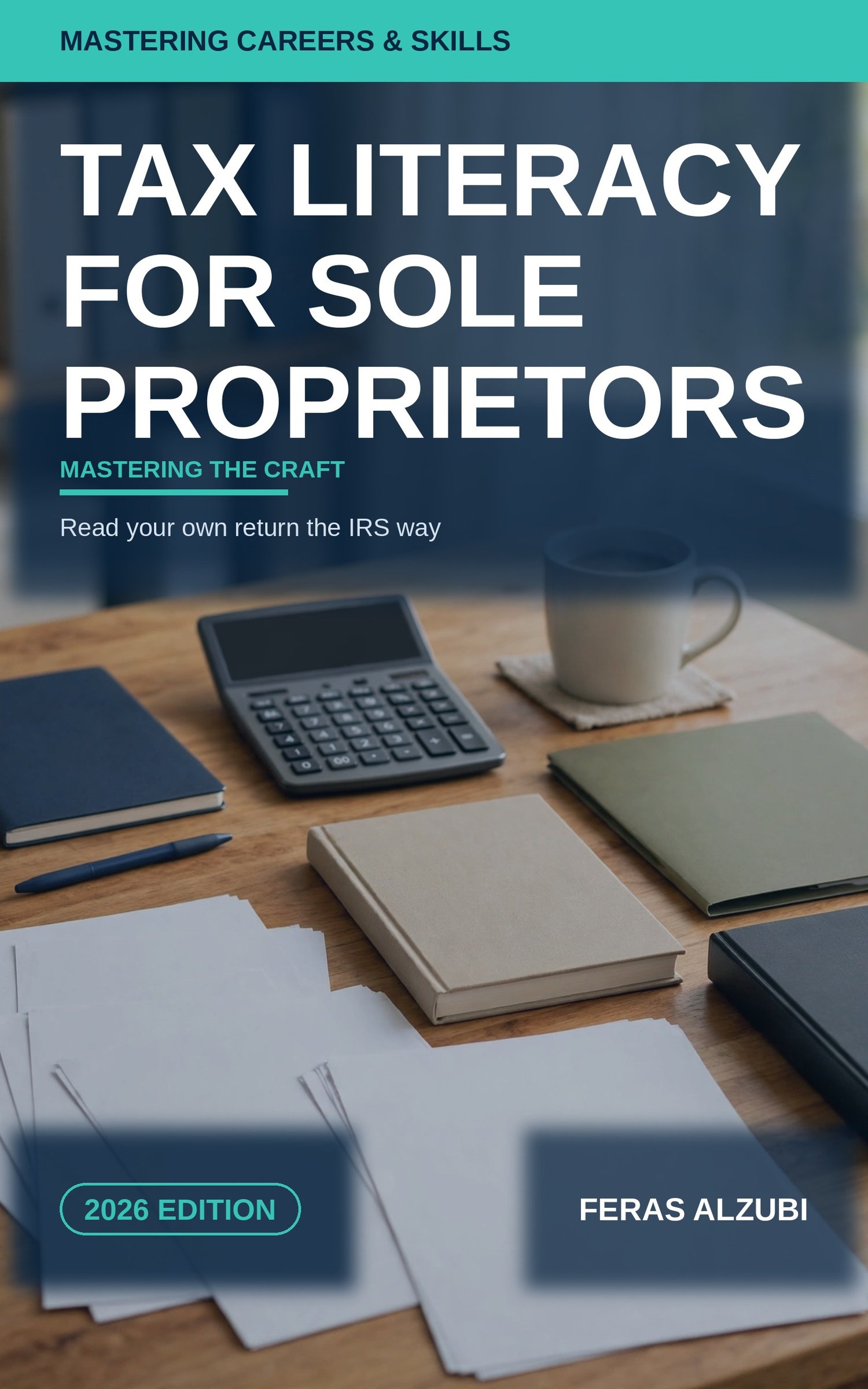
Tax Literacy for Sole Proprietors & the Self-Employed: Mastering the Craft
Tax Literacy for Sole Proprietors & the Self-Employed: Mastering the Craft — The Complete Tax Literacy Course
Tax Literacy for Sole Proprietors & the Self-Employed teaches a sole proprietor to understand the federal tax system their business lives inside. Schedule C is read line by line — what every line is for, where its figure comes from, and which IRS publication governs it; the self-employment tax is computed whole on Schedule SE; estimated payments are run as a pay-as-you-go discipline on the published general rule, with due dates read off the current year's own Form 1040-ES; the deduction lines are read at publication strength — ordinary and necessary, the vehicle choice, the home-office choice, and depreciation's three doors — as literacy; the records the system requires are taught whole, for as long as it requires them; and governing all of it is the verify-for-your-year method. Its method is stated on the cover as a method description — "Read your own return the IRS way." This book is never individual advice: it teaches the published federal system for sole proprietors in general; it does not advise any reader about their own return, deduction, election, classification, method, or filing position, and no passage in it is a substitute for the reader's own year's publications or their own tax professional. It promises teaching only: no lower tax bill, no bigger refund, no deduction, no audit outcome, and no saving or result of any kind is promised or implied anywhere in it. It teaches federal tax only: state and local taxes appear solely as a pointer — your own state has its own system, forms, and dates, verified with your state's own tax authority.
This is the complete course in one volume: 18 chapters in five parts and 127,379 words, with 165 exercises, drills, checks & steps, all explained — the Tax-Ready Check of 30 checks with explained routing notes and no score and no verdict, six scenario exercises closing every chapter, form-repair drills in five chapters, and the 12-step capstone that builds your own verify-for-your-year system — plus 51 worked examples and computations, 18 worked dialogues, 8 worksheets completed in worked form inside their chapters and reprinted blank in the back matter, 32 figures, and a glossary of 116 terms.
What this book teaches. The course's arc runs in five movements. The system: one taxpayer; the forms as a connected set; the publications as the standing authority; and verify for your year taught first, as a skill. Schedule C, line by line: the header; income; both expense parts; cost of goods sold and inventory; the vehicle information; other expenses; and the closing lines — every line's figure worked on the specimen. The second tax and paying as you go: Schedule SE computed whole; where the profit lands inside Form 1040; estimated tax as the pay-as-you-go system; and the calendar — an extension as time to file, never time to pay. Deductions and records in depth: depreciation literacy; recordkeeping duties whole; and notices, examinations, and rights at literacy strength — stages and published rights, taught as the system describes them. Boundaries and your system: the professional boundary and the credential landscape; errors and amendments at system strength; and the capstone, in which you assemble your own verify-for-your-year system. All worked arithmetic in this book runs on one fictional specimen business, Sun Mesa Cleaning Co., a small cleaning business filing for tax year 2025. Sun Mesa is labeled illustrative wherever it works: its figures are its own, chosen so its schedules tie exactly at every seat — not market data, not typical amounts, and not expectations for any reader.
Who it is for. The sole proprietor or self-employed owner who files Schedule C and wants to understand the federal tax system their business lives inside — read their own return line by line, compute the second tax whole, pay as they go, and verify every figure for their own year. The book assumes no tax background and teaches the published federal system from the ground up. It is education, never individual advice for any reader's own return.
What's inside (every count verified against the actual book):
18 chapters in five parts — the complete tax literacy course, in the course's own order: the system, Schedule C line by line, the second tax and paying as you go, deductions and records in depth, and boundaries and your system
165 exercises, drills, checks & steps, all explained — 108 scenario exercises (six closing every chapter, with model answers), 15 form-repair drills in five chapters, the 30-check Tax-Ready Check, and the 12-step capstone that builds your own verify-for-your-year system
The Tax-Ready Check, taken first: 30 checks in five domains, answered on a plain scale, with explained routing notes that send you to the chapters your answers point to; it computes no total, renders no verdict, and assigns no grade
Schedule C read as anatomy: the header and its identity and method decisions; income whole; both expense parts line by line; cost of goods sold and inventory; the vehicle information; other expenses; and the closing lines that carry the profit forward
The second tax, computed whole: Schedule SE walked line by line from the Schedule C profit to the self-employment tax and its one-half deduction, every rate and threshold printed with its tax year
Paying as you go: the published general rule for estimated tax in its published form; the worksheet worked as method on stated inputs; the four payment periods and their due dates read off the current year's own form; and the calendar whole, with an extension taught as time to file, never time to pay
51 headed worked examples and computations, worked in full on the specimen's stated figures
18 worked dialogues, one per chapter
8 worksheets completed in worked form inside their chapters and reprinted blank in the back matter — the publications shelf & verification record, the Schedule C anatomy sheet, the expense sorting sheet, the vehicle & home method sheet, the Schedule SE computation sheet, the estimate worksheet, the year calendar, and the records & retention sheet
18 chapter cheat sheets reprinted content-identical in the back matter
32 figures at 32 teaching placements
A 116-entry glossary, defined where each term is first taught
The pair boundaries are stated here as the book states them. Bookkeeping — how entries are made and how the books are kept as a craft — is taught whole in its own companion volume, and this book teaches none of it. Cash timing — when money arrives, when it leaves, and the forecast — is taught whole in its own companion volume; no passage here derives when an amount moves. Pricing and costing — building a price from cost and costing a job — are taught whole in their own companion volume; this book reads the return a priced business files and owns that subject alone. Reading the financial statements — the profit-and-loss statement, the balance sheet, and the cash-flow statement read as one story — is taught whole in its own companion volume and is not taught here. Preparing returns for others and representing a taxpayer before the IRS as a profession — the preparer credentials and their examinations — belong to the profession's own volumes; this book names that landscape at literacy strength and prepares no reader for any credential. The hiring and employment-tax body is taught whole in its own companion volume and is not taught here. No companion is named by title here, and none is presented as available.
Every figure in this book carries its year, and that discipline is the book's central feature, not a caution attached to it. Every rate, threshold, limit, and date prints with the tax year it belongs to; the book's figures are seated for tax year 2025, the year of its forms and publications as served. The verify-for-your-year routine is how you confirm every figure for your own year: name the figure, name its governing publication or form, open the current year's edition, confirm or replace the figure, and record the year verified. The book teaches that routine first, exercises it in every chapter, and assembles it in the capstone as your standing system — so a figure in this book is a dated, seated fact you are taught to verify, never a number you are asked to carry forward on trust.
Read the first chapter free — the sample on this page is Chapter 1 of this book, exactly as it appears in the full edition.
From the Mastering Careers & Skills library — complete A-to-Z professional teaching books for careers, trades, and certifications.
Not-affiliated disclosure: This book teaches from the publications, forms, and instructions of the Internal Revenue Service and the publications of the U.S. Small Business Administration, neither of which endorses or is affiliated with this book. This book has not been reviewed by the Internal Revenue Service, the U.S. Small Business Administration, or any tax practitioner, preparer, Enrolled Agent, CPA, attorney, or professional body, and no such review is claimed or implied anywhere in it. This book is general education about the published federal system for sole proprietors. It is never individual advice.
Refunds: Please read the free sample chapter before you buy. This is a digital ebook, delivered instantly by download. If the file is defective, or you cannot open or download it and we cannot fix the problem, you will receive a full refund — email us within 14 days of purchase. Because the book is delivered instantly as a downloadable file, all other sales are final.
How to read this book (EPUB format): After checkout, download the EPUB file, then open it in any free ebook reader app. On iPhone or iPad: Apple Books — it is already on your device. On Android phones and tablets: Google Play Books (free: https://play.google.com/store/apps/details?id=com.google.android.apps.books) — upload the file in the app — or ReadEra (free). On a Windows or Mac computer: Thorium Reader (free: https://thorium.edrlab.org) or Adobe Digital Editions (free). On Kindle: use Amazon's free Send to Kindle (https://www.amazon.com/sendtokindle) to add the file to your Kindle library.