
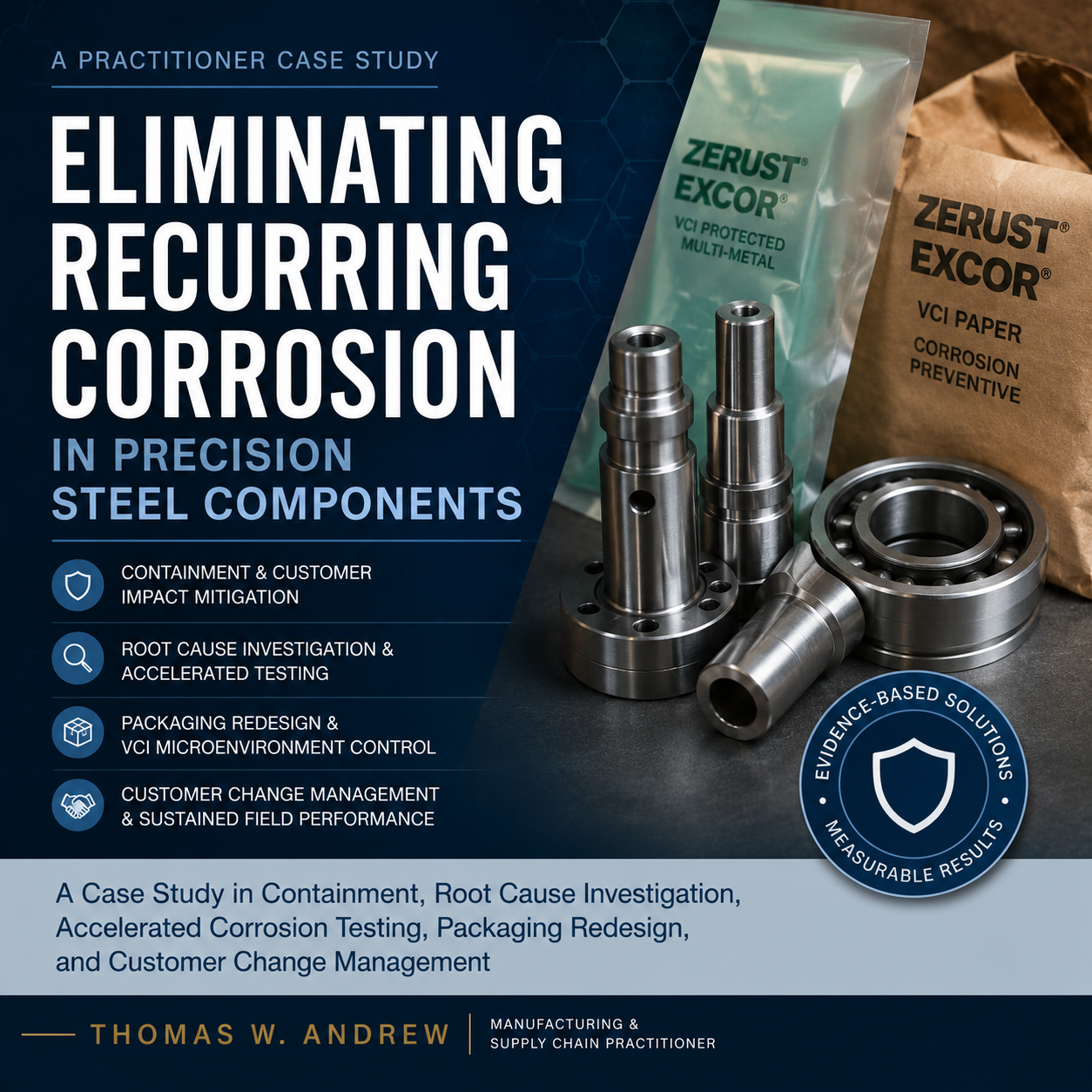
Eliminating Recurring Corrosion in Precision Steel Components
A customer corrosion complaint involving precision steel components initiated a corrective-action investigation that ultimately challenged assumptions about rust prevention, packaging materials, and the transportation microenvironment.
This practitioner case study follows the complete progression from customer notification and traceability containment through interim rust-preventive treatment, independent accelerated corrosion testing, packaging-material evaluation, production-representative testing, and final corrective-action implementation.
The investigation demonstrates why containment should not be confused with corrective action—and why replacing a suspected packaging material may still fail to address the complete corrosion mechanism.
The final solution combined a 100% recycled polyethylene component-presentation tray with a 4-mil ferrous VCI enclosure containing at least 30% recycled polyethylene. The redesigned packaging system eliminated a separate 6-mil polyethylene liner, reduced film cost by approximately 48%, removed one packaging operation, preserved point-of-use component accessibility, and eliminated the need for a permanent rust-preventive coating.
Following implementation in 2023, the revised packaging configuration supported seven related part numbers and approximately 780,000 components of annual consumption without a reported recurrence of the original corrosion condition through May 2026.
The complete white paper includes:
• Customer concern, traceability containment, and suspect-lot control
• The distinction between interim containment and permanent corrective action
• Four technical exhibits from NTIC/ZERUST corrosion laboratory testing
• Polyurethane and polyethylene packaging-material evaluations
• Production-representative recycled polyethylene tray testing
• VCI microenvironment testing using actual precision components
• 408-cavity vertical component-presentation and point-of-use considerations
• Packaging cost and labor simplification analysis
• Customer supplier-change governance and PPAP determination
• Breakpoint management and implementation supply-risk considerations
• Sustainability and extended producer responsibility considerations
• Approximately three years of observed post-implementation field performance
Written from the perspective of an operations, logistics, packaging, and continuous-improvement practitioner, this white paper is intended for manufacturing leaders, packaging professionals, quality and corrective-action practitioners, supply-chain leaders, and operational improvement professionals.
Format: Digital PDF white paper
Edition: Final Version 1.0
Author: Thomas W. Andrew
Customer and component-supplier identities are intentionally anonymized. Independent corrosion laboratory evidence is attributed to NTIC/ZERUST and presented as cropped technical exhibits with identifying and administrative information omitted.