
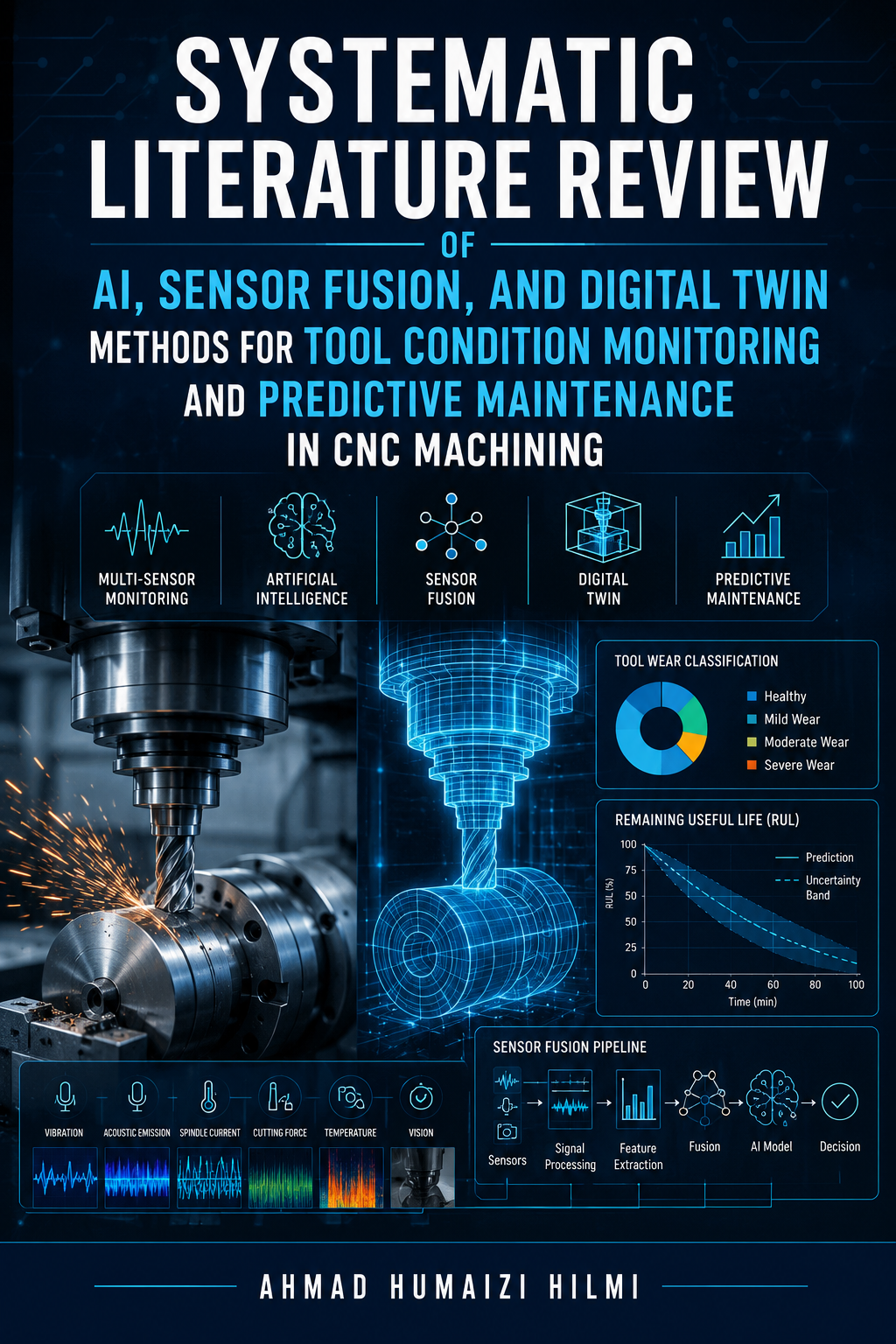
Systematic Literature Review of AI, Sensor Fusion, and Digital Twin Methods for Tool Condition Monitoring and Predictive Maintenance in CNC Machining
This systematic review synthesises empirical evidence on tool condition monitoring and predictive maintenance for CNC machining to identify which sensing pipelines, modelling architectures, digital-twin patterns, and explainability practices support robust wear classification and remaining useful life forecasting. We review studies that combine vibration, acoustic emission, spindle current, cutting force, temperature, and vision with classical and deep learning methods, and we evaluate signal transforms, fusion levels, validation protocols, edge feasibility, and uncertainty quantification. Two dominant evidence streams emerge: ensemble tree learners (Random Forest, CatBoost, LightGBM) perform well on small tabular feature sets, while deep multi-channel/time-series and hybrid architectures (CNN, ResNet variants, CNN–RNN hybrids, compact Transformers) excel for spectrogram-like and raw multi-sensor inputs and for RUL tasks. Multi-sensor fusion at synchronized, windowed feature levels consistently improves classification F1 and reduces RUL RMSE. Transfer-learning and domain-adaptation reduce cross-condition degradation, and digital twins that integrate calibrated physics sub-models with uncertainty-aware prognostics enable actionable maintenance policies. Common limitations include inconsistent dataset sharing, heterogeneous partitioning that risks leakage, and uneven reporting of hardware and latency metrics. We provide pragmatic guidelines for model selection, reproducible evidence maps, methodological checklists, and a prioritized research agenda for benchmarking, edge-validated compact models, and standardised explainability protocols.