
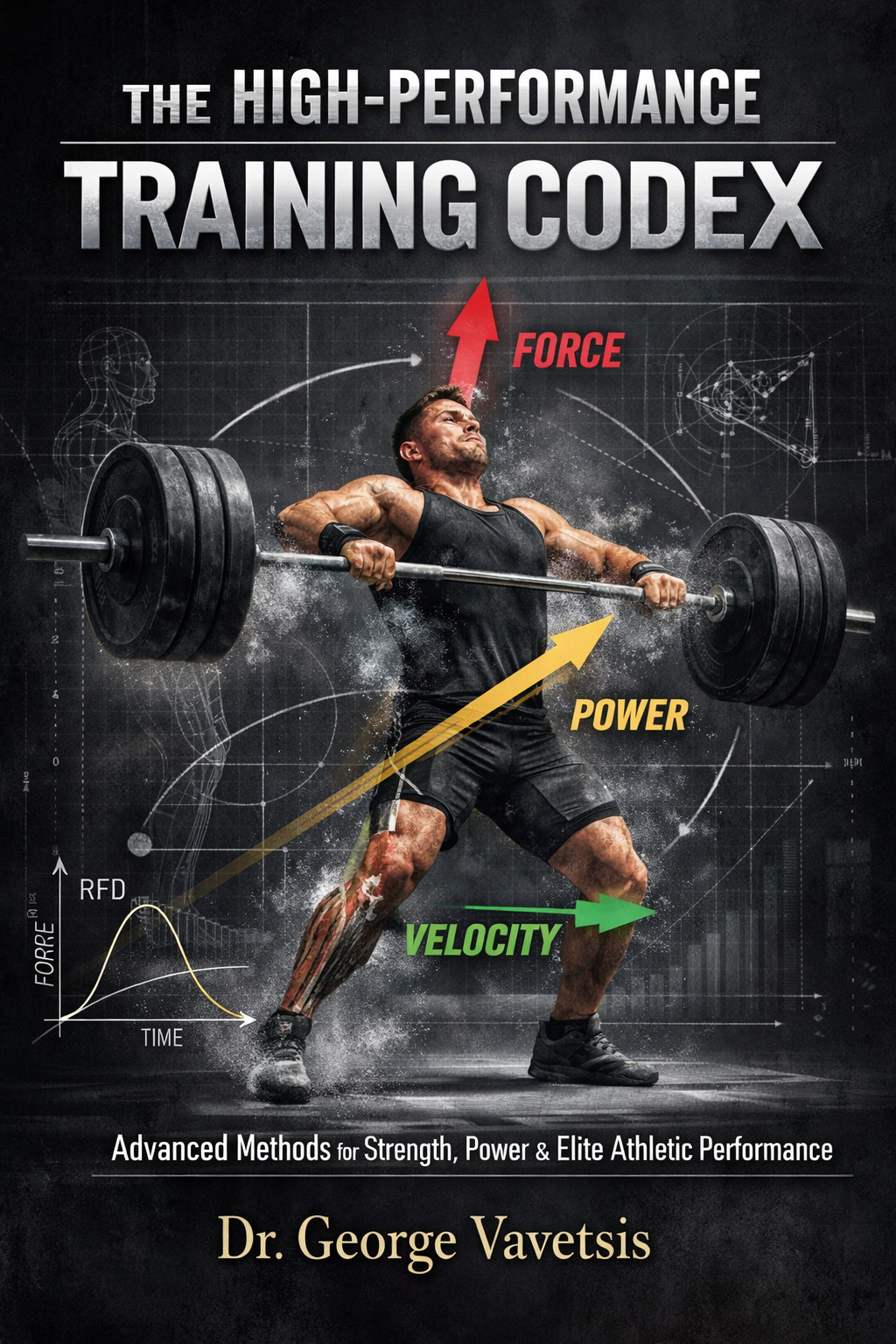
The High-Performance Training Codex
Pages: 3394
High-performance sport has evolved far beyond the era when strength training meant merely lifting heavy weights and endurance training meant simply running longer distances. Modern athletic preparation exists at the intersection of biomechanics, neurophysiology, sports science, and coaching art. The contemporary strength and conditioning professional is no longer just a trainer of muscles, but an architect of performance systems—integrating movement efficiency, neuromuscular coordination, metabolic conditioning, and psychological resilience into a unified training philosophy.
This book, The High-Performance Training Codex, was written to serve as a technical and practical guide for coaches, sport scientists, and elite performance practitioners who seek a deeper understanding of resistance training methodology and athletic power development.
At the center of modern athletic preparation lies the concept of force production and its efficient transfer into sport-specific movement. Strength alone does not guarantee performance. What matters is the athlete’s capacity to produce force rapidly, coordinate that force across the kinetic chain, and apply it within the extremely short time windows that define competitive sport.
Olympic weightlifting and its derivatives represent one of the most powerful training systems ever developed to cultivate these qualities. These movements combine high levels of neuromuscular activation, triple-extension mechanics, and rate-of-force-development demands in a way that few other exercises can replicate. Their ability to train explosive strength has made them fundamental tools across numerous sports that require sprinting, jumping, rapid acceleration, and changes of direction.
In many sports, athletes must repeatedly generate explosive actions—whether it is a volleyball spike approach, a basketball first step, a rugby tackle, or a sprint start. These movements rely on the coordinated extension of the ankle, knee, and hip joints, often referred to as triple extension, which forms the biomechanical basis of many Olympic lifting derivatives. The capacity to produce rapid power through this coordinated sequence is therefore a central objective of modern strength and conditioning systems.
Yet despite the proven effectiveness of Olympic lifts, many training manuals focus primarily on the traditional competition lifts themselves. In reality, the derivatives of these lifts—such as pulls, hangs, block variations, and power versions—often provide even greater value for sport performance training. These variations allow coaches to manipulate range of motion, technical complexity, loading parameters, and velocity demands to suit the needs of athletes in different sports and developmental stages.
This book therefore places particular emphasis on Olympic lifting derivatives, exploring their biomechanical rationale, coaching strategies, and programming applications. These exercises allow coaches to isolate specific phases of explosive movements, refine technical mechanics, and develop power production with reduced technical barriers compared with the full competition lifts.
The philosophy guiding this text is rooted in a fundamental principle of performance science:
Training must replicate the mechanical and physiological demands of sport while remaining adaptable to the individual athlete.
Athletes do not succeed merely because they are strong, fast, or powerful in isolation. They succeed because their training system develops the right qualities at the right time and in the right context.
For this reason, the High-Performance Training Codex approaches strength training not as a collection of exercises but as a system of applied biomechanics and neuromuscular development. Each exercise described in this manual is analyzed through multiple lenses:
- Performance objective
- Mechanical positioning
- Movement execution
- Coaching cues and correction strategies
These dimensions ensure that training is not only effective but also safe and repeatable in high-performance environments.
Another key theme throughout this work is the importance of technical mastery. Olympic lifts and their derivatives are among the most technically demanding movements in strength training. Proper execution requires coordination between multiple joints, precise barbell trajectories, and refined neuromuscular timing. Even small deviations in technique can reduce power output or increase injury risk.
Consequently, coaches must adopt a systematic teaching progression, emphasizing position control, movement rhythm, and consistent bar path mechanics. Athletes must first learn to control the barbell before attempting to accelerate it. This principle is essential to both performance development and long-term athlete durability.
Equally important is the concept of intent in training. Research consistently demonstrates that explosive intent during resistance exercises significantly influences neural adaptations and rate of force development. Olympic lift derivatives naturally encourage maximal acceleration and therefore serve as powerful stimuli for improving explosive performance.
However, effective use of these exercises requires intelligent programming. Factors such as load selection, repetition structure, technical fatigue, and recovery must be carefully managed. The most powerful exercise can become ineffective—or even harmful—if applied without strategic planning.
The High-Performance Training Codex therefore aims to bridge the gap between scientific theory and practical coaching application. The descriptions provided in this manual integrate biomechanical analysis with real-world coaching cues that can be immediately implemented in high-performance training environments.
Ultimately, the goal of this book is not simply to describe exercises but to cultivate a deeper understanding of how explosive strength is developed and transferred to sport performance.
The modern strength and conditioning coach operates in an environment where marginal gains can determine victory or defeat. The ability to refine technique, enhance power production, and optimize neuromuscular efficiency represents a decisive advantage in elite sport.
This codex was created to support that mission.
It is my hope that the knowledge contained within these pages will help coaches design more effective training systems, teach complex movements with greater clarity, and ultimately contribute to the development of stronger, faster, and more resilient athletes.